Knowing what leads to building collapses can help make African cities safer:
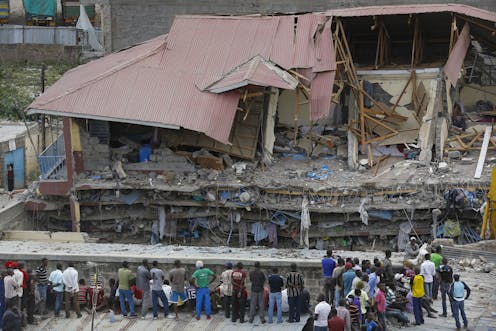
It’s a sadly familiar image in several developing countries’ media reports: people frantically searching the rubble of a collapsed building for survivors.
The data is disparate and scattered. But what is known confirms what the images tell us: building collapses are a common, tragic occurrence in developing countries’ cities. In Kampala, Uganda, one study counted 54 building collapse deaths and 122 injuries between 2004 and 2008. Another study identified 112 cases in Lagos, Nigeria from December 1978 to April 2008. Between February and May 2019, 29 deaths and 76 injuries were recorded from 13 building collapse incidents across Nigeria.
Ghana and Kenya, too, have recorded a number of fatal incidents in recent years.
This isn’t a uniquely African problem, though. It occurs in the rapidly urbanising parts of Asia as well.
I set out to understand this rather under-researched phenomenon of building collapse in developing countries’ cities. I wanted to know the range of agencies, motivations and causes that propel the widespread creation of unsafe buildings in cities in developing countries. I also wanted to know why so many of these buildings collapse.
This is important because of how quickly cities in the developing world are filling up. Today around 40% of those in Africa live in cities – that’s around 500 million people. This is projected to rise to more than 1.4 billion people in the next few decades.
Urbanisation is here to stay. It’s up to authorities to make sure that the people arriving in their cities don’t end up suffering such incidents.
The “pathology” of cities
Studies suggest that the social problems experienced in cities usually have a uniquely “urban” dimension. In this way of thinking, urbanisation processes – the concentration of people and socioeconomic activities in cities – affect the extent to which problems occur and the particular forms they take in those places. Studies of this nature are classified under the broad term “urban pathology literature”.
I drew on the ideas and methods of urban pathology literature to explore the phenomenon of building collapse in cities in developing countries. To do this, I reviewed contemporary and historic documents on housing and construction, media, scholarly and investigative reports on building collapses and other cognate materials on the growth and development of cities.
Here’s what I found.
The more people come to a city, the more demand for buildings is amplified. People need accommodation, offices, or both. This demand creates pressure from which a range of agencies, motivations and causes arise. And that often encourages shoddy construction and building use practices. Buildings are hastily built. Those which already exist are hastily converted for uses that weren’t built into the original design. Extra floors are added atop old buildings.
Usually, city authorities would step in to enforce safe building regulations and guard against these practices. But too often in the developing world, institutional cultures like corruption and political interference undermine authorities’ responsibilities. Add to that a dearth of building inspectors or other resources, and unsafe building practices multiply.
In the end, huge stocks of unsafe buildings are created, sometimes in hazard-prone locations. This, then, can lead to disaster.
Understanding context
All of this means that building collapses in cities are a pathological feature of urbanisation.
One insidious dimension of the problem relates to how socioeconomic inequalities associated with urbanisation processes impede poorer people from finding safe, sturdy accommodation. This exposes them to tremendous risk, forcing them to either rely on or undertake construction practices that are inherently unsafe. Two issues could be addressed to ease this problem: the high cost of urban land and unfavourable mortgage and credit schemes that lock people out of accessing building or accommodation finance.
Essentially, unless conscious efforts are made to address the building needs of Africa’s urban poor, the creation of unsafe (illegal) buildings in hazard-prone areas cannot be prevented.

Festival Godwin Boateng does not work for, consult, own shares in or receive funding from any company or organization that would benefit from this article, and has disclosed no relevant affiliations beyond their academic appointment.
Source: The Conversation – Articles (AFRICA)
Read more on The Conversation.
Join the fun: Add Your event | Submit a Press Release | Add your listing.


