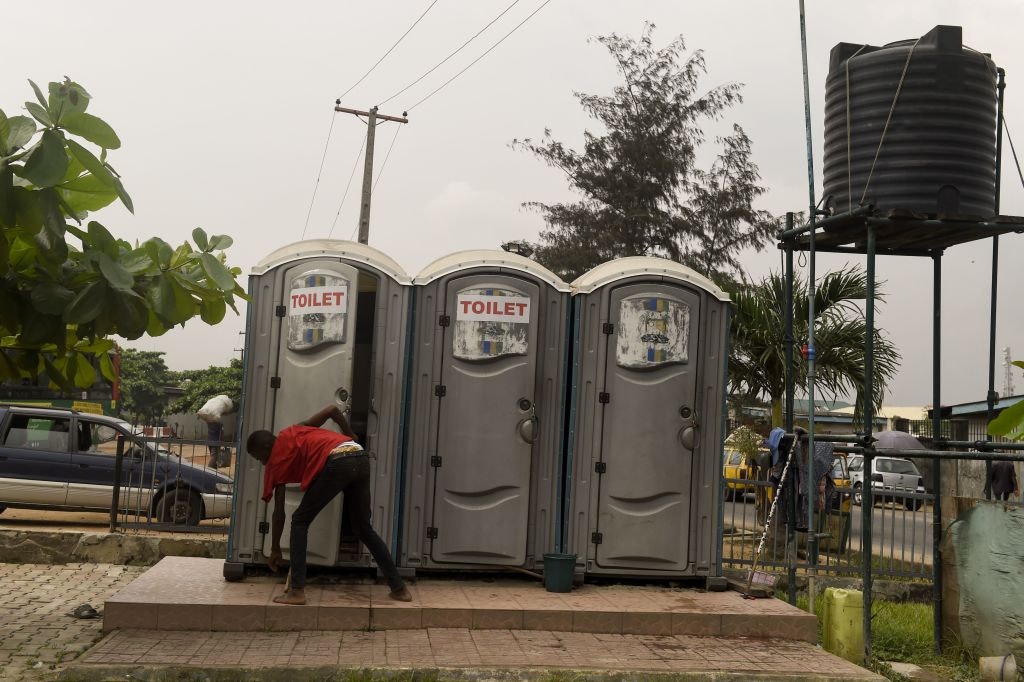
The population of Lagos is growing ten times faster than that of New York and Los Angeles. Nigeria’s most densely populated city has almost 25 million people and is adding about 600,000 every year. As with many cities in developing countries, many residents lack an adequate water supply and sanitation: both fundamental human rights essential for the health of all people.
Water and sanitation were at the centre of the Millennium Development Goals signed in 2000. Every goal is directly or indirectly hinged on them. But Nigeria failed to meet the target of halving the population of people without access to safe and adequate water supply and sanitation before the goals’ deadline expired in 2015. United Nations member states then replaced these goals with the Sustainable Development Goals in 2015; and water supply and sanitation was goal number six.
The intrinsic link between water supply and sanitation and other sustainable development issues – such as poverty, hunger, health, education and gender inequality – formed the basis of my study.
I assessed the water supply and sanitation sector for the post-2015 development agenda in Lagos. Knowing more about residents’ access to domestic water supply and sanitation can help the city – and the country – avoid missing its targets again. It can help policy makers and authorities plan their response.
Read more: Cholera is still a danger in Nigeria: here’s what the government can do
Three areas of Lagos
The local government areas in Lagos have been generally classified as low, medium and high density areas. Areas with 20–10,000 people/km² are regarded as low density; those with 10,001–20,000 are medium density; and those above 20,000 people/km² are considered high-density.
I randomly selected one local government area of each density category. Agege, Kosofe and Ojo represented the high, medium and low density areas, respectively.
I focused water supply and sanitation at residential buildings. The target person for my survey was women aged 18 years and over. This is because women tend to be the family members who collect water and manage sanitation. The sample size for the study was 878 residents on which questionnaires were administered.
Read more: Safe drinking water should mean safe collection too: how to reduce the risks
The profile of these residents varied across the residential density areas. I found that education and income level increased with the reduction of density in residential areas.
On water supply coverage, the majority of the residents in the medium and low density areas depended on boreholes as their household’s main water source. In the high density area, households depended mainly on boreholes and hand-dug wells. The average volume of water – 205.4 litres – consumed per an average household size of five people in the study area revealed daily per capita water consumption of 41.1 litres. This is lower than the required minimum standard for daily per capital water consumption of 50 litres. Based on subjective assessment, most residents in the high density area said they lacked good quality water. The situation was better in the medium and low density areas.
In essence, there was low public water supply coverage in the metropolis leading to quantitative and qualitative inadequacy. This means that the residents had no access to the required volume of water consumption and the available water supply of was not of satisfactory quality to the residents.
Three kinds of toilet were found in Lagos Metropolis: flush toilet, ventilated improved pit latrine and open pit latrine. These are all on basis of on-site sanitation. That is, the disposal of human wastes from the toilets was done on the plots on which the buildings were developed because there was no central sewer system. Despite the prevalence of households with flush toilets (59.9%) and ventilated improved pit latrines (19.8%), especially in the low and medium density areas, a significant proportion of residents (20.3%) used open pit latrine, detached from the house and without hand-washing facilities. This was even worse (34.5%) in the high density area.
The quality of available toilets varied with density areas.
Meeting the goals
The low level of water supply and sanitation coverage my study found suggests that the success of the sustainable development goals hangs in the balance. This, for instance, is further established by a reported statement by the governor of Lagos State that less than 40% of Lagos residents had access to water supply. Concerted efforts are needed to achieve the goals. This is because the poor status of condition of water supply and sanitation could be a factor for recurrence of failure recorded in the MDGs in this era of post-2015 development agenda.
The state government should resuscitate the public water supply by expansion of coverage of water services in the state and and adoption of a novel method such as metering for cost recovery in order to ensure the sustainability of the water services. The local governments in Lagos and community-based organisations should also provide mechanically operated boreholes, especially in high-density residential areas.
Governments should enact laws that require house owners to provide adequate sanitation for residents. The local government should carry out its constitutional responsibility as contained in the operative 1999 constitution of Nigeria to provide public toilets at an affordable rate for residents. And community based organisations should be encouraged accordingly to support the governments in provision of water and sanitation services.
Governments should ensure there is adequate finance for the water and sanitation sector through collaboration with international donors. This could be sustained by reforming the sector through significant budgetary allocation, establishment of a specific agency for the sector and provision of effective legal and regulatory framework and the reform should be backed with a strong political commitment.


