Land reform in South Africa is doomed unless freed from political point-scoring:
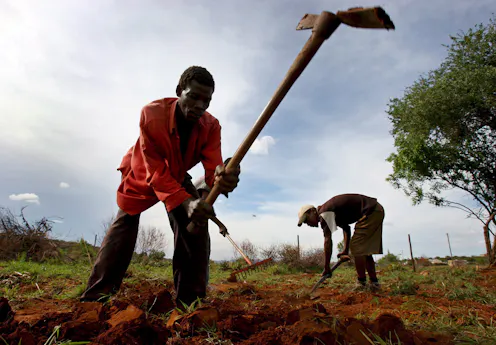
Black landlessness has become a convenient weapon for political populists in South Africa. With elections around the corner, the lingering questions about land reform are ever more crucial and timely. But, challenging questions need to be debated if a radical land reform programme is to be realised.
The pace of land reform has been slow since South Africa’s first democratic elections 25 years ago. Recent findings confirm that the land reform programme has done very little to achieve equitable distribution and access to land for black South Africans.
By 2017 less than 10% (8.13 million ha) of agricultural land had been transferred through land reform.
The latest political wave of calls for land reform has resonance because millions of black South Africans remain landless and poor. This has led to the issue becoming a potent weapon in the hand of populist politicians.
All hopes for radical land reform have been placed on the amendment of Section 25 of the Constitution to allow for expropriation without compensation. This drastic step could be seen as a strategy by the African National Congress (ANC) to take the wind out of the radical Economic Freedom Fighter’s political sails.
In fact the two parties are much more interested in attracting voters than in genuinely addressing longstanding racial inequalities. As a result many vital questions remain poorly explored. And most are lost in the political noise about land expropriation without compensation.
Some of these questions include: how should land for expropriation and redistribution be identified? Who should benefit from land redistribution in rural areas and which institutions should deliver?
How should land be identified?
Where should the country look for land for the accelerated redistribution programme?
Some argue that land redistribution should target tax-indebted farmland (or farms that are financially distressed). Others argue that state-owned land should be the primary target for land redistribution.
There’s also a strong argument made by some that the majority of landless people are more interested in relatively smaller pieces of land (0.1 – 1 ha) which they can use for household food production. This land could be acquired closer to the large and small urban centres.
But for black commercial farmers to thrive, a distinction has to be made between black small-scale and large-scale farmers. And their different needs must be prioritised when land transfers are being considered.
Others propose a more radical approach that promotes the division of large farms into smaller farms and a radical redistribution that will include decongestion of densely populated urban and rural areas.
Buying land from the current owners is just one of many means of land acquisition that could be pursued. Others include expropriation, donations, release of public land, reviews of unjust leases over public land and, in some instances, granting legal recognition to land occupiers where necessary.
Who should benefit?
Prof Michael Aliber, an agricultural economist at University of Fort Hare, argues for an approach to land redistribution that acknowledges the wide range of reasons people want land. This approach should cater for:
-
the relatively small number of people who want large plots on which to pursue large-scale commercial farming;
-
the larger number of people who want small-to-medium plots on which to farm as commercial smallholders, and
-
the still larger number of people who want small pieces of land for tenure security and food security.
For most of the past 20 years, the land redistribution programme has sought to cater to only the first of these three groups.
Aliber argues that the overemphasis on large scale farms has significantly slowed the pace of land reform and led to the capture of the redistribution project by well-connected elites. Yet the primary beneficiaries of land reform should be landless black people and other historically marginalised groups. These include evicted farm workers and farm dwellers, unemployed urban and rural people, women and other rural people who live on communal land.
Can the state still be trusted to deliver?
There’s still a great deal of disagreement about which institutions should drive land reform. The poor performance by the ANC government in addressing the land issue, particularly its inadequate support for black land reform beneficiaries and farmers in communal areas over the past 25 years, has seriously depleted public confidence in the role of state in land reform.
For land reform to work, redistribution should focus beyond land transfer. It should begin to focus on providing adequate support for new farmers. Which institutions can deliver on this crucial undertaking? Is it the state, business, civil society or a collective effort?
Undoubtedly, the mounting scepticism about the capacity and political will of the state to deliver is warranted, given the failures of the ANC-led government.
This points to the fact that private sector support remains crucial in promoting commercial agriculture. But, then again, some are still sceptical about the private sector. For land rights activist Mazibuko Jara, the state and civil society need to play a key role.
A land debate left only to vote-hungry politicians is doomed. For politicians, black landlessness is nothing more than a political tool – hence the landless poor have been voting since 1994 but are still without land.
This article is based on debates at a land reform conference hosted by the Institute for Poverty, Land and Agrarian Studies (University of Western Cape (UWC)), University of Fort Hare and Rhodes University in February at UWC.

Sonwabile Mnwana receives funding from the Open Society Foundation-South Africa and the Southern Centre for Inequlaity Studies – Wits University.
Source: The Conversation – Articles (AFRICA)
Read more on The Conversation.
Join the fun: Add Your event | Submit a Press Release | Add your listing.


