In 1835 Charles Darwin, the father of the theory of evolution, was exploring an island in the Galápagos archipelago when he encountered “two large tortoises, each of which must have weighed at least two hundred pounds”. He had never seen anything like them. He became entranced by the animals and took at least one back to England as a pet.
Large tortoises are still associated with the Galápagos Islands, about 1,000km off the coast of Ecuador, as well as Aldabra Island in the Seychelles.
Now, for the first time, evidence has been found to suggest that a species of very large tortoise once lived on South Africa’s Cape south coast. Our study of fossil tracks indicates that, between 139,000 and 109,000 years ago, a tortoise species existed that was around 106cm long. This is not as big as the Galápagos tortoises, which can reach 150cm or more in length, but is significantly bigger than any tortoises in southern Africa today.
The period when these tortoises were wandering round the southern tip of Africa was called the Pleistocene Epoch. They shared the landscape with large animals like giraffes, extinct giant buffalo, crocodiles and breeding sea turtles, none of which inhabit the region today. Our ancestors, Homo sapiens, were also present.
Today, the leopard tortoise (Stigmochelys pardalis) is the largest tortoise species in the area. The record length for a leopard tortoise is 70cm. Given the length of the tortoise in our findings – 106cm – we conclude that either the tracks were made by a previously unknown very large tortoise or that the leopard tortoises of the Pleistocene period were much larger.
Before this research, there was nothing to suggest the presence of very large tortoises from southern Africa in the region’s extensive archaeological record and body fossil record. Such findings demonstrate the capacity of ichnology – the study of tracks and traces – to complement and fill gaps in the traditional fossil record. And doing so doesn’t just create a fuller picture of ancient landscapes: it’s an important part of understanding what’s changed over time and the effects of climate change and humans.
Tracks
The fossil tracks were found in aeolianites (cemented dunes) and were made when these deposits consisted of unconsolidated sand. These sites would have been situated at the margin of the vast Palaeo-Agulhas Plain, which was alternately exposed and inundated during Pleistocene sea level oscillations.
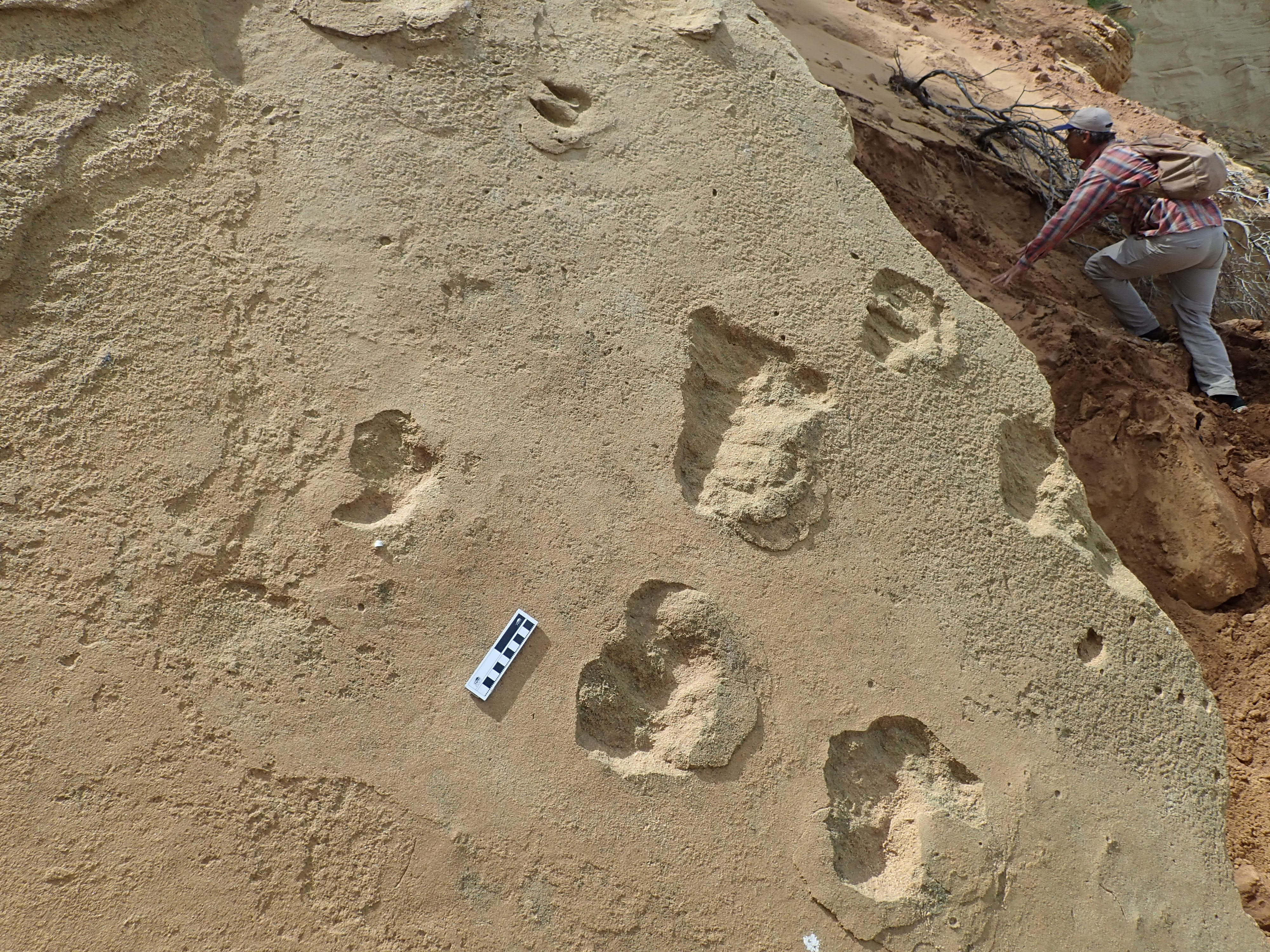
The main tracksite was located east of Still Bay, around 340km from Cape Town, on a rugged, remote stretch of coastal cliffs. Here we were fortunate to intercept a large aeolianite block on its slow but relentless journey from the cliffs above, from which it had broken off, down a sandy slope to the sea below.
When we initially identified it, the track-bearing surface was covered in a thin veneer of sediment which preserved exquisite detail. Not only were two sets of parallel large tracks evident, but a number of traces were also present centrally between these sets of tracks, indicating where something large had scraped the surface and caused shallow parallel striations and other deeper impressions.
It was a good thing we found the block when we did: within a couple of weeks the veneer (with the parallel striations) had been eroded away by wind and water. Months later the block had disappeared into the ocean.
A large trackmaker
By then we had already photographed and measured the block, the tracks and the surrounding area. We also took rock samples to perform dating studies from sites west and east of the main tracksite through a technique known as optically stimulated luminescence and established that the tracks were probably made between approximately 139,000 years and 109,000 years ago.
After ruling out other possibilities, including large crocodiles and monitor lizards, it was evident that this trackway had been made by a large tortoise, and that the midline features were caused by the dragging of the plastron (the underside of the tortoise shell) and by the tail spearing the surface.
The trackway was 69cm wide. We studied tracks and traces of leopard tortoises for comparison, and used these to estimate that the trackmaker at our site was as much as 106cm long, at least 50% longer than the largest recorded leopard tortoises.
Changing sizes over time
Many species of giant tortoises on islands have become extinct in the last few centuries. It would also not be unprecedented if what was once a giant species had evolved into a smaller species, the extant leopard tortoise. Tortoise giantism is a recurring theme in the fossil record.
It is known that some carnivorans, birds and reptiles were larger in some phases of the Pleistocene than today, so both possibilities are plausible.
Our team’s latest discovery adds a little more to the picture that both our and other scientists’ findings have painted of the ancient Cape south coast landscape. With each find, the image becomes clearer – and allows us to understand how it has shifted over time.


