Libya conflict boils down to the man driving the war — Khalifa Haftar:
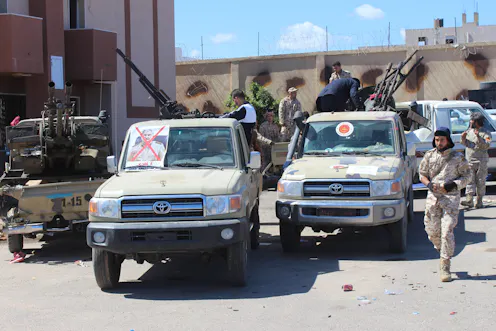
There’s been an escalation of conflict in Libya. Fighting has moved to the outskirts of the capital, Tripoli, and the United Nations has called for a ceasefire. Moina Spooner from The Conversation Africa spoke to Jacob Mundy, author of a recent book on Libya’s ongoing civil conflict, about what’s happening and what can be done to end the clashes.
How bad is the situation in Libya and is the whole country affected?
This appears to be the most serious escalation in the fighting since the current Libyan civil war started in 2014. This war emerged when the end of Muammar Gaddafi’s longstanding regime created a vacuum that various factions tried to fill.
Today Libya is divided between two political-military authorities: a parliament in the east backed by Khalifa Haftar’s Libyan National Army, which now controls large swaths of territory, and an internationally recognised executive in Tripoli backed by militias largely based in the capital and the region around it.
Recent reports show that nearly 50 people have been killed and over 180 wounded.
Initially, the fighting was mainly on the outskirts of Tripoli but it now appears that there’s fighting in other locations further east and in the south, near the Sahara. But these are scattered incidents.
A serious concern is the possibility of a long, drawn-out siege of the capital. In recent years this happened in Libya’s largest second city, Benghazi, as well as the smaller towns of Derna and Sirte. All three suffered enormous infrastructural damage and witnessed significant violations of the civilian populations’ rights at the hands of the militias and terrorists fighting for control.
Read more: 13 Hours: what actually happened at the US consulate in Benghazi
The wider metropolitan area of the capital is home to nearly a third of all Libyans, so the threat to noncombatants —- like the recent surprise aerial assault on the civilian airport -— is very real.
What groups are involved?
Haftar leads the forces behind the current assault on the capital. A veteran of the Libyan war in Chad in the 1970s and 1980s, he later became an exiled opponent of the regime and reportedly worked with the US Central Intelligence Agency. In 2011, he joined the rebellion against Gaddafi.
In 2014 Haftar created an alliance of militias to restore security in Benghazi. After the 2011 revolution, Libya witnessed a proliferation of militias, including violent Islamist ones with ties to Al-Qaida and the Islamic State. Haftar and his supporters accused Libya’s interim leaders of turning a blind eye to this growing menace.
Haftar’s forces are called the Libyan National Army. But, like all such security forces in Libya today, this army is really a coalition of militias. The increasingly professional look of Haftar’s troops and equipment is a result of the support he gets from Egypt and the United Arab Emirates. He appears to enjoy Saudi and Russian support, too. Even France has coordinated with Haftar on counter-terrorism matters.
In terms of domestic politics, Haftar is backed by Libya’s House of Representatives, the country’s interim legislature, which has been based in the east of the country since the civil war broke out in 2014.
Haftar’s assault is officially targeting militias that he describes as “terrorists” in the capital. But in reality his opponents are the various militias that have controlled Tripoli for a number of years, including forces from the powerful city of Misrata. Many of these militias are allied to Libya’s internationally-recognised executive authority, headed by Fayez Serraj.
What has led to the recent escalation of violence?
It’s unclear what exactly triggered Haftar’s sudden move to “liberate” Tripoli. His recent military successes in the east and the south have been the result of months of logistical and social preparation —- that is, building alliances with potential allies in the places he seeks to conquer.
Some think that Haftar wanted to disrupt an important UN peace conference that had been planned for this month. Given the collapse of talks between Haftar and Serraj earlier this year, Haftar could be seeking to impose himself militarily in the face of opposition to his inclusion in the current or future government of Libya.
Those opposed to Haftar view him as a potential military dictator, though the forces that seized Tripoli in 2014 and ejected the internationally recognised parliament were to a degree working with the Libyan Muslim Brotherhood, which is backed by Turkey and Qatar.
More broadly, there are concerns in Libya that the old Gaddafi regime will try to reconstitute itself through people like Haftar. However, Haftar and some of his supporters feel that hardline revolutionaries and Islamists have sidelined and antagonised experienced politicians and military leaders because of their roles in the Libyan state before 2011.
Are there any possible solutions?
There is obviously a need for a ceasefire before the situation spirals out of control, though that threshold might have already been crossed.
Donald Trump’s administration in the US appears to be taking the matter more seriously after deeming Libya not worth its attention for two years. But there are indications that Italy and France are working at cross-purposes in Libya, and Russia may be too. Those with acute leverage over Haftar in Egypt and the Gulf are perhaps the least likely to use it.
The situation will also be very difficult to deescalate because Haftar’s apparent all-or-nothing blitz has painted him into a corner. Those who voiced concern that he wanted to impose himself as a dictator now have all the proof they need. Whatever various grievances had been driving the conflict in Libya in recent years, it now boils down to one issue —- the Haftar question. This clarity of purpose could be the galvanising force Haftar’s opponents have often lacked.

Jacob Mundy is currently a Fulbright Scholar in Tunisia.
Source: The Conversation – Articles (AFRICA)
Read more on The Conversation.
Join the fun: Add Your event | Submit a Press Release | Add your listing.


