A report by the Global Initiative Against Transnational Organised Crime (Gitoc) released in September 2022 argues that South Africa has increasingly become a centre of organised crime, transcending national boundaries.
The picture emerging from the report is that there are organised networks inside and outside the state that enable, facilitate and exploit opportunities for private gain. Or, they exercise unfair advantage in economic activity in the public and private sectors, using coercive methods. Some actively go about sabotaging critical infrastructure to benefit from this.
The areas of public life where criminals exploit or intimidate their way into influence are growing. In recent times grand-scale crime has seeped through to healthcare, education and parastatals. Speaking out against malfeasance comes at a high price.
Read more: Crime, COVID and climate change – South African tourism faces many threats, but it’s resilient
This is apart from the scores of political assassinations of local activists and officials, either for political gain or sheer vengeance against those who dare to call out corruption.
Mafia state
There is no doubt that there is a growing ecosystem of organised crime overwhelming the state and public life in the country. And, because political actors or state institutions are so often implicated in it, some commentators are even asking if South Africa is becoming a “mafia state”.
The term “mafia state” refers to the interpenetration of governments and organised crime networks. In his influential 2012 article, Mafia States, Venezuelan journalist and writer Moises Naim said:
In a mafia state, high government officials actually become integral players in, if not the leaders of, criminal enterprises, and the defence and promotion of those enterprises’ businesses become official priorities.
There is no single prototype for when a state can be labelled a mafia state. The concept is best thought of as a spectrum. The most extreme cases involve politicians at the highest levels taking direct control of organised crime operations. Other characteristics are collusion between crime syndicates and powerful political figures, money laundering to hide illicit proceeds, and the use of violence and intimidation to protect those involved.
The Gitoc report shies away from using the label “mafia state” to describe South Africa. What it does make clear is that there is a proliferation of crime networks that involves not just criminal “kingpins” and politically connected individuals but also ordinary people. They become part of this “value chain”, for different historical reasons. But South Africa may be reaching a point where the link between crime and politics is sustained because there are role-players who do not want to see it changing.
Fighting corruption
The prevalence of criminal elements within the state does not mean that the whole of the state has become a criminal enterprise. But it is true that many state institutions, have been targeted by criminals, with the collusion of people on the inside.
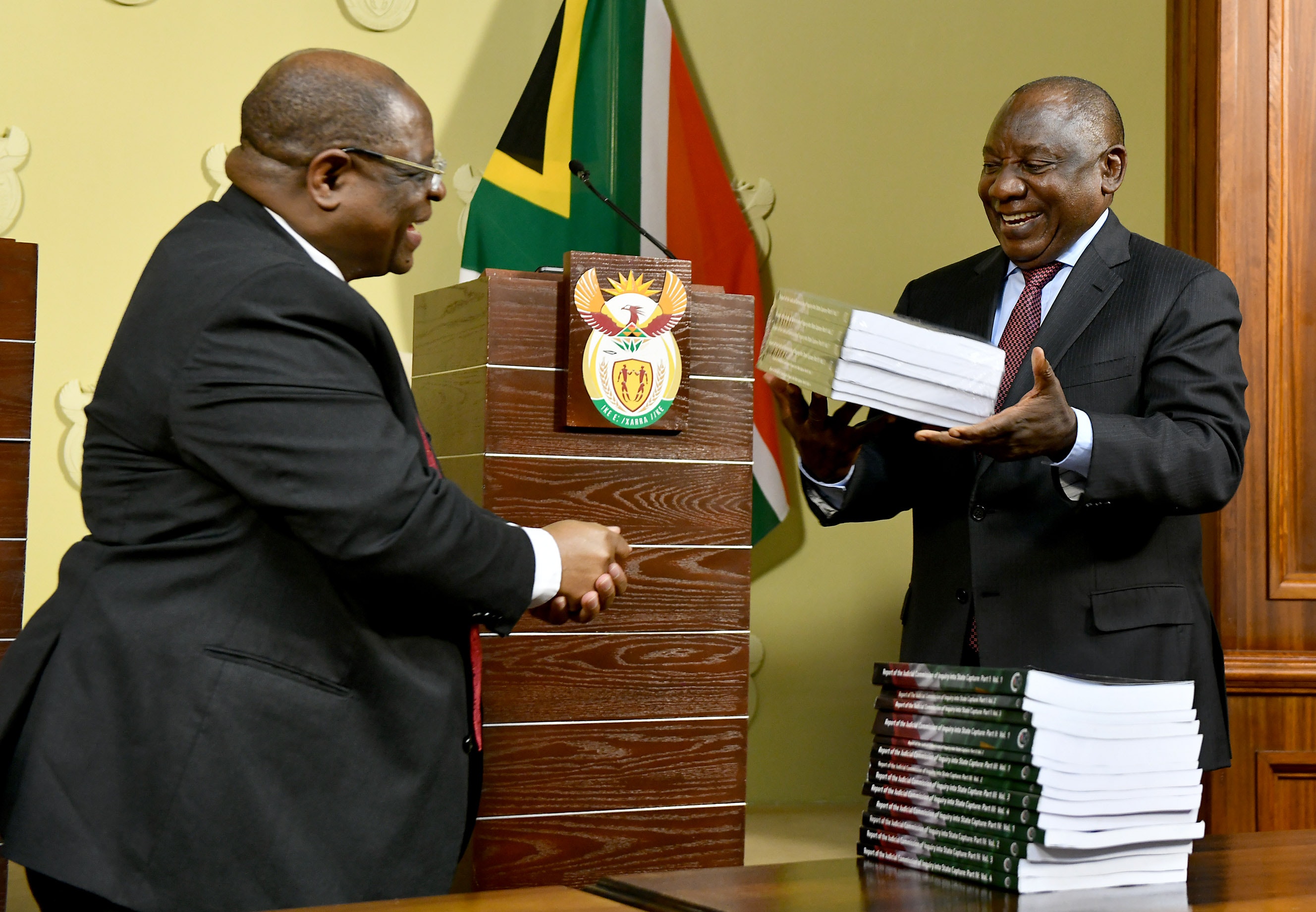
South Africans are not resigned to the criminalisation of the state, and are actively challenging it. Many of the revelations about fraud, corruption and nepotism come from principled whistle-blowers within state structures. Others come from the relatively free media, and voices in civil society and politics. Some of the malfeasance has been revealed by inquiries initiated by the executive itself. This is the case with the Zondo Commission, which probed state capture.
Read more: Using the South African army to fight crime is a bad idea: here’s why
Poor communication strategies make it difficult for ordinary citizens to assess how the state is responding to these challenges. A case in point is the government’s decision to deploy the military to beef up security at several electricity generation facilities. It remains to be seen whether the deployment will be able to stop the acts of sabotage that the ESKOM senior management claim to be a major factor in the worsening energy crisis.
As with the July 2021 riots, sparked by the jailing of former president Jacob Zuma for contempt of court, there are conflicting public pronouncements from cabinet ministers on critical sectors and services affected by crime.
The political economy of organised crime
The South African economy has a formal sector (“first economy”) and an informal sector (“second economy”). Economists call this a dual economy. To this should be added a “third economy” – the illicit economic activities described above, that have seeped into the formal and informal economies.
The overlap between the licit and the illicit economy in South Africa is complex. Even big, multinational companies may also covertly engage in illicit operations in spite of appearances. On the other hand, criminals often exploit vulnerable people where the state has failed to meet basic needs: they offer jobs, opportunities and income, a phenomenon seen not only in South Africa, but across the African continent.
Looking forward
Part of the reset South Africa needs to untangle political and crime networks is better policing and security strategies. The state must be able to assert its authority in the interests of the majority, law-abiding citizens who want to live honest lives in a climate of certainty.
If the crime-politics nexus is being deliberately sustained through the collusion of influential actors within the state, then it is going to be much harder to dismantle.
The resources being spent to address crime will be ineffective. The spectre of corrupt, pliable or compromised people in the criminal justice sector will make the future more unstable. Violence and threats against those who stand up against organised crime will become more commonplace.
The reports of the Zondo Commission, the Special Investigating Unit, whistle-blower reports, work by investigative journalists, research by academics, think tanks and civil society organisations, all go some way towards showing how the slide towards a criminal state can be halted. The criminal justice system must bring criminals to book, not give way to impunity.
But more important than combating crime is asking the difficult questions about how ordinary people end up involved in organised crime, and why the country’s democracy is becoming more polarised.
Read more: Many Kenyans have embraced vigilante cops – an ineffective police force is to blame
If the dire socio-economic conditions persist, there is every likelihood that organised criminals will continue to exploit the contradictions in society, and organised crime markets will expand.
The stakes are high. Stopping South Africa from becoming a “mafia state” ought to be a priority for everyone. This will become a key issue of concern to voters ahead of the 2024 national general elections.


