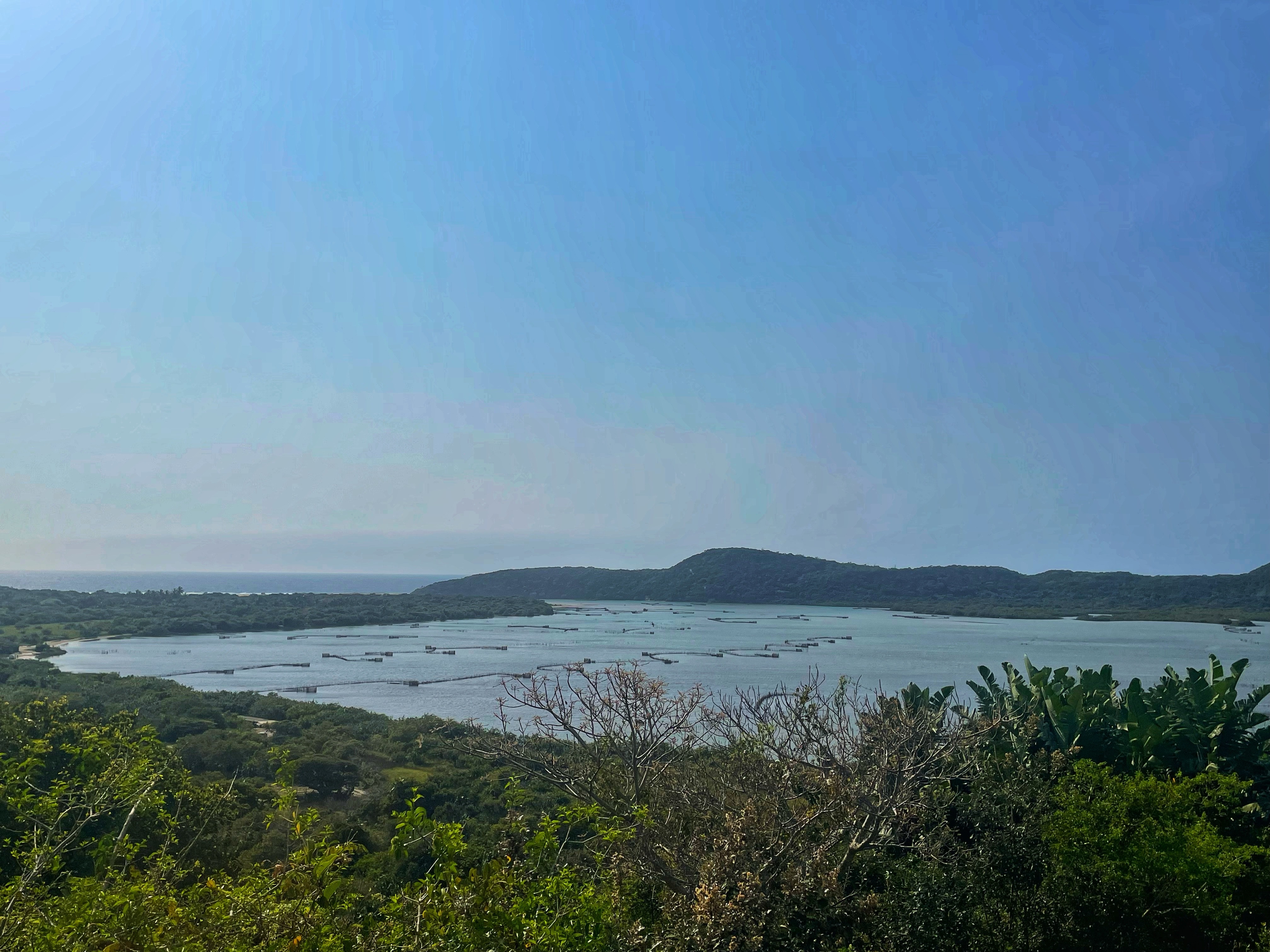
Mangrove forests are a common sight in some tropical and sub-tropical areas of the world like Indonesia, Florida in the US, parts of Brazil and Australia. They can also be found on African coasts, including South Africa’s KwaZulu-Natal and Eastern Cape provinces.
These tidal forests of trees and shrubs are often talked about in the context of climate change. Along with other coastal wetlands like salt marshes and seagrasses, they are able to store more carbon than terrestrial ecosystems. Waterlogged soils preserve the organic carbon and prevent decomposition – and if they’re left undisturbed, this “blue carbon” is locked up over thousands of years. This means they can play a key role in the oceans’s carbon cycle.
Mangroves are also valuable assets as ecosystems because they support a significant amount of biodiversity.
Mangroves won’t grow in cool climates. In the northern hemisphere, their range ends at areas where it snows in winter. But, even though the coasts of places like Brazil, Australia and South Africa don’t get freeze events, mangroves still stop occurring at a certain latitude in the southern hemisphere.
We wanted to know why this is the case and to determine whether there are other areas along South Africa’s coast that are climatically suitable for mangroves but where the forests don’t grow.
We also wondered, since climate change will make some parts of the world warmer in the coming years and decades, whether mangroves might in future be able to grow in parts of South Africa where they’re not found now. Finally, we wanted to understand whether climate change will make areas in South Africa where mangroves currently exist unsuitable for the forests in future.
Our new study reveals the answers. Through a combination of species modelling and ocean modelling, we discovered it is South Africa’s high wave-energy that keeps mangroves from spreading: their seeds are pushed around the ocean without being easily able to get washed into the estuaries where they can take root and grow.
And existing mangrove forests are at risk from changes in rainfall, which are predicted in climate change scenarios for the region. Increased rainfall can lead to more flooding. Less rainfall can result in estuary mouths closing off from the sea. Extreme or repeated occurrences of either change can make it difficult for mangroves to survive and thrive.
It’s therefore essential to safeguard existing mangrove forests. Different approaches will be needed for mangrove forests in rural and urban areas, but whatever is done must be done soon to preserve these important wetlands.
Modelling
Mangrove forests don’t cover a lot of ground in South Africa. Their total range in the country is only about 2,000 hectares across 32 of the 214 estuaries along about 1,000km of the country’s east coast. Mangroves are classified as an indigenous forest type and are therefore included in the country’s National Forests Act. This requires that all natural forests on private, communal or state-owned land are protected. Most mangrove forests in South Africa, however, are not in formally protected areas.
Read more: How South Africa’s mangrove forests store carbon and why it matters
As the first step in our research, we created a species distribution model. We collated everything we knew about where mangroves grow in South Africa. We ran the model to see where else in South Africa those conditions were met and whether mangroves grew there.
The model identified good candidate areas. But mangroves did not occur in those places. This meant there must be another process creating this limitation.
Then we ran the same model but took climate change into account by feeding in data about areas that are predicted to become warmer (and so may be more hospitable for mangrove forests in future). This also showed that estuaries further south would be suitable for mangroves, but that conditions in some estuaries that currently support mangroves could become unfavourable – and this could lead to mangrove loss.
Ocean activity
Mangroves spread to new locations through floating seeds (known as propagules), which fall from the trees and are carried out to sea. Recent research has shown how important ocean currents are for transporting mangrove propagules in different part of the world. We wondered whether this could be the process limiting mangroves from occurring in those other suitable estuaries.
Through a collaboration with colleagues at the University of Brussels and the San José State University in California in the US, we were able to include some of this ocean modelling in our study. This was a way to simulate how mangrove propagules would float offshore in the southern African region.
The ocean model showed that although the Agulhas Current transports mangrove propagules rapidly south (about 600km in three weeks) to those suitable estuaries, the coast is very exposed, with lots of waves and sandy beaches. These conditions make it difficult and increasingly unlikely for mangrove propagules to reach and enter relatively small estuary mouths.
Many seeds wash up on beaches or rocky shores where they cannot establish new mangrove forests or become part of existing forests. The ocean modelling confirmed that propagules can float for weeks or months without reaching an estuary.
These findings suggest that mangroves are not going to become more widespread in South Africa as temperatures rise with climate change. This is contrary to what has been predicted at the global scale for mangrove forests, and what is already occurring in other regions.
We are however not advocating for mangroves to be manually planted further south because the places where this would happen are already occupied by salt marsh vegetation. Salt marshes support different species to mangroves; for example they provide habitat for certain birds to nest that don’t use mangroves. Replacing one natural ecosystem with another is not recommended.
Value what we have
We recommend that estuaries currently supporting mangroves be safeguarded through appropriate conservation, restoration, and management measures. This would give mangroves the best possible chance of naturally responding to climate change (as they have done through millennia).
The protection and management of mangroves in South Africa needs to be integrated into coastal management practices and biodiversity conservation, as well as national and provincial climate adaptation strategies.
For example, stewardship programmes are likely to help reduce human impacts on these ecosystems. In rural areas where mangrove wood is sometimes used as building material and for building fish traps, approaches such as community-based monitoring, or payment for ecosystem services programmes, are viable options. In contrast, in urban areas mangroves can be afforded protection by reducing pollution and limiting activities through zoning in estuary management plans.


