Mauritius heads into coronavirus storm with strong social welfare buffers:
The global economic costs of the COVID-19 pandemic will be massive, with the International Monetary Fund forecasting the worst global recession since the 1929 Great Depression. In Africa, the epidemic is gaining momentum. The continent is bracing itself for an unprecedented sanitary and economic crisis.
The World Bank estimates that the continent’s pace of economic growth may drop from 2.4% in 2019 to -2.1% to -5.1% in 2020, the first recession in 25 years. The continent could face a balance of payments shortfall in excess of $ 100 billion in 2020. A balance of payments records a nation’s transactions with the rest of the world. These transactions include imports and exports as well as capital inflows and outflows.
The nations at the centre of the pandemic – China, the UK, continental Europe and the US – are grappling with both supply and demand shocks. These are Africa’s major trading partners. Countries in sub-Saharan Africa are therefore seeing a huge drop in demand for their primary commodities. Their manufacturing and tourism industries have also seen substantial disruptions due to restrictions on the transportation of goods and people.
Many African countries are dependent on food and pharmaceutical imports. Some also rely on overseas remittances and tourism for foreign exchange earnings. This means more hardship is yet to come.
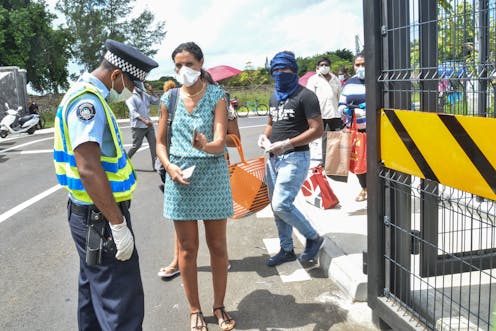
Mauritius has not been spared from COVID-19. The country has been under national confinement since 20 March, a curfew since 24 March. As it is a globally interdependent economy, the impact on the country has been unparalleled. The first estimates point to a GDP contraction of 3% to 6% in 2020. The crisis is expected to spread well into 2021. Government has committed close to Rs.12 billion (US$ 300 million) worth of measures in support of businesses and workers. A further fiscal stimulus will be necessary to weather the storm.
But Mauritius heads into the epidemic on a stronger footing than many sub-Saharan Africa countries. The country’s solid social protection system provides a strong foundation which government can use to expand support to the most vulnerable Mauritian households.
Stronger welfare buffers
Mauritius had a strong Fabian socialist inspired leadership at independence. It is therefore one of the few countries that successfully preserved its welfare state throughout its stabilisation and structural adjustments programmes in the 1980s. Today the country boasts a social protection system that is broad and relatively extensive in coverage.
Mauritius’ entrenched social protection culture meant that government promptly acted to minimise job losses from the 2008 global financial crisis. Its welfare system enabled timely policy responses, helping minimise the socio-economic impact of the crisis.
Mauritians benefit from universal and free health coverage, free education from the age of five, free higher education, an unemployment benefit scheme that embeds provisions for informal labour, a minimum wage (US$ 258 per month), a 13th month salary, a range of social assistance schemes for the most vulnerable and a universal pension scheme (US$ 228 per month).
The latest available data shows that Mauritius allocated 9.3% of its GDP to social protection measures. The average across sub-Saharan Africa is 4.5%. Only South Africa, Botswana, Djibouti and Lesotho spent more than 6% of GDP on social protection.
With 3.4 hospital beds per 1,000 population, Mauritius is better equipped than the UK (2.8 beds per 1,000 population) and this contrasts with the sub-Saharan Africa average of 1.2 beds per 1,000 population. The fight against Ebola and HIV/AIDS enabled some countries to accumulate valuable expertise in containing the spread of contagious diseases. Nevertheless most health systems in sub-Saharan Africa remain deeply fragile and massively underfunded.
Primary commodity exporters with limited social protection and limited cash transfer programmes in central and western Africa will probably be the hardest hit. With limited fiscal space they will urgently require international funding and support in implementing immediate COVID-19 targeted solutions.
With the pandemic still unfolding, African finance ministers have called for international fiscal support and a coordinated policy response to address the sanitary and economic impacts.
Calls for reform
There is debate as to whether the Mauritian welfare state should have undergone more fundamental reform in terms of quality of delivery, especially in the areas of health and education. The government’s vision of becoming a high-income economy by 2030 may have obstructed the need to focus on sustainable outcomes rather than quantitatively measurable growth objectives. These concerns are legitimate and will need to be addressed.
But for now, Mauritius can count on its existing welfare system as it crosses the coronavirus desert. As it battles the health and economic impacts of the pandemic:
-
the sick will be systematically treated for free, irrespective of socio-economic class, by the national health care system;
-
the unemployed will receive unemployment benefits for up to a year;
-
pensioners will receive a guaranteed income through the universal pension; and
-
fiscal stimulus measures will be manageable and easier to implement given the systems and institutions already in place.
Post-COVID-19
Will the welfare state be enough to save Mauritius from increased inequality post-COVID-19?
Probably not. But it will help save lives across social classes and will cushion the social impact for the most vulnerable, with obvious knock-on effects for social cohesion and the local economy. All else being equal, it also means Mauritius will require less incremental spending per head for an equivalent health and economic impact, compared to countries with less social protection.
What the Mauritius experience indicates is that an economic policy anchored on capital accumulation and growth alone cannot protect people from the impact of global exogenous shocks. What’s needed is systemic social protection that reaches the most vulnerable.
As countries rebuild their economies post COVID-19, they will need to ensure that social welfare lies at the heart of their strategies. Each country will need to find the social protection system that suits its specific situation.
The prevalence of self-employment and informal economic activity in some countries might call for welfare solutions that are flexible and agile. Technology and artificial intelligence could be useful tools to allow welfare to reach the most vulnerable, in the same way that mobile banking enabled wider access to basic financial services.
Countries will need more fiscal space and transparency. But whatever reconstruction plan is in place, universal access to quality health care and education must be at the heart of any strategy.

Myriam Blin does not work for, consult, own shares in or receive funding from any company or organisation that would benefit from this article, and has disclosed no relevant affiliations beyond their academic appointment.
Source: The Conversation – Articles (AFRICA)
Read more on The Conversation.
Join the fun: Add Your event | Submit a Press Release | Add your listing.


