Mitochondrial DNA reveals unexpected ancestral connections:

Biochemists study life on a molecular level. So, as a biochemist, it made sense to investigate my own existence at that deepest of levels, which is why I had my DNA sequenced – my mitochondrial DNA, or mtDNA, to be exact.
This genetic material is found inside mitochondria, the sub-cellular compartments or organelles where food is converted into energy. DNA from this organelle is passed down primarily from mothers to their children. During fertilisation, the father’s sperm transfers his chromosomal DNA into the female egg, leaving the mitochondria behind.
If any of the male-mitochondria are transferred into the egg, it is usually destroyed by internal processes. However, recently published work has shown that in a small number of cases, mitochondria from the father got into the egg, was not destroyed and was passed on to the children.
In most cases though, sons do not pass along mtDNA to their children. Every mother, however, transfers her mtDNA to her daughter who will in turn, transfer it to her daughter and so on throughout the ages. Because mtDNA does not change much over time, maternal lineage information from thousands of years ago becomes accessible today.
My female ancestor would, I thought, be Khoi-San. That’s what family records and knowledge of my immediate ancestors suggested. The Khoi-San were southern Africa’s first people, and dominated the region for thousands of years.
I expected to belong to the haplogroup L0, typical for all Khoi-San and many Coloured people. “Coloured” is a racial classification introduced by the apartheid-era Population Registration Act to refer to a multiracial ethnic group native to South Africa with Khoi-San, Bantu, Afrikaner, English, Indian and South Asian ancestry.
A haplogroup is a genetic population group of people who share a common ancestor on either the matrilineal or patrilineal line. The results of the sequencing tests surprised me: my mtDNA was assigned to the M2 haplogroup, a group whose origins are described as not native to Africa (see Figure 1) yet common to Cape Malay or Cape Muslims who have their origins outside the continent.
Historically, people in this group were brought over from South-East Asia to South Africa as slaves for European colonisers. Apartheid displaced the slavery narrative to the recesses of South African history: as a country we focus on apartheid as the origin of all our ills, while our slavery heritage is largely forgotten. Now, as my experience shows, developments in mtDNA sequencing are returning it to view. This is important because South African identity is more complex than just black and white, and slavery shaped the society in ways that should not be ignored.
The history of haplogroups
So what is haplogroup M2, the one I have discovered I belong to? Haplogroup M, together with its sister group N, originated from the same ancestor – known as haplogroup L3. Members of this haplogroup are believed to be the first humans that migrated out of East Africa between 80 000 and 60 000 years ago. Once these ancient humans left the African continent they went on to populate the world.
Haplogroup M is found almost exclusively in Asia (Figure 1); M2, with an estimated age of 50 000 years, is found primarily in South East India and Bangladesh.
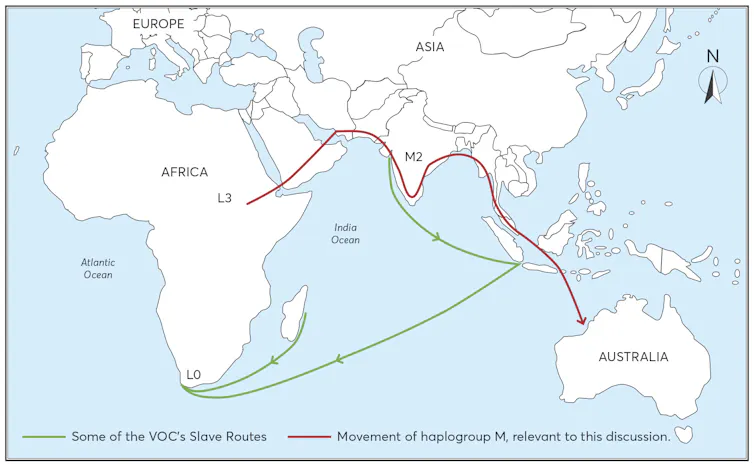
I was suspicious of my results. But my siblings’ mitochondrial DNA sequencing results were assigned to the same haplogroup and analyses done at three different laboratories – two national and one international – reached the same conclusions. So, I was left with finding a way to get this outcome to make sense.
The colonisation of what is today the Western Cape province and the subsequent contact of the indigenous Khoi-San with Europeans and their slaves provides a plausible explanation as to how the mitochondrial M2 haplogroup pattern could end up in someone with documented Khoisan ancestry.
Colonisation
The dominance of the Khoi-San in southern Africa was ended by the Verenigde Oost-Indische Compagnie – VOC or Dutch East India Company in 1652 with the establishment of a refreshment station that became a colony and, finally a settlement.
The VOC’s plans required labour. So the first shipment of slaves, mostly captured in present-day Angola or Guinea, was brought to the Cape in 1658 by the slave ships Amersfoort and Hasselt, respectively. In subsequent years, the vast majority of slaves were brought in from Madagascar, the Indian subcontinent and South East Asia (Figure 1). Some of these female slaves brought the M2 haplogroup with them.
For the 180 years of slavery at the Cape, slaves far outnumbered the colonial population. The colonial economy could not function without the use of slave labour, meaning slave ownership was widespread. There are records of inter-marriage between the KhoiKhoi and San populations with colonial slave populations, as well as with African farmers and white settlers.
Add to this the unrecorded and involuntary unions between especially the masters and their slaves, and it becomes easy to envisage sexual contact between a female slave and a European male circa 1660 – and the birth of a female child or children who went on to have offspring-producing relationships with other European/Slave/Khoisan/Coloured men in subsequent cycles until eventually one such cycle produced my great grandmother. This is illustrated in Figure 2 below.

With one or more of the male ancestors in my maternal lineage being Khoi-San, the cross-over sharing of chromosomal DNA between parents explains the Khoi-San phenotype – that is, observable, physical characteristics – in my family.
Advances in technology
Without the technology to sequence mitochondrial DNA, I would not know of my ancestral links to slavery. Artificial intelligence is making sequencing faster, cheaper and more accurate while machine learning algorithms that improve with experience are accelerating our ability to compare large, complex DNA sequencing data sets and interpreting its meaning.
Chances are, then, that in a few years mtDNA sequencing will disclose even more disruptive ancestral information – and allow us to see ourselves and our histories more clearly.

Debra Meyer does not work for, consult, own shares in or receive funding from any company or organisation that would benefit from this article, and has disclosed no relevant affiliations beyond their academic appointment.
Source: The Conversation – Articles (AFRICA)
Read more on The Conversation.
Join the fun: Add Your event | Submit a Press Release | Add your listing.


