For most people who finished school or university even a decade ago, the idea of virtual reality in the classroom probably seems like the stuff of science fiction. But immersive technologies like virtual reality (VR), augmented reality (AR) and mixed reality – which all aim to marry the physical and digital worlds – are increasingly being used to bolster teaching and learning.
Its proponents argue that immersive technology could be especially useful in low-resource settings. No laboratory equipment at school? Can’t afford pricey field trips? No problem: mobile phones and tablets could take entire labs and libraries into schools and universities.
Those opposed to an all-out migration to such technology point out that poorer countries’ education sectors already have serious resource and infrastructure constraints.
The COVID pandemic, with its resulting lockdowns and university closures, forced countries to shift towards online teaching and learning. But it didn’t miraculously improve infrastructure issues – if anything, it made them worse. Still, it seems likely that some element of online learning will become the norm in many parts of the world.
How might educational institutions in poorer contexts adapt without leaving students behind? Our experience in developing an immersive mobile phone application for university anatomy students offers some insights.
The departments of computer science and medical biosciences at South Africa’s University of the Western Cape collaborated to develop Anat_Hub for two reasons. First, we wanted to reach students who were no longer on campus because of the pandemic, and create an avenue for self-paced learning. Second, practical training in medical biosciences has been hampered by resource constraints and limited teaching staff. In anatomy, for instance, there is a global lack of cadavers. That makes practical training difficult.
In a recent paper, we outlined how students experienced the app as well as the constraints and problems they faced.
An immersive experience
Anat_Hub is a practical immersive AR technology for the musculoskeletal system. It teaches the names, attachments and actions of muscles of the human musculoskeletal system. The app provides detailed graphics of both the upper and lower limbs. The models can be viewed in four different sections: the shoulder and arm; forearm and hand; hip and thigh; and leg and foot.
In the AR mode, the animation functionality built into the app allows the student to view and interact with the model from different sides. As with the 3D version, users can start by looking at the muscles of each limb, and peel away layers down to the nervous system.
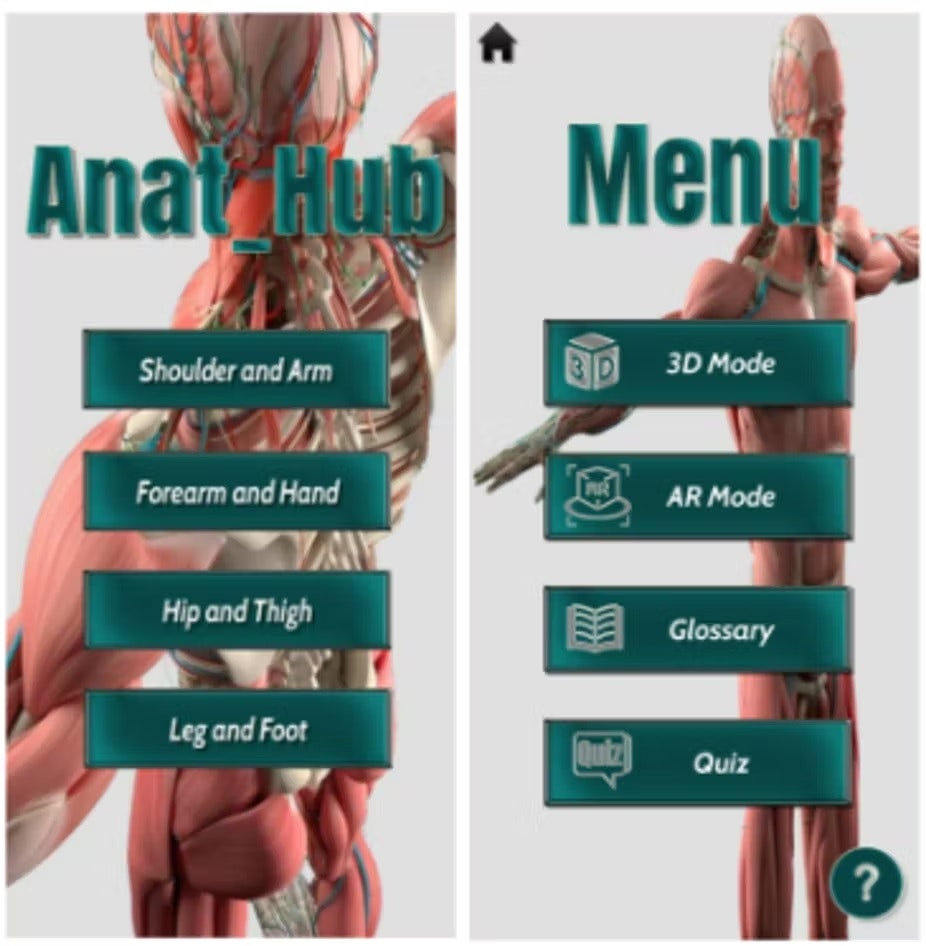
The application, based on the Android operating system, offers a wide range of useful features intended to promote active and self-regulated learning. These include 3D mode, a glossary, and a quiz where students’ cognitive abilities are tested on the material covered.
Anat_Hub is about 300MB in size and internet access is needed for it to be downloaded and installed. However, it can be used offline once it’s downloaded. Internet access was a foremost consideration in the app’s development process given its African context. It has been reported that some 82% of university students in sub-Saharan Africa do not have internet access. In South Africa, a survey by publishers Juta found that 32% of responding students struggled with internet access.
We piloted the system on a group of volunteer first-year undergraduates from several anatomy-related disciplines. Then we evaluated their experiences of the app’s functionality and usability. There were, ultimately, 53 respondents. Only 13.2% had used AR prior to seeing Anat_Hub. Most had relied on lecture notes (96.2%), internet resources (77.4%), videos (75.5%) and textbooks (56.5%) to study anatomy. Few had turned to alternative sources such as mobile applications (24.5%), anatomy atlases (11.3%) and e-learning software (7.5%).
Students rated the app well. Nearly two-thirds of the volunteers scored it a 4 or 5 on a scale of 1-5 (“poor” to “excellent”). Nearly 70% of the respondents particularly liked the app’s 3D mode. Many found the glossary useful. And 96.2% told us they would recommend the app to others. This all hints at the potential and opportunities for such technology.
The digital divide
Of course, there were problems too. These largely centred on faulty or missing features, user interface and navigation, 3D elements in the navigation bar and difficulty with the AR mode. These issues could possibly be ascribed to the type of mobile device used not meeting the app’s required specifications (Android API level 26 to 30 with a mobile screen aspect ratio of 16:9).
This is a reminder that not all mobile or smart phones and computer tablets are made equal. They are not all configured the same way and some students simply cannot afford the high-end phones that are more likely to meet the app’s specifications. This emphasises South Africa’s deep digital divide and its high poverty levels. Many students at our university, and others in South Africa, come from households with no basic infrastructure and where parents have neither the education nor means to provide them with a technology leg-up.
Read more: Digital equality: South Africa still has a long way to go
This is not the end of our work with Anat_Hub. For one thing, future research will aim to determine whether students’ performance in anatomy tests and examinations will improve as a result of the app. Further effort is planned to optimise and reduce the size of the app. The ultimate goal is to roll out the app as a learning tool for anatomy within the University of the Western Cape and other institutions.
Applications like Anat_Hub show that home-grown technologies can be developed to meet local needs. But the availability of the technology itself is no “cure” for shortcomings elsewhere in the education system or society more broadly.
Professor Okobi Ekpo and Marjorie Smith contributed to this article.


