More people in Africa need to be insured against natural disasters:
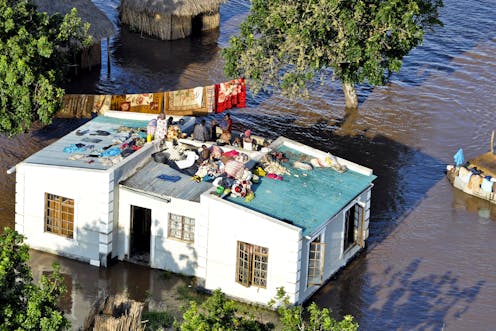
Mozambique was the site of one of Africa’s most devastating natural disasters in recent times. In the year 2000 floods killed 700 people, displaced 60,000, and left more than 500,000 needing humanitarian assistance.
The disaster also inflicted economic damage totalling over US$ 273 million – that’s six times Mozambique’s GDP.
Unfortunately, neither the citizens nor the government had disaster insurance. This meant that the country had to seek donations and humanitarian aid to rebuild. At the time, Mozambique’s economy was already constrained by poverty and low levels of social development. So the aftermath of the floods was another blow to the economy.
Compare this to the 2010 earthquake that devastated Christchurch in New Zealand. There, over 81% of the losses were covered by disaster insurance. This ensured a quick recovery, and reduced the economic burden on both the government and the people.
These two scenarios demonstrate the importance of disaster insurance. Current global estimates suggest that over a billion people are susceptible to natural disasters.
Between 2006 and 2015 the damage caused by disasters cost Africa $ 8.1 billion dollars. Global estimates of the same damage costs have nearly doubled in 2017 from $ 188 to $ 306 billion.
Insurance is one way that citizens and governments can mitigate against the damage caused by natural disasters. But in Sub-Saharan Africa the uptake of such insurance remains low. This is surprising given the increased threat large parts of the continent face from climate related hazards and the extreme economic losses that may be incurred.
So what are the factors underpinning this lack of demand for disaster insurance? They include risk assessment, access to information, and the affordability of premiums.
Disaster insurance
Disaster insurance is an agreement between an insurance company and a nation state, body corporate, or individual that entitles them to compensation for losses incurred during disasters. For that entitlement, a cash premium is paid every month.
The seminal works of academics Howard Kunreuther and Jack Hirshleifer were among the first to assess the role of insurance in disaster recovery. They were both concerned with how to mitigate the effects of disaster losses.
Kunreuther argued that insurance was a potent tool in mitigating disasters by securing recovery funds for disaster victims. Hirschleifer contended that insurance would secure resources for urgent problems and ensure faster recovery for those affected. Both advocated for insurance as a way of building up the cash reserves that would be needed in the long-term management of disasters.
Despite these studied and stated benefits, the demand for disaster insurance in Sub-Saharan Africa remains critically low. Only 2.6% of consumers have disaster insurance. An estimated 80% of those are in South Africa. Why is this the case?
Traditional literature points to factors such as poor insurance education. But insights from behavioural economics – the process of economic decision-making – indicate that the problem may be elsewhere.
Behavioural economics
Behavioural research has consistently shown that individuals deviate from rationally expected behaviour. In the context of the threat of natural disasters, the rational thing would be to prevent economic losses by insuring one’s assets.
And yet this isn’t how people behave in this case. While empirical evidence suggests that high premiums are responsible for the low uptake by ordinary citizens this is only part of the problem.
An individual’s attitude towards risk, together with a lack of information, are also likely to play a significant role in insurance uptake. While the general population is considered to be slightly risk averse, individuals who are risk neutral or risk averse are less inclined to be insured. This is compounded by the geographical distance from a potential disaster: for instance, the further away a person is from a disaster site, the safer they’ll feel.
Research also shows that general understanding of insurance products and disaster probability is limited. Finally, trust is key. Individuals will not pay for insurance if they do not believe support will be provided when it’s needed. As such, the relationship between consumers and insurers is very important for boosting demand.
Future policy considerations
To solve the sub-Saharan African insurance problem, our research indicates that a raft of coordinated policies should be implemented to ensure a net increase in demand for disaster insurance.
Behavioural insights suggest that policies should be directed at influencing individual decision-making processes by removing barriers such as lack of information, mistrust and prohibitive costs.
Mandatory disaster insurance is another option; it would broaden the insurance pool, spread the risk and lower individual premiums – making insurance affordable to the average citizen.

Matthew Abunyewah receives funding from the International Postgraduate Research Scholarship of the University of Newcastle, Australia for his PhD.
David A. Savage receives funding from the Australian Research council DP170100177, for research on the Microeconomic Impacts of Australian Natural Disasters.
Michael Odei Erdiaw-Kwasie is affiliated to Outback Emergence Ghana – a Ghana-based organisation that champions development research in developing countries. He receives funding from Outback Emergence Ghana to undertake research into social problems that undermine development efforts in developing regions.
Seth Asare Okyere is part of a research team that receives funding from the Japan Society for the Promotion of Science (JSPS) for exploring socio-spatial dynamics and sustainable community-based improvements in Accra's informal settlements
Kim Maund and Thayaparan Gajendran do not work for, consult, own shares in or receive funding from any company or organisation that would benefit from this article, and have disclosed no relevant affiliations beyond their academic appointment.
Source: The Conversation – Articles (AFRICA)
Read more on The Conversation.
Join the fun: Add Your event | Submit a Press Release | Add your listing.


