At the start of the last decade, Mozambique’s prospects looked stellar. Following from the early 1990s, when peace finally arrived after a devastating and protracted armed conflict, this vast country in Southern Africa could look back proudly on a sustained period of rapid growth and poverty reduction.
Mozambique was a darling of the international development community, enjoying significant direct support to the government budget, and investment possibilities in the natural resources sector seemed bright.
By 2016, much of this lustre had been lost. In part this was due to an economic crisis heralded by the discovery of illegal debts taken on by newly formed state companies. Ultimately, these appeared to have been designed to enrich a small political elite and their overseas collaborators. And this led international donors to freeze much of their support.
But mounting debts have not been the only challenge. By the early 2010s, prospects for the coal sector – which, under conservative assumptions, had been projected to deliver $1 billion in annual government revenue by now – had been slashed. The exit of Rio Tinto in 2014, at a loss to the company of over US$3 billion, was indicative.
Fast-forward to the present day. The macro-economy has stabilised somewhat. Yet little of the promise of 10 years ago has been fulfilled. Even though massive private investment inflows have continued, real economic growth has fallen sharply. Poverty and other indicators of deprivation have also remained stubbornly high.
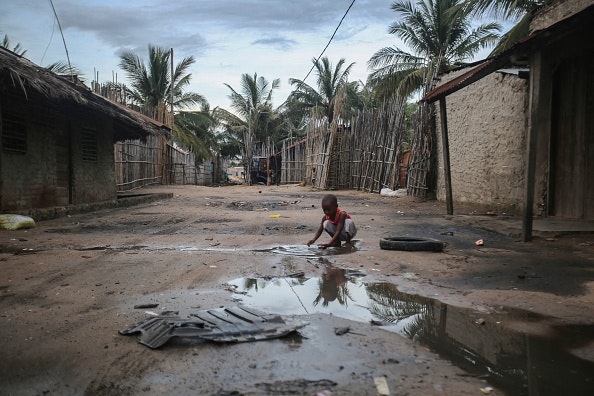
And serious conflicts have emerged, especially in the north of the country. An estimated 700,000 people – that’s 2% of the country’s population – have been internally displaced due to conflict.
Large investments in the natural gas sector have been delayed or cut back. And the largest potential investment, by the French giant Total, has now been placed on indefinite (if not permanent) hold, citing security concerns.
COVID-19 has only added to the list of complex, protracted challenges facing the country.
In sum, Mozambique has experienced a difficult decade. It’s time to recognise that the development strategy of this period has not delivered.
Drawing lessons
A few lessons are emerging as to why Mozambique’s recent development path has failed to live up to expectations. These are relevant to avoid further mistakes. They also serve as a warning to other low-income countries betting heavily on large-scale inward foreign direct investment.
Three lessons stand out:
Don’t believe the hype: A consistent and defining feature of the engagement of foreign companies in Mozambique’s natural resource sector has been their tendency to make extremely bullish predictions of their own success. One example was Rio Tinto, which proclaimed in 2011 that its newly acquired Mozambique operations represented the “greatest underdeveloped seaborne coking coal in the world”.
Projected project timelines have been routinely highly optimistic, suggesting production and government revenues will quickly come on stream, to the benefit of all parties. Alas, as the US Securities and Exchange Commission complaint against managers at Rio Tinto notes:
On-the-ground realities in Mozambique quickly undermined {their optimistic} narrative.
Both international partners and government officials have often sung the same tune. Indeed, the International Monetary Fund’s 2015 debt sustainability assessment projected new liquefied natural gas (LNG) production would start as early as 2021. And that it would yield annual growth rates of 50% in the value of exports.
Similarly, Mozambique’s 2016 presentation to commercial creditors suggested new LNG production should come online as early as 2022/23, generating double-digit growth in real GDP. In a stroke the country’s external debt problems would be resolved.
These projections were wildly over-optimistic.
Of course, hindsight has clear advantages. But excessively bullish predictions, which are then used as key assumptions to forecast future macroeconomic sustainability, have been repeated on multiple occasions.
Foreign investment is a means, not an end: The theme of natural resource investments has dominated policy discussions in Mozambique over the last decade. Assuring these projects move ahead has often seemed like the only objective, automatically guaranteeing Mozambique becomes a middle-income country, perhaps even the “Qatar of Africa”.
Sadly, emerging macroeconomic challenges have only entrenched the salience of finalising these investments. The IMF’s message has been clear:
Ensuring that LNG production materialises remains important to underpin Mozambique’s long-run debt sustainability.
But natural resource investments in low-income countries have rarely delivered widespread developmental gains. As the experiences of Nigeria and Angola show, benefits are often extremely narrow and captured by a small elite. At worst, the distortionary effects can undermine competitiveness in the rest of the economy, leaving the poorest even poorer.
Arguably, some of these effects have already been apparent in Mozambique. Millions of dollars have been poured into the capital city, fuelling multiple high-end real estate investments. Any dividend for the poor has yet to emerge. And public investment has collapsed.
The more general lesson is that managing large-scale private investments so that they deliver broad-based (inclusive) developmental gains is never easy.
At the minimum, alongside genuine political will, it demands pro-active upgrading of the capabilities of the state. This includes strengthening institutions and the quality of economic governance. Without this, weaknesses are easily exploited to the private benefit of the companies and corrupt local factions.
people: A flip side of the focus on natural resource investments has been a lack of attention to other sectors, as well as the increasingly unbalanced regional and rural-urban patterns of development. A pronounced north-south gradient has been evident in a range of socio-economic outcomes for decades. But the imbalance has worsened over recent years.
Many commentators suggest that current conflicts, particularly in the north, directly reflect these growing inequalities. The lesson is that rising inequality, particularly in countries such as Mozambique where nation-building remains a work in progress, can represent a very serious threat to developmental success.
What comes next?
In addition to the immediate cessation of conflict, Mozambique requires a coherent set of policies, not projects, based on a clear vision for the development of the country as a whole.
These cannot be formulated from the luxury of air-conditioned offices in Maputo, Brussels or Washington. Without a genuine understanding of the complexities of “on-the-ground realities”, including weaknesses in state capacity and political dynamics, earlier mistakes are likely to be repeated. Listening to poor communities, learning from local successes, and building a common – yet realistic – vision of the future is fundamental.
This takes time. Delegating it to external consultants or political apparatchiks will be a recipe for failure.
But the process of building an inclusive developmental vision also represents an opportunity – to build state capability as well as to renew today’s fragile social compact.
Nurturing engines of economic growth outside the natural resources sector will be critical for long-term development and sustainability. In their absence, it may not be so bad if some natural resources stay in the ground.


