Nadya Krupskaya: the Russian revolutionary:
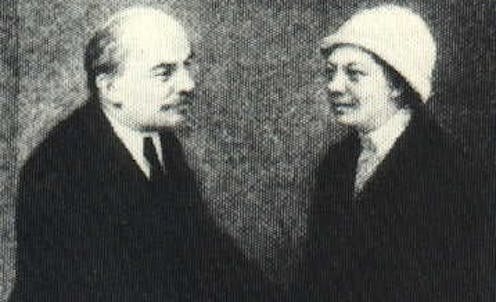
Nadezhda (Nadya) Krupskaya was a significant figure in the radical movement that made the Russian Revolution a century ago. But, like many women in politics before and after her, Krupskaya has been reduced to her relationships to men. In her case, being the wife of Soviet leader Vladimir Lenin.
She was born into an impoverished family in St Petersburg in 1869. Her father, an aristocrat, had lost his commission as an officer, possibly for being suspected of being involved in revolutionary activities.
Krupskaya’s first political passion, as a teenager, was for Russian author Leo Tolstoy‘s theory of democratic education. For Tolstoy science needed to be democratised and placed in the service of the people as a whole rather than used as a weapon of domination and exploitation by an elite. In contrast to the rigid curriculum of the Russian schools of the day he argued for education based on an experiential and unstructured embrace of free and open inquiry.
In 1891, at the age of 22, Krupskaya began teaching evening classes in literacy and arithmetic to factory workers. By 1894 she was involved in underground Communist study groups and soon became involved in building factory workers’ organisations.
In 1896 Krupskaya was arrested and exiled to the Siberian village of Shushenskoye. Her first pamphlet, The Woman Worker, was written in 1899 and published, via an underground press, in 1901. It examines women’s work on the land, in the factories and in the family. It’s often said to have been the first Marxist text to specifically tackle the condition of women in Russia and a significant feminist text.
Krupskaya and Lenin had met in 1894 in a Communist discussion group. From the outset, their relationship was a meeting of comrades. Krupskaya’s classes with factory workers gave her knowledge about conditions in the factories that was vital to the pamphlets that Lenin was writing at the time.
Lenin and Krupskaya had shared their exile in Siberia, on condition that they married. It has been suggested that their relationship was more a matter of shared political commitment than a passionate love affair. But this is pure speculation. Both Lenin and Krupskaya spoke very little of their courtship, marriage and personal lives.
Secret letters
After her release Krupskaya moved to Geneva where, in 1903, she became the secretary of the editorial board of “Iskra” (Spark), the underground paper of the Russian Social Democratic Labour Party. In his autobiography, fellow Russian revolutionary Leon Trotsky recalls that,
She was at the very centre of all the organisation work; she received comrades when they arrived, instructed them when they left, established connections, supplied secret addresses, wrote letters, and coded and decoded correspondence. In her room, there was always a smell of burned paper from the secret letters she heated over the fire to read…
In 1910 Krupskaya was a co-founder of International Women’s Day, which was first celebrated in Russia in 1913. It was conceived, as Krupskaya made clear in her article in the radical women’s journal Rabotnitsa, as a revolutionary celebration. Four years later, on 8 March 1917, the massive strike that started the Russian Revolution began on International Women’s Day, and was led by women textile workers.
After the revolution Krupskaya was appointed as deputy to the People’s Commissar of Education. After Lenin’s death in 1924, and the ascent of Joseph Stalin to lead the Soviet Union, women were rapidly isolated and there was rapid regression in terms of state and party positions on gender and sexuality. International Women’s Day was turned into a twee celebration of patriarchal values, not, as it has been noted, unlike Mother’s Day in the United States.
No anomaly
Krupskaya, like other leading women in the new Stalin-led state, was marginalised. But in her case, there was another aspect to the hostility that she encountered. She was Lenin’s widow. Her political and intellectual life and work was rapidly reduced to her relationship to her husband.
This is no anomaly. In South Africa for example, it was also the case for Winnie Madikizela Mandela, Ruth First and Albertina Sisulu among others. These three women, although independent ANC and SACP activists in their own right, were often defined by the men they were married to (Nelson Mandela, Joe Slovo and Walter Sisulu respectively).
It’s no wonder that many powerful women choose to be without men, or not to highlight their lives as wives or mothers, because all their work then gets defined by their relation to the men in their family.
Public attack on Stalin
In December 1925, Krupskaya led a public attack on Stalin. But in May 1927 she backed down from this position for reasons that remain unclear and contested. She wrote important articles on children, leisure and the green city. In 1933, she backed away from some of her feminist positions, again for reasons that remain unclear and contested.
After her death in 1939 she was largely, although not entirely, forgotten as anything other than the woman who had been Lenin’s wife. It’s not unusual for historians to credit men around Lenin for aspects of his success. Krupskaya however, fades into her role as Lenin’s wife, a role that is assumed to be contained to the domestic space, which itself is assumed to be a space outside of politics.
Writing almost a week after her death Leon Trotsky described Krupskaya as one of the most “tragic figures in revolutionary history”. This view of Krupskaya could only be held by Trotsky because he defined her by the men in her life. He defined her by Lenin, and later by Stalin.
Trotsky’s one-dimensional view of Krupskaya is typical of the narratives about women that seek to flatten their identity and have them fit the simplistic narratives of patriarchy. She could not be, as men are often acknowledged to be, a complex individual with a capacity to struggle, love, deceive and hate.

Vashna Jagarnath is affiliated to the National Union of Metal Workers of South Africa (Numsa)
Source: The Conversation – Articles (AFRICA)
Read more on The Conversation.
Join the fun: Add Your event | Submit a Press Release | Add your listing.


