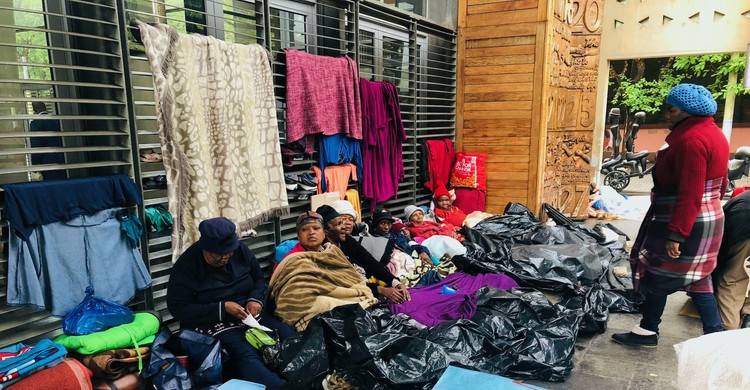
Dozens of people sleeping outside the Constitutional Court in November to demand reparations for crimes committed against them during apartheid. Archive photo: Kimberly Mutandiro
- The President’s Fund was established to pay reparations to victims of human rights abuses under apartheid.
- Over the past five years, the Fund has received R531-million in investment revenue but only disbursed R97.7-million in reparations.
- Progress on housing provision, as recommended by the TRC, has been slow.
For almost two months, about 150 victims of apartheid have been sleeping outside the Constitutional Court as part of the Khulumani Galela Campaign. They say they qualify for apartheid reparations from the President’s Fund but they have not received them.
The President’s Fund, established by the Promotion of National Unity and Reconciliation Act of 1995, is mandated to make reparations to victims of human rights abuses under apartheid.
Over the past five years, the Fund has received R531-million in investment revenue but only disbursed R98-million in reparations. The fund has grown by more than R300-million since March 2018.
GroundUp first reported on the unspent money in the fund in 2013, when it was R1.1 billion. As of March 2022, the Fund was worth just shy of R1.9-billion.
The Fund is administered by the Truth and Reconciliation Commission (TRC) Unit within the Department of Justice and Constitutional Development (DoJ). The Accounting Officer of the Fund is also the Director General of the Department.
As per the recommendations of the TRC, the fund is supposed to make reparations in four categories
- a once-off individual grant to victims of apartheid,
- educational support for victims and their families,
- housing provision for victims,
- financial assistance with exhumations and reburials of deceased apartheid victims,
- access to healthcare, and
- rehabilitation of communities severely affected by apartheid.
Once-off individual grants
In March 2003, then-President Thabo Mbeki announced that people identified by the TRC as victims of human rights abuses under apartheid would each receive a R30,000 grant.
The TRC report included a list of 21,000 people. This was later cut down to 17,000 people eligible for reparations. According to the Fund’s annual reports, all people who applied and were found eligible received the R30,000 grant, except for 13 people who could not be traced, seven of whom are confirmed to be living overseas.
Khulumani Support Group, with a membership of more than 100,000 apartheid victims, has been challenging how funds are disbursed since the fund was established.
Judy-Anne Seidman, a board member of Khulumani, says that the TRC list of victims was limiting. Some people apparently fell off the list during the migration from analogue to digital records, she said. There are also Khulumani members who did not make it to the TRC, because the commission was at full capacity. Some were turned away at the door after days of queuing.
“There is also a constitutional problem around rape,” Seidman says. Of the 21,000 victims identified in the TRC report, only 14 were identified as rape victims. Seidman says from her experience running workshops with Khulumani members, the number of women raped by apartheid officials must be much higher.
Seidman says that the Department of Justice is insisting on using a closed list and is only accepting new applications for the R30,000 grant from people who are named on its list. But she says it is not clear what list they are currently working from, raising concerns about the transparency of the process.
Education
Seidman says that in a recent meeting with the Department of Justice, they were told that about 3,000 people received funding for basic education and 630 for tertiary education. This is low, given that there are 17,000 people on the TRC’s list, and that the DOJ estimates four people per victim are eligible for education assistance.
Application forms for education funding are 20 pages long and arduous to fill out. Seidman says they have been assisting people to apply. To make matters worse, the application forms were cancelled this year and new application forms were promised based on amended regulations. These have not yet been made available.
Housing
The President’s Fund is mandated to provide housing for apartheid victims. According to the Fund’s Annual Reports, progress has been slow:
- 2017/2018: A list of TRC-identified victims in need of housing assistance was compiled.
- 2018/2019: A housing needs analysis was conducted by the DoJ and a draft guideline for housing reparations was being prepared.
- 2019/2020: No progress is reported in the Annual Report.
- 2020/2021: Still no progress was made.
- 2021/2022: The draft guidelines were finally completed and ready to be published for public comment.
According to the reports, the “housing needs analysis” consisted of “a countrywide door-to-door survey by means of a questionnaire developed by the TRC Unit in consultation with the Department of Human Settlement”.
Healthcare
The Fund is supposed to provide apartheid victims with assistance in accessing healthcare. But since 2013, the Fund has maintained that because of the proposed amendments to the National Health Act and the introduction of National Health Insurance, the Department of Health would take care of this mandate.
National Health Insurance is yet to be introduced. In the meantime, the Fund’s latest annual report says there is a dedicated person at the National Department of Health to assist apartheid victims. According to Seidman, the justice department has not been able to tell Khulumani how to access this person.
Community Rehabilitation
Communities particularly affected by apartheid crimes are supposed to be rehabilitated by the President’s Fund. The Department of Justice planned to launch projects in two communities per province, at a cost of R30-million per community. Later it was decided to only fund five communities.
Seidman says there has been little explanation of how communities have been identified. The South African Coalition for Transitional Justice (SACTJ), of which Khulumani is a member, has engaged with the Department of Justice on the regulations. The latest proposal for community projects, Seidman says, was sent to the minister for sign-off without first showing it to SACTJ.
According to the Fund’s Annual Reports, the TRC Unit established “multi-stakeholder project teams” to conceptualise community projects in the five communities.
Reburials and Exhumations
This is one aspect where the Fund has been relatively successful, says Seidman.
The Fund covers the expenses of searching for disappeared persons, and of exhumations and reburials for deceased victims, including an allowance for family members to attend cleaning and hand-over ceremonies, a payment of R1 500 to purchase animals for ceremonial slaughtering, and the provision of coffins and other accessories to a value of R12 000.
As of 31 March 2022, a total of R3.6-million has been spent on reburials and exhumations.
The Department of Justice and Constitutional Development did not respond to GroundUp’s questions.
© 2022 GroundUp. This article is licensed under a Creative Commons Attribution-NoDerivatives 4.0 International License.
You may republish this article, so long as you credit the authors and GroundUp, and do not change the text. Please include a link back to the original article.
We put an invisible pixel in the article so that we can count traffic to republishers. All analytics tools are solely on our servers. We do not give our logs to any third party. Logs are deleted after two weeks. We do not use any IP address identifying information except to count regional traffic. We are solely interested in counting hits, not tracking users. If you republish, please do not delete the invisible pixel.