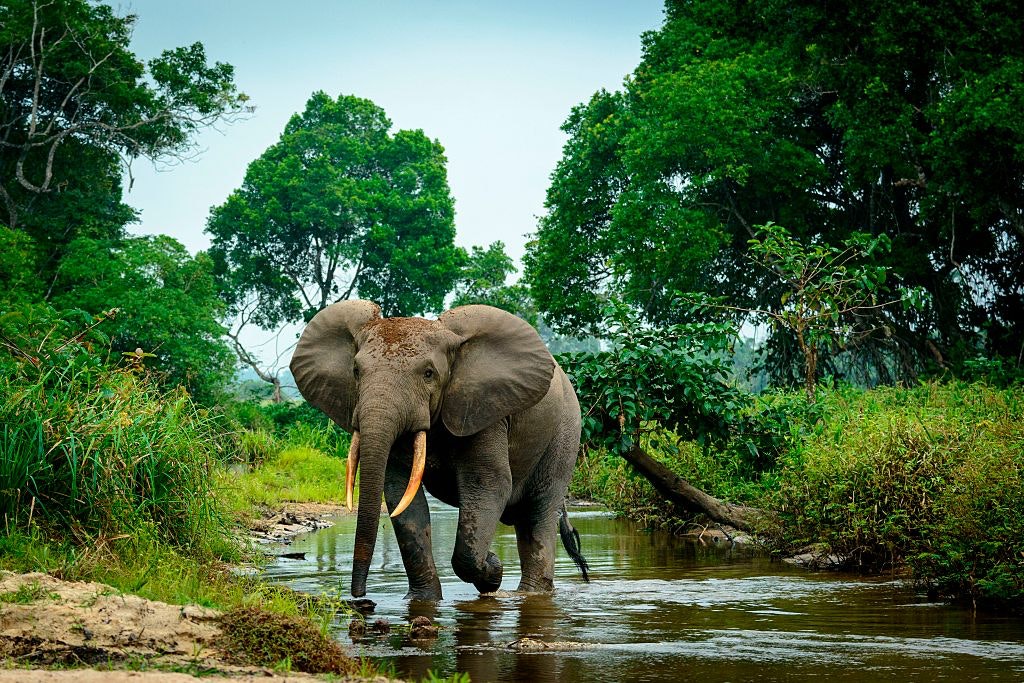
Two big decisions have been made in the last few weeks in relation to African elephants that will have major implications for the survival of the giant mammals.
The first is that a global body devoted to the conservation of elephants in Africa recognised the African elephant as two species: forest and savanna. Previously they had been considered a single species. This matters because their individual populations are smaller than when recognised as a single species, and because they face shared as well as unique threats.
Secondly, in March, the International Union for Conservation of Nature updated its Red List, and moved African elephants into more threatened classifications. As a single species, African elephants were previously listed as “Vulnerable”, because there had been a reduction of more than 30% of the population in the past three generations.
But the body has now listed forest elephants as “Critically Endangered” – a category for species that have declined over 80% within three generations. And it has listed savanna elephants as “Endangered” – a decline of over 50% within three generations.
Highlighting the African forest elephant as a distinct species and listing it as “Critically Endangered” will change how these animals are studied and conserved. Ecologists and conservationists can focus on understanding their unique ecology and addressing the specific threats they face from human pressure.
Species split
Genetic studies show that African savanna elephants and forest elephants split into two species between 5 million and 6 million years ago. There are some hybrid areas, where the forest and savanna elephants meet, but the numbers are few and they’re mostly found in the border zone between Uganda and the Democratic Republic of Congo.
African forest elephants are found in 20 countries, where they live in forests and in forest-savanna mosaics, with most found in Central Africa. By contrast, savanna elephants are found in 23 countries and live in a variety of habitats, from deserts to open and wooded savannas, and even some forests. The largest populations are in Southern and Eastern Africa.
Forest elephants differ from savanna elephants in their shape, behaviour and ecology. Forest elephants are smaller than savanna elephants, with much smoother skin. Forest elephant tusks are slim, parallel, and often downwards-pointing, presumably to better pass between the trees. Savanna elephant tusks diverge widely. Forest elephants have rounded ears; savanna elephant ears resemble the shape of the African continent.
The diet of forest elephants is dominated by fruit. This means that they are hugely important seed dispersers of forest trees, but they will also eat grasses, foliage and even tree bark. Savanna elephants graze on grasses and, depending on the season, feed on a wide variety of trees, shrubs and fruits.
Forest elephants also have a much slower reproductive rate than savanna elephants, so cannot bounce back from population declines as quickly as savanna elephants can. Forest elephants can only double their population in 60 years under current conditions. That doubling rate is about three times slower than savanna elephants.
Forest elephants
The new assessment of forest elephants used results of over 300 surveys going back to 1974. Estimated population decline was 86% between 1990 and 2015, putting forest elephants squarely into the “Critically Endangered” category.
The decline of forest elephants has been driven by ivory poaching. This has affected both forest and savanna elephants for centuries, but has been greatly exacerbated by the introduction of modern weapons and, in the last 30 years or so, the rise in the price of ivory.
However, forest elephants are elusive and live in remote, often inaccessible habitat. This means they’ve received little attention compared to savanna elephants.
Their new endangered status highlights the need for conservation management that fits with their unique ecology and habitat requirements.
Understanding their behaviour is fundamental to protecting them. For instance, some savanna elephant populations buffer seasonal changes in resource availability by migrating. But it appears that forest elephants do not respond in the same way. Instead, they are “nomadic” within their very large home ranges, searching for the most productive fruit patches.
We also know that fruiting events are decreasing in some African forests due to changes in the climate. This renders forest elephants highly vulnerable to a reduction in their food supply.
Read more: Fruit famine is causing elephants to go hungry in Gabon
Better protection
There are certain steps which can be taken to better protect forest elephants.
Some well-protected national parks and Forest Stewardship Council-certified logging concessions have stable and safe elephant populations. Most of these sites are in Gabon and the Northern Republic of the Congo, with a few in Cameroon.
Gabon in particular has conserved its forest elephants relatively well, and half of all African forest elephants are now found there. The country has a zero tolerance approach towards ivory trafficking, including penalties of up to 10 years’ imprisonment. There’s also a specialised wildlife crime court and, in 2021, Gabon’s National Parks Agency built the first wildlife DNA forensics laboratory in Central Africa. DNA analysis of seized ivory provides critical evidence to increase prosecutions. It also helps scientists identify poaching hotspots and trade routes.
The most urgent measure required to stop forest elephant decline is effective anti-poaching within the range states. Anti-trafficking work along the supply chain, from hunters through to ivory traffickers and dealers, is also vital.
In the immediate term, elephants can only be protected by shutting down these networks and reducing or eliminating the demand for ivory – a material of no intrinsic value.
But monitoring threats to forest elephants is challenging. This makes scientific research a key tool which can be used to better guide their protection. This includes counting forest elephants, understanding their distribution and movements, detecting threats and monitoring population trends.
In the long term, three main strategies are required to protect forest elephants. These are strong international policy agreements and implementation to tackle climate change and habitat degradation; ensuring that national and regional land-use planning maintains elephant habitat connectivity; and engaging local communities who live alongside elephants. These measures will maximise the chances of protecting elephants and other species in the Central African forests at a time of rapid environmental change.
Dr Stéphanie Bourgeois, who leads elephant conservation research for the National Parks Agency of Gabon, contributed to the writing of this article.


