Tens of thousands of years ago, a huge horse species walked, trotted and galloped across the shifting sands of what is today South Africa’s Cape south coast.
The Giant Cape Zebra (Equus capensis) weighed an estimated 450 kg. Its extant relatives in southern Africa are far smaller: the plains zebra weighs between 250 and 300 kg and the Cape mountain zebra is the smallest of all zebra species, with a mass of between 230 and 260 kg.
The Giant Cape Zebra became extinct just over 10,000 years ago. This may have been partly because of the loss of its preferred habitat of extensive grasslands, as rising sea levels flooded the vast Palaeo-Agulhas Plain. But until now it hasn’t been clear how common the species was on the Cape south coast because its body fossils are predominantly from southern Africa’s west coast.
That’s where ichnology – the study of tracks and traces – comes in. Since 2007 our team has documented more than 350 fossil vertebrate tracksites along a 350 km stretch of the Cape south coast.
Now, by studying the tracks left by those galloping, walking and trotting zebra so long ago, we’re able to say that they must have been a fairly regular sight on the landscape of the Cape south coast, and were more common than was suggested by the body fossil record in the area. This confirms the capacity of the body fossil record and ichnology to complement each other.
Being able to look back in time in this way doesn’t just help scientists to better understand ancient landscapes. It’s also an important part of understanding what’s changed over time and the effects of climate change and humans.
Zebra crossings
In our recently published article we described how we have identified 26 equid tracksites – including tracks belonging to Equus capensis – in aeolianites (cemented dunes) on South Africa’s Cape south coast in the vicinity of towns like Still Bay and Plettenberg Bay.
This is especially exciting because equid tracks dating to the Pleistocene epoch, which started 2.6 million years ago and ended about 11,700 years ago, are rare. In fact, our finds mean that the Cape south coast accounts for the majority of the sites known globally from this time period (other sites are in Kenya, Ethiopia, Italy, the Arabian Peninsula, and the Americas).
Thirteen of the tracksites we found contain tracks 12 cm or greater in length, and eight contain tracks 10 cm or less in length (in the remaining five cases we could not access the tracks for measurement). Well preserved equid tracks are fairly distinctive: features include an unbroken hoof wall and what is known as a “frog” towards the centre of the track.
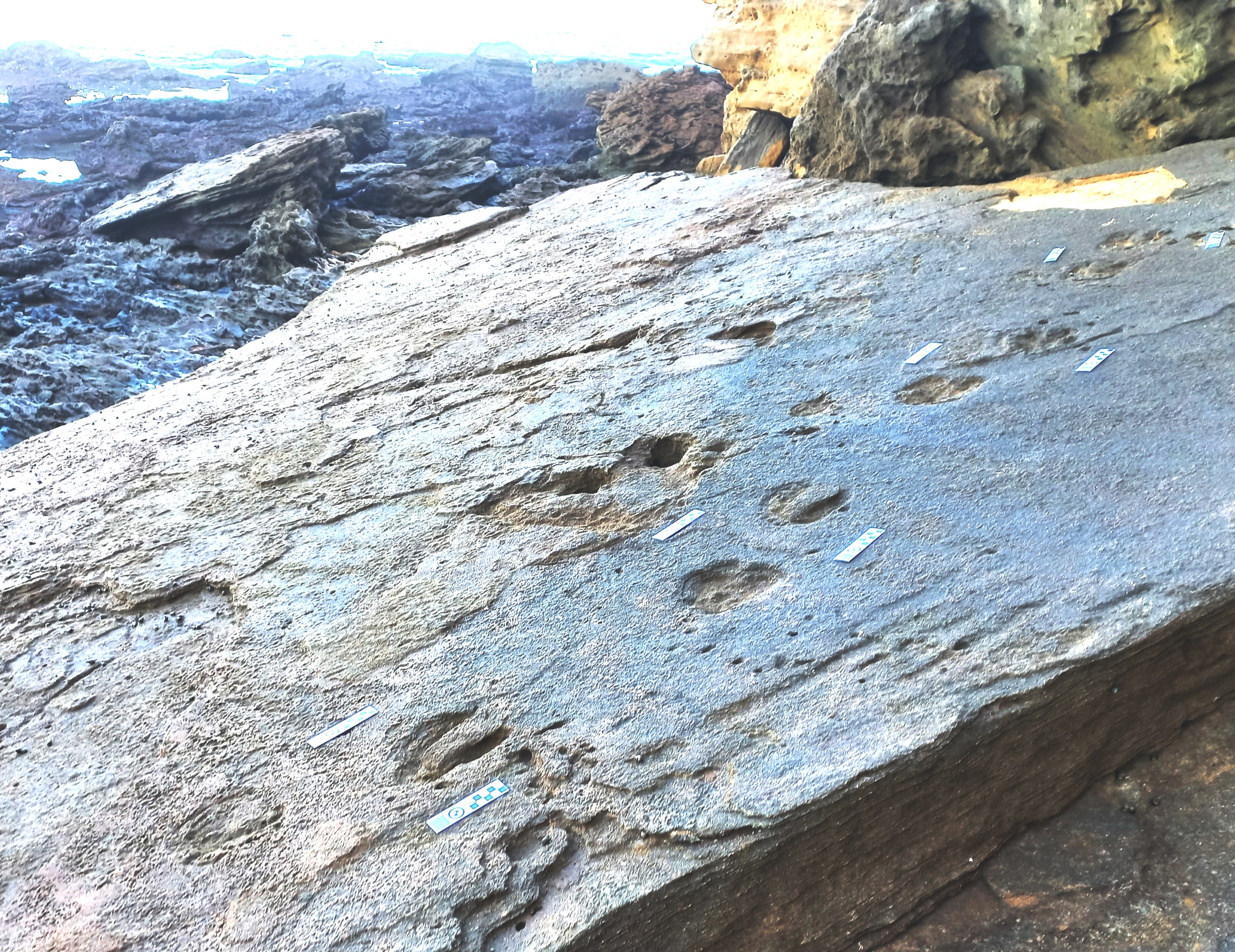
We were able to attribute the large tracks to Equus capensis, and the small tracks to the quagga (Equus quagga quagga), the plains zebra subspecies that became extinct in the 19th century.
One of the Giant Cape Zebra sites comprises a single trackway containing 12 tracks. Another contains two probable quagga trackways that intersect at right angles, respectively containing ten and six tracks. We informally dubbed this the “zebra crossing”. Such long fossil equid trackways are especially rare, as equids are often gregarious (resulting in trampled areas) and isolated trackways are unusual.
One other African example of a long equid trackway is from Laetoli in Tanzania from the older Pliocene Epoch. Sadly, the finest such site was in Nevada in the US, where a 50,000 year-old equid trackway contained 28 tracks – but it was covered in the 1930s during prison construction and is no longer accessible.
Through our Optically Stimulated Luminescence dating program, we have established an age range for the equid tracksites from about 161,000 years to about 43,000 years.
Looking back – and ahead
Identifying and reporting the tracks of the Giant Cape Zebra allows us not only to imagine its presence on the Cape south coast many thousands of years ago, but also reminds us of how extinction often follows in the wake of climate change. And it allows scientists like ourselves working in southern Africa to contribute substantially to a relatively sparse global record of such sites.


