Some 260 million to 265 million years ago, a huge creature called Anteosaurus roamed what is today the African continent. This period was known as the middle Permian – and Anteosaurus was one of its most ferocious carnivores. It had massive, bone-crushing teeth, a gigantic skull and a powerful jaw.
Despite its name, Anteosaurus was not a dinosaur. It belonged to the dinocephalians, a family of mammal like reptiles that predated the dinosaurs. Much like the dinosaurs, dinocephalians roamed and ruled the earth at one stage. But they originated, thrived, and died about 30 million years before the first dinosaur even existed.
The fossilised bones of dinocephalians are found in many places in the world. They stand out because of their large size and heaviness. Dinocephalian bones are thick and dense, and Anteosaurus is no exception. Its skull was ornamented with large bosses (bumps and lumps) above the eyes and a long crest on top of the snout. This, along with its enlarged canines, made it look like a truly ferocious creature.
But because of its skeleton’s heavy architecture, scientists have always assumed that Anteosaurus was a rather sluggish, slow-moving animal, only capable of scavenging or ambushing its prey, at best. Some scientists even suggested that Anteosaurus was so heavy that it must have lived in water.
Now our team of palaeontologists from South Africa and Europe has been able to re-assess Anteosaurus’s hunting capabilities. Our findings show that Anteosaurus’s nervous system and fine-tuned sense organs were optimised for hunting swiftly and striking fast, like the cheetah or the long-extinct, infamous velociraptor. Contrary to what’s long been believed, Anteosaurus was no primitive, sluggish creature: it was nothing short of a mighty prehistoric killing machine.
Technology offers a new view
We used x-ray imaging and 3D reconstructions to better understand what Anteosaurus’s nervous system would have looked like. As Anteosaurus is a very large animal, most specimens would be too big to fit into most CT scanner, so we used a specimen that was found many years ago in South Africa’s Karoo region with its bones disarticulated. In this way, we were able to scan each bone independently and to digitally reconstruct the skull completely afterwards, using the powerful computers at the Evolutionary Studies Institute at the University of the Witwatersrand in Johannesburg.
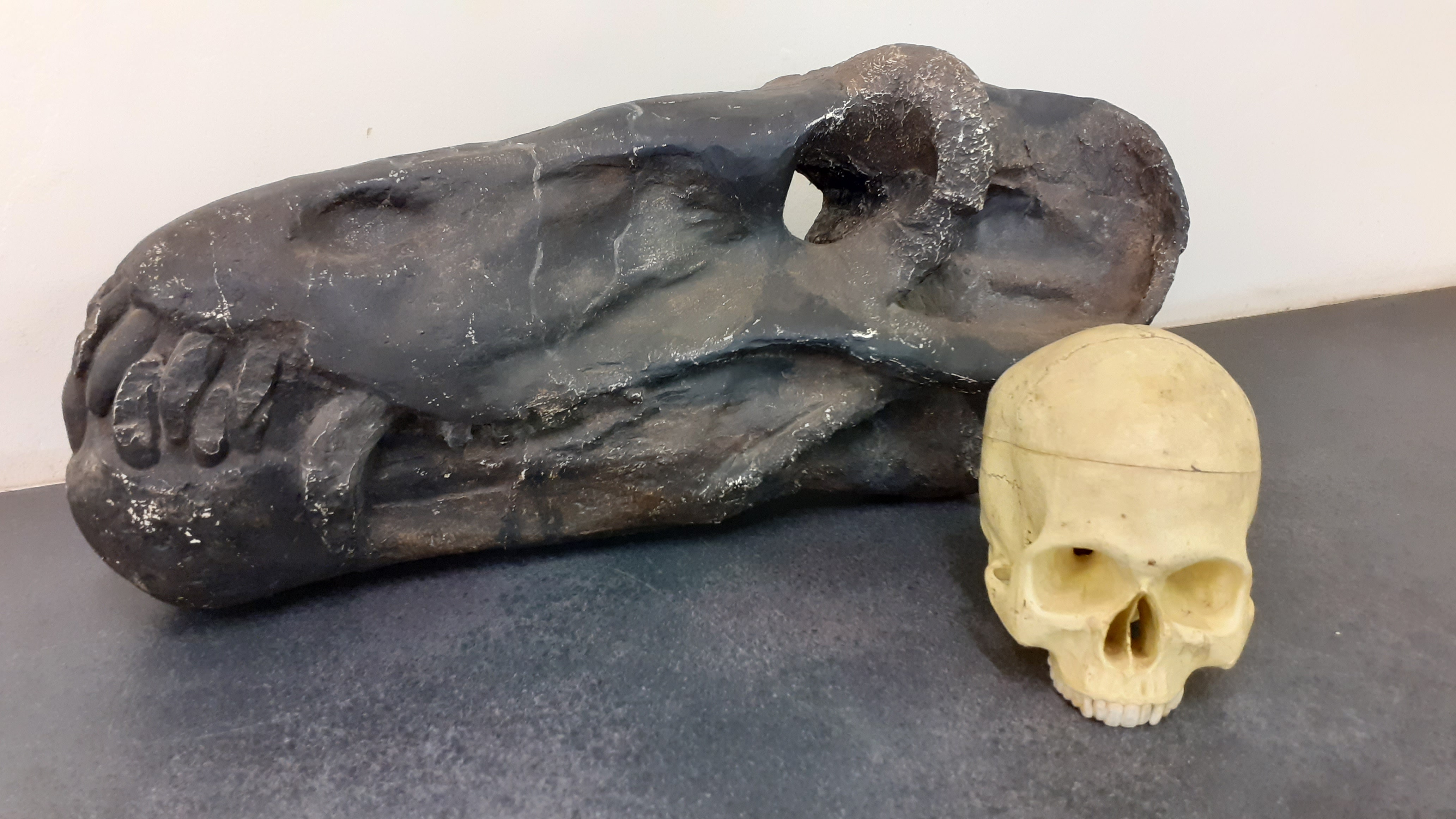
We were then able to investigate its internal structures. Anteosaurus’s organ of balance, its inner ear, was found to be relatively larger than that of its closest relatives and other predators living contemporaneously. This indicates that Anteosaurus was capable of moving much faster than its prey and competitors. We also found that the part of the brain responsible for coordinating the movements of the eyes with the head was exceptionally large. This would have been a crucial trait to ensure the animal’s tracking abilities. Its agility, as we pointed out in the paper, could be compared to that of the North American mountain lion, or cougar.
Taken together, all of these findings show that Anteosaurus’s nervous system was specialised and optimised so the animal could hunt swiftly and strike fast. Its prey would have included large herbivores like Moschognathus, small lizard-like animals, large amphibians or even other carnivores.
Changing our understanding
Dinosaurs were once believed to be slow-moving, sluggish animals living in swamps, and unable to move their body outside water for a long time. They were considered “primitive” and doomed to become extinct. Since then, the Dinosaur Renaissance has proved that these preconceived ideas about dinosaurs were wrong – now dinosaurs have become more alive than ever in people’s imaginations. This improved understanding was also a gateway to finally understanding that birds are the direct descendants of dinosaurs.
Anteosaurus belongs to the pre-mammalian reptiles, an extinct group of animals that ultimately evolved into the ancestors of mammals. New imaging techniques are reshaping our understanding of these old animals’ biology, which is essential to better grasping our own origins as mammals. This study of Anteosaurus contributes to rewriting the narrative of pre-mammalian evolution; like the Dinosaur Renaissance, this has the potential to shed new light on our mammalian origins.


