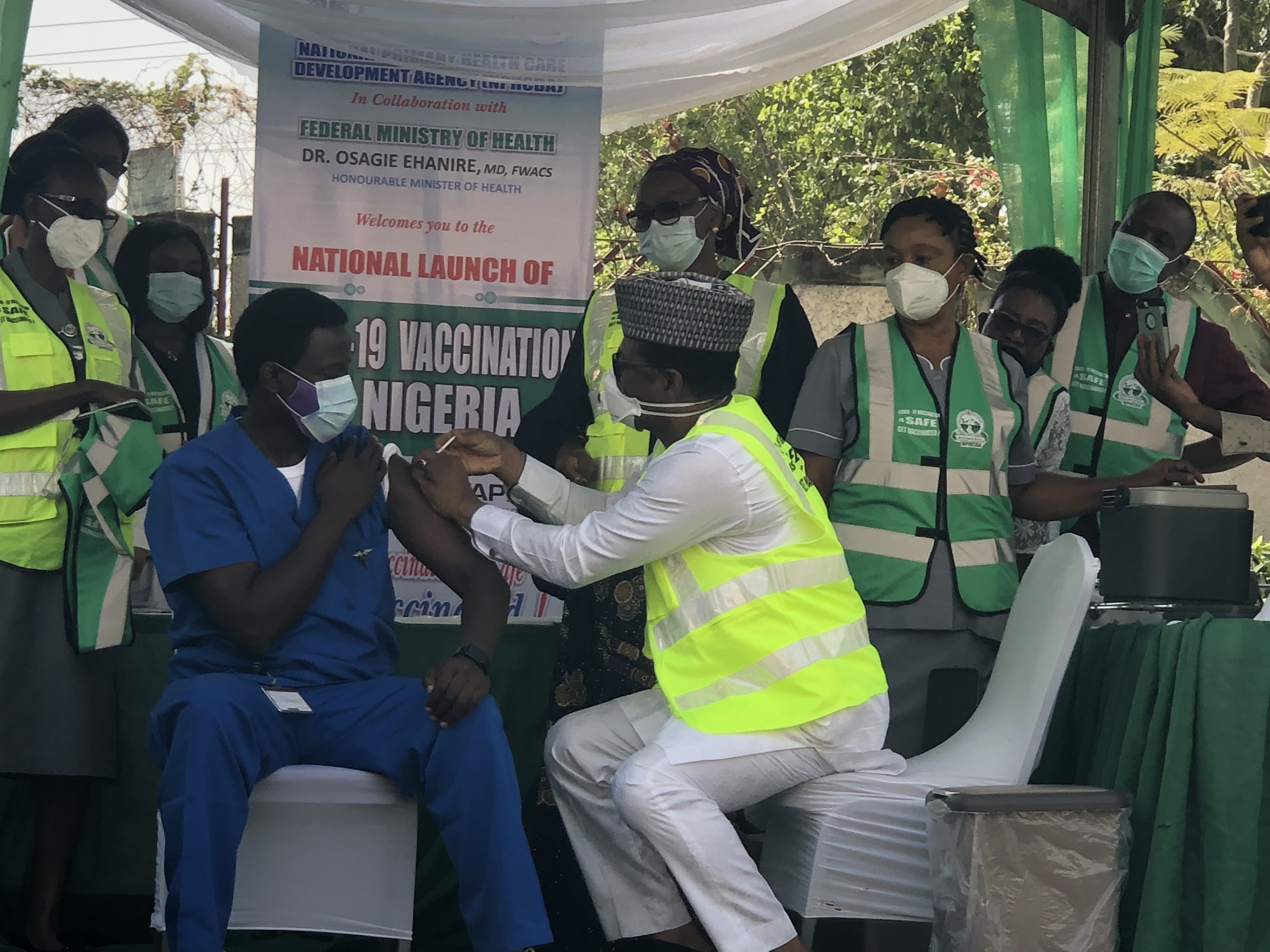
Nigeria has started to vaccinate people after receiving its first batch of COVID-19 vaccines. Virologist and senior research fellow Dr Solomon Bakarey provides some insights on how the country should go about the rollout plan.
The government hasn’t unveiled a coherent plan. How much of a problem is this?
It’s a big problem, and it’s making Nigerians sceptical about the vaccines.
Many countries, including some African neighbours, have rolled out distribution plans for the vaccines they’ve procured. But Nigerian government is yet to unveil a coherent plan.
In my view this means that the government isn’t sincere about making sure there’s equitable distribution. The consequence is that people will have doubts about the efficacy of its efforts as well as the vaccine. They might therefore be reluctant to show interest when the vaccines are made available.
This will not help the country and the international community will not take the country seriously.
What vaccines have been procured?
In early March it was announced that Nigeria had received 3.94 million COVID-19 vaccines shipped by the Vaccines Global Access facility – COVAX. These were Oxford/AstraZeneca vaccines manufactured in India. This meant that the country could begin its vaccination programme.
The government has also announced it is expecting 41 million doses through the auspices of the African Union, which is also sourcing them from manufacturers in India. And the country’s regulatory authorities, the National Agency for Food and Drugs Administration and Control, have approved the vaccines for use.
Earlier this year, Nigeria did not specify which of the three available COVID-19 vaccines – Pfizer BioNTech, Moderna or Oxford/AstraZeneca – would be procured but said it would budget for all of them. This was before considering issues such as the suitability of vaccines from a storage point of view.
The Pfizer vaccine, for example, can only be stored at -70°C conditions while the Moderna vaccine can remain stable at refrigerator temperature for about 30 days. The Oxford/AstraZeneca vaccine, due its different formulation, only needs to be kept in normal refrigerated conditions. This is better for Nigeria given the country’s erratic power supply.
What’s the rollout plan?
Nigeria plans to vaccinate 40% of its citizens against COVID-19 before the end of 2021, and 70% by the end of 2022.
The government has not released details of how this will be achieved, though it’s been possible to piece together some elements. For example, there is an online registration site which also gives details about which groups of people will be prioritised. At the front of the queue are frontline healthcare workers, those who work in high risk areas like entry points and contact tracing teams.
COVID-19 vaccination teams are also included. Others include security personnel, teachers and the elderly, especially those with co-morbidities –cancer, diabetes, asthma, HIV and AIDS, and immunocompromised patients.
The general population will follow.
What’s the role of private companies, if any?
The government clearly cannot do it alone. Any rollout will have to be implemented with the help of a wide range of organisations. To save the country’s healthcare system from total collapse in the face of COVID-19 requires the input of all.
For the moment, only government agencies can procure COVID-19 vaccines. The reason for this is that global supply is low. This makes it imperative for governments to take charge until more vaccine manufacturers produce enough to go round.
But I think it will not be long before private companies will be asked to get involved.
Private sector involvement is already happening on other fronts. For example, the government announced that it has secured the services of the private sector for ultra-cold storage facilities to help store and distribute the vaccines.
This is not new. Private facilities already contribute significantly to healthcare provision in the country. One example is the involvement of private healthcare institutions in previous federal government vaccination programmes such as child immunisations against polio and measles.
What lessons can Nigeria learn from other countries?
Nigeria can learn from the vaccination plans of countries such as the US, Canada, the UK, South Africa, Kenya and Ghana. It boils down to phasing the distribution of vaccines across different groups of the society, starting the priority lists with the most at risk population, teachers and then finally the general population.
Nigeria stands to gain a lot if it adopts their COVID-19 vaccine strategies to prevent and control the scourge. These include:
-
Having a coherent strategy to distribute the vaccines considering equitable distribution.
-
Unveiling a coherent plan for distribution and effective vaccination strategies.
-
Educating the public on the time-line for the exercise.
-
Communicating clearly to citizens about how it intends to reach the end point of the whole population being vaccinated.
Is there resistance to the available vaccines? Why?
Yes. There is distrust. This ranges from being sceptical about the government’s ability to deliver a coherent plan, and to put in place necessary modalities, all the way through to the vaccination exercise until success is achieved.
The government has disappointed Nigerians before. Ordinary citizens find it difficult to trust political leaders.
Examples abound. Take the way the government handled measures to offset the effects of the lockdown. Its efforts left much to be desired. This added to Nigerians’ doubts of government intentions.
Also, many Nigerians do not know how potent the newly procured AstraZeneca vaccine is. Some are also bothered about the speed with which things have been done – from testing to manufacturing.
The government will have to work hard if it’s going to win people’s trust.
It is trying to reduce fears by putting top officials in line for vaccinations. For example, Dr Cyprian Ngong of the National Hospital, Abuja was the first to be vaccinated. Some health workers from the hospital have also been vaccinated. So also the president, vice president and some ministers.
But it will need to do a whole lot more to win over sceptical citizens.


