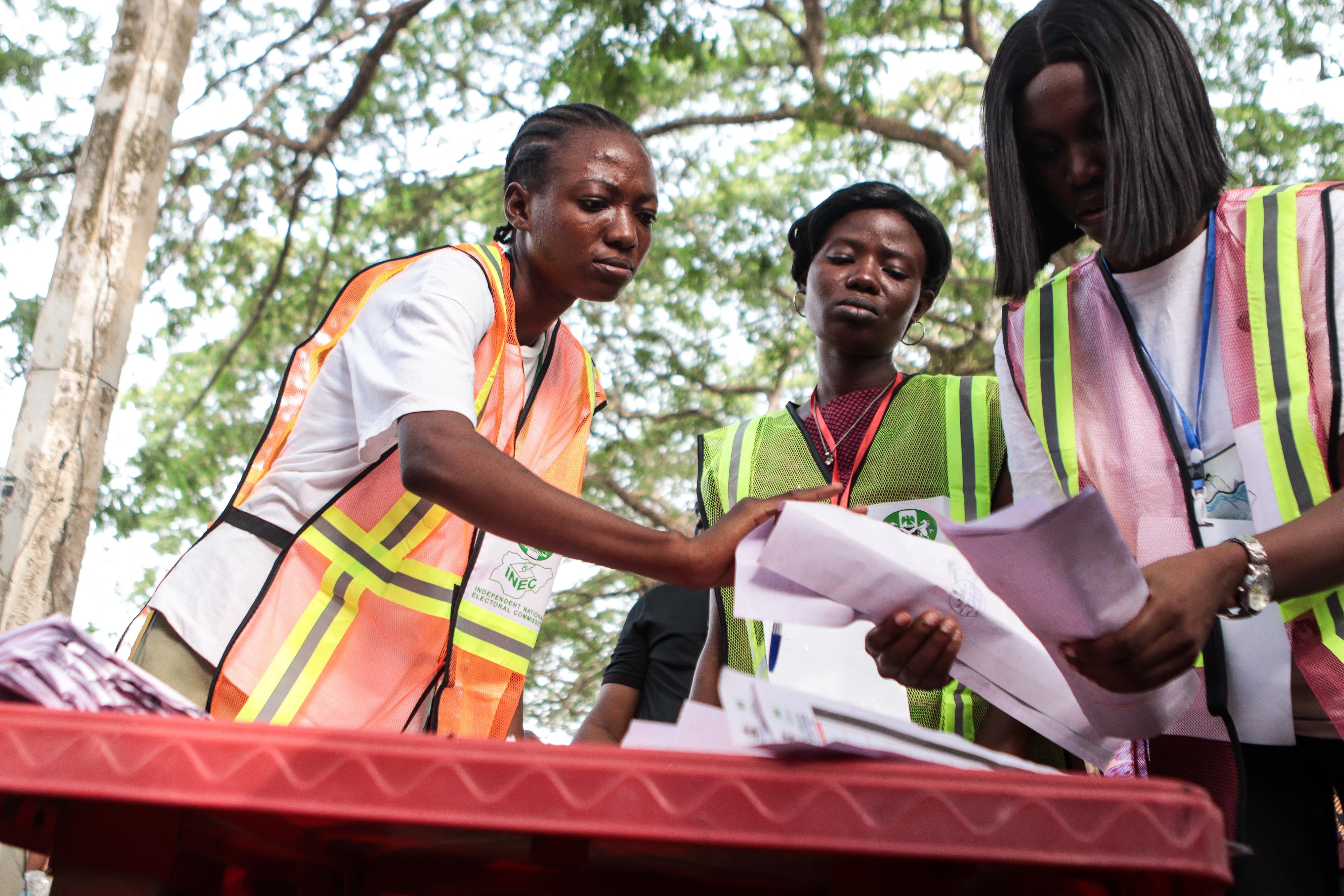
Nigerians went to the polls in late February to vote for a new president, as well as representatives to two houses of the federal parliament. The turnout was abysmal. There were over 93 million registered voters. But only a little over 25 million people voted. The Conversation Africa asked political scientist Chikodiri Nwangwu to unpack what happened.
Why was Nigeria’s voter turnout so low?
Firstly, there was insufficient voter education. Many Nigerians don’t understand the benefits of political participation, or don’t understand the electoral process. Little effort is made to explain it to them.
Although voter education is the statutory responsibility of both the electoral commission and political parties, their commitment to this task has been rather underwhelming. Many adult Nigerians – especially in remote areas where media access and literacy levels are low – lack adequate appreciation of the voting process. They also don’t know enough about political parties’ ideologies and internal workings.
Secondly, there were logistical challenges for the electoral body. Voting material was delivered late, even on election day.
Some voters got discouraged and left their polling centres because of the late arrival of materials.
Thirdly, there was a lack of confidence in the electoral commission’s capacity to conduct credible elections. This point was noted in the European Union election observer report after the election. The report says:
On election night, trust in the institution was seen to diminish due to information gaps and INEC’s failure to promptly respond to stakeholder disquiet over logistical and security lapses and later the failure of public access to presidential results on the IReV.
IReV is the online portal where polling unit-level results are uploaded directly from the polling unit, transmitted and made available for public monitoring. INEC is the country’s electoral agency, the Independent National Electoral Commission.
Fourthly, voters might have stayed away because they were scared. Nigeria has a long history of violence during elections.
Fifth is the issue of apathy. The failure to turn up could be read as a vote of no confidence in the Nigerian state. The government’s recurrent failure to arrest the country’s growing social problems, like the cash crisis and petrol scarcity, are reasons for voter apathy.
Read more: How to poll 93 million voters – the challenge of pulling off Nigeria’s presidential elections
.
How low was the turnout compared to previous years?
Voter turnout refers to the percentage of people who actually take part in an election relative to the total number of registered voters. More broadly, it compares the total number of people of voting age in a country and those who cast their ballot during a particular election. A little over 25 million voters, about 28.63% of the registered voters, turned out for the 25 February 2023 elections. Over 93 million voters were registered to vote in the elections.
Data from the election management body shows that Nigeria’s voter turnout has been declining almost every year since 2007.
Voter turnout went up from 52.3% in 1999 – the first general election since 1993 – to 69% in 2003. But it’s been on the decline nearly ever since – 57.5% in 2007, 53.7% in 2011, 43.7% in 2015 and 34.8% in 2019. This year’s is 28.63%.
Increasing voter registration has failed to translate into more voters turning out.
Bola Ahmed Tinubu of the ruling All Progressives Congress was declared winner with fewer than 9 million votes. This is 36.61% of the votes cast to govern a country with a population of 220 million people.
Read more: Bola Ahmed Tinubu: The kingmaker is now Nigeria’s president-elect
.
What can be done to turn the tide?
The Independent National Electoral Commission and political parties should be more committed to educating the voting public on the importance of participating in politics.
Competent logistics companies should be used in the delivery of sensitive voting materials instead of an approach that has proved to incubate electoral disenfranchisement and voter apathy.
Relevant security agencies should be more proactive and intelligence-driven in quelling political thuggery and electoral violence.
Further, the electoral commission should deal firmly with politicians who aid political violence in Nigeria. Above all, the government should be unmistakably committed to delivering democratic goods to regain public trust and confidence in electoral processes.
Lastly, there should be a proper audit of the voter register. This has never happened, and in my view the register is largely inaccurate. The increasing use of voter accreditation technology since 2015 has shown that figures for previous voter turnouts are inaccurate. The new technology has thrown up attempts at fraud and the manipulation of registration processes.
Given the lack of an audit, it would not be surprising if the current register contained names of those who have died and other ineligible voters.


