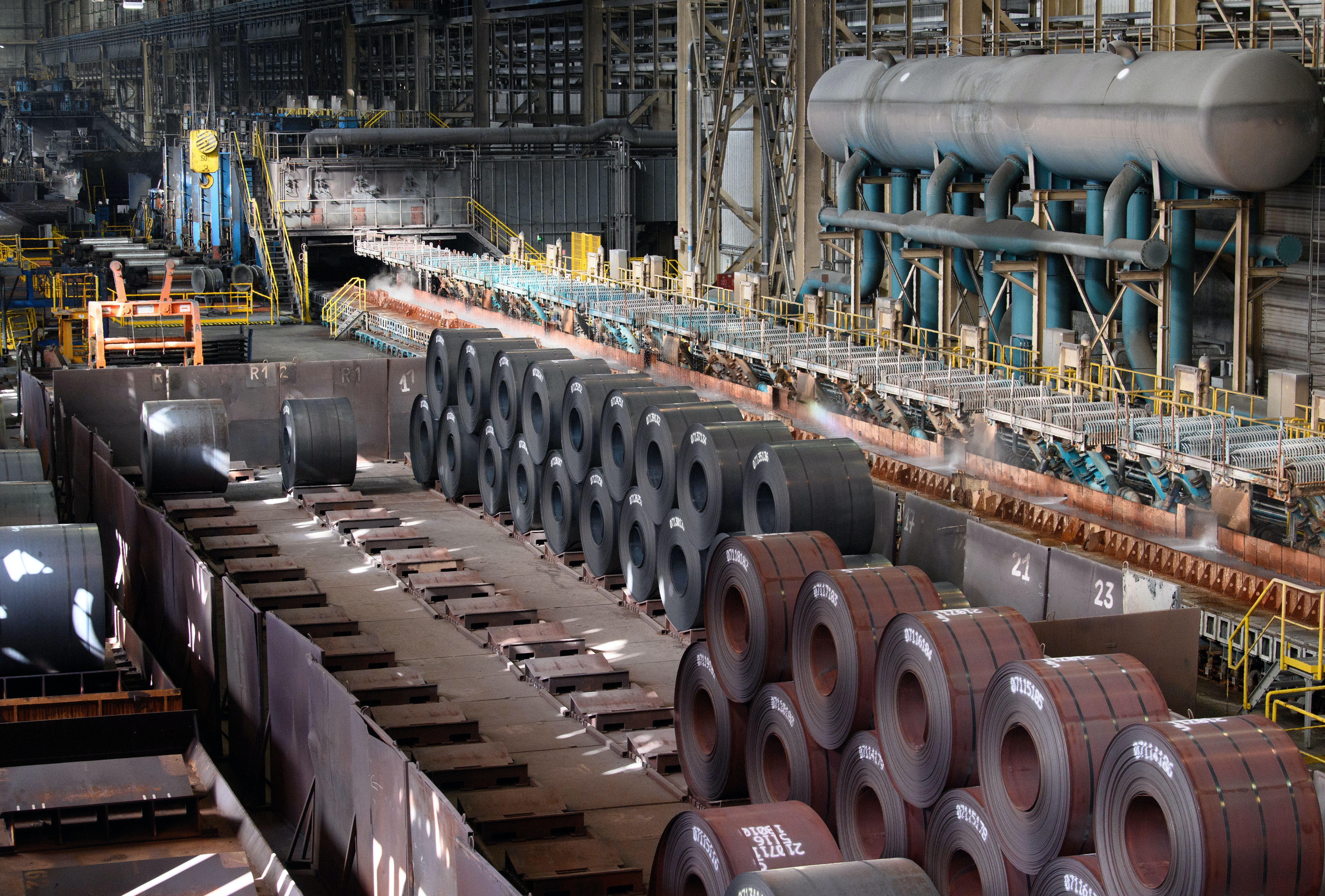
Nigeria has pumped more than US$8 billion into Ajaokuta Steel Company, a project which began more than 40 years ago but has yet to produce one tonne of steel.
Several attempts have been made to bring the plant into production, but without success. It was built to 98% capacity by the Soviet Union’s Tyazpromoexport. But the lack of a rail line around the plant, and changes in political and operational management over the years, stymied completion.
Bilateral discussions in 2019 raised the possibility of Russian funding to resuscitate the steel plant, but the COVID-19 pandemic and the Russia-Ukraine crisis may have stalled any unofficial agreements.
Another problem for the plant is that some of its installed equipment may have been corroded and degraded by now.
Steel corrodes quickly in acidic environments. Consumer-grade steel and other iron-rich metals can develop iron oxide (or rust) after just four or five days of exposure. Corrosion of parts has been reported by a team of Nigerian and Ukrainian experts auditing the plant.
Still, the Nigerian federal government is now having yet another go. It is looking for a core investor that can get it running profitably on a concession basis.
The cost of revamping the steel company was put at $1.4 billion in 2020.
Instead of concessioning, we propose remanufacturing as a way of rescuing the plant. Remanufacturing is an industrial process whereby used or broken down products or components are restored to useful life.
Based on our research, we argue that remanufacturing’s economic, social and environmental advantages would solve the Ajaokuta Steel Company Limited problem, make it competitive, meet contemporary demands of sustainable manufacturing and get it operational.
Nigerian demand for steel
Ajaokuta Steel was conceived in 1958 to meet Nigeria’s steel demand and launch Nigeria’s and West Africa’s manufacturing sector. The idea of a large-scale national steel production plant was based on the argument that no country could talk about power status or the defence of national interests without its own steel industry.
Nigeria had a fast growing population, with rising demand for manufactured goods. A number of manufacturing industries sprang up in the 1960s and the 1970s. Local demand for steel products was about 3.5 million tonnes a year between 1985 and 1995, the bulk of which could only be met through imports.
The manufacturing industry grew from 9% in 1985 to 19% in 1995, encouraging government’s industrialisation drive.
Challenges of concessioning
As to how to meet that demand, a concessioning agreement for a steel plant presents some key challenges.
Although the concession may put the steel plant into the hands of a competent investor, it is only for 10 years. Then legal challenges may arise. The most recent operator, an Indian company called Global Steel Holdings Limited, had its 10-year concession agreement revoked by the Nigerian government and the matter ended in an out-of-court settlement in 2016.
A concession agreement with foreign operators cannot guarantee the involvement of local human resources, which Nigeria’s manufacturing desperately needs.
Remanufacturing inputs
A major challenge of reviving the Ajaokuta Steel plant is that much of its equipment is in a broken-down state.
We argue that remanufacturing could restore the equipment and get it working. It could also develop the local capacity for remanufacturing among Nigerians.
Remanufacturing is an industrial process of steps that make make a used product as good as new. It is a key circular economy strategy.
Broken-down parts are referred to as “cores”. They are passed through a number of standardised remanufacturing operations – inspection, sorting, disassembly, part reprocessing or refurbishment, reassembly and testing – to ensure they meet product standards.
The resulting output is a product which meets or exceeds the quality and performance standards of a newly manufactured product.
Studies suggest that remanufacturing can save up to 50% of the cost of a newly manufactured product, 60% of the energy, 70% of the material and 80% of the air pollutant emissions.
Remanufacturing is labour intensive, so it can support new jobs and other jobs in the supply chain, such as transporting cores from the original manufacturers or disposal site to the remanufacturer’s site.
The UN Environmental Programme has studied how remanufacturing can retain value, finding that it can reduce new material requirements by between 80% and 98% and increase skilled labour hours by up to 120%.
Nigeria does engage in some remanufacturing, for example remanufacturing of medical devices, but it is largely unorganised and driven by small, independent operators.
What makes remanufacturing ideal for Ajaokuta
For remanufacturing to happen, cores must be available. It must be possible to disassemble the cores. And there must be labour and access to customers.
We have assessed the challenge with the Ajaokuta Steel Company Limited and concluded that the barriers to remanufacturing can be overcome.
First, the broken-down components in the steel facility form the remanufacturing cores.
Most of these mechanical components (gearboxes, conveyor belts, cranes, blast furnace) can be disassembled and remanufactured.
The steel plant would serve as the original equipment manufacturer (and customer) and a supply route could be created using the road networks around Ajaokuta, where the plant is located. A long term transport system should include a rail line to enable access to coal sites, for instance.
Nigeria has a young population which could provide the unskilled and skilled labour for remanufacturing.
How to revive the steel plant
For effective engineering management, we propose that Tyazpromoexport, the Russian company that first installed the Ajaokuta Steel plant, should work with Nigerian engineers to remanufacture the plant. The same company has successfully installed steel plants in Egypt, Algeria, Pakistan and India.
We recommend the following broad steps:
- audit and assess worn-out and broken-down components
- determine what can be remanufactured and at what cost
- assess supporting stakeholders: independent remanufacturers, local routes, raw materials, facilities and labour
- remanufacture identified parts
- procure parts that can’t be remanufactured
- install remanufactured and newly procured parts.
We understand that Ajaokuta Steel Company Limited faces other challenges. They include the politicisation of the steel project, the Russia and Ukraine crisis and the resulting geopolitical fall-out.
However, with over $8 billion already invested, zero production and the corroding of the facility, there is a need to urgently revive the steel complex.
Remanufacturing presents an excellent opportunity to resuscitate it in a green, efficient and sustainable manner.


