Since gaining independence on 1 October 1960, Nigeria has struggled to maintain a democratic government.
The election of 1999 offered renewed hope after a series of military coups and periods of generals in uniform running the country.
More elections followed over the years. Holding elections is a commonly accepted feature of democracy, along with having an informed electorate and protecting basic human rights.
My doctoral study explored Nigeria’s (and Senegal’s) progress with consolidating democracy between 1999 and 2012. As a researcher on elections and democratisation a key question that’s emerged for me is whether democracy has led to development in Nigeria.
Democracy and development
The dominant perspective in the literature is that there’s a strong correlation between democracy and development. In most developed democracies, it is assumed that democracy and economic development are linked.
But in fact the impact of democracy on development is not linear. There is growing evidence that development can occur in both democratic and non-democratic states.
There is therefore a need for caution in correlating democracy to development. The freedom of choice and political pluralism offered by democracy may not necessarily translate to improving material conditions. Empirical evidence also suggests a weak link between democracy and economic growth.
There are conscious efforts by African countries to embrace democracy as a form of government that will strengthen development. Botswana and Mauritius are good examples. In both, democracy has been pinpointed as one of the main reasons for economic growth.
Others on the list of countries that have advanced their democratic practices and achieved development outcomes are Ghana, the Seychelles and Cape Verde.
But democratic countries like Lesotho, Senegal and Madagascar all score low on human development. In 2019, 73.2% of Madagascar’s population lived on less than US$1.90 a day. For Lesotho it was 36.4% and Senegal 29.7%.
Countries such as Namibia, Tanzania and Zambia conduct regular elections. Yet they are underdeveloped. And despite periodic elections Niger, Chad, Guinea, Burkina Faso, Sierra Leone and Burundi score low on development indices.
Nigeria’s experience
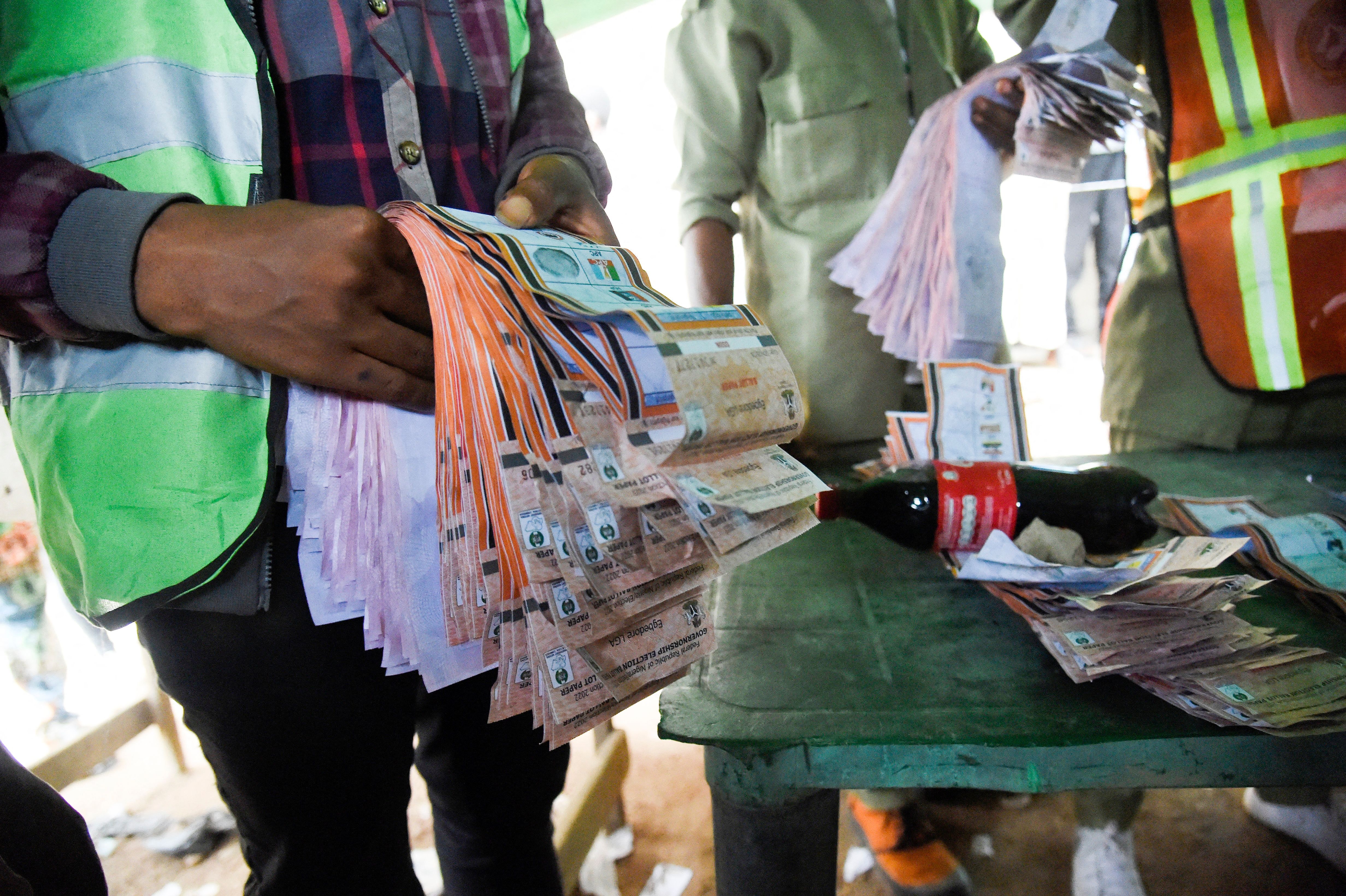
Nigeria has shown signs of consolidating its democracy. It has held elections in 1999, 2003, 2007, 2011, 2015 and 2019 without an interruption of the electoral cycle. The regularity of the electoral cycle led to the first electoral turnover in 2015, when the incumbent President Goodluck Jonathan handed over power to Muhammadu Buhari after a peaceful electoral outcome.
But Nigeria is yet to attain the desired economic development despite its democratic practice since 1999.
Nigeria faces acute poverty, youth unemployment, institutional corruption and widespread insecurity.
A 2022 World Bank report stated that:
as many as 4 in 10 Nigerian live below the poverty line.
Tens of millions Nigerians cannot access education, basic infrastructure, safe drinking water and healthcare service as a result of poverty. Poverty has been further worsened by climate change variability and the recent COVID-19 pandemic.
Nigeria was ranked 163 in the Human Development Index for 2020 and 2021 out of 189 countries. It compares badly with other countries like Mauritius, Seychelles, Egypt and Tunisia.
The low development index is related to the fact that about 40% of the Nigerian population (about 83 million people) still live on less than US$1 dollar a day.
What’s gone wrong?
In my view there are two issues that have stopped Nigeria translating its democratic dividend into better economic outcomes.
The first is poor quality leadership. The second is weak institutions. This has led to poor governance, corruption and insecurity.
Without strong and ethical leadership, institutions are weakened and the established culture of democracy frequently withers. Democratic culture is a set of values, attitudes, and practices shared by citizens and institutions, without which democracy cannot exist.
Democratic culture is missing because of the enduring legacy of military and authoritarian rule. Democratic institutions such as parliament, political parties and the judicial system are still affected by this legacy. They have become less reflective of citizens’ demands. And they have become corrupt.
Nigeria has been ranked as one of the most corrupt countries in the world. It is ranked 154 out of 180 in the Transparency International Perception Index.
The ruling elites frequently reserve government appointments and contracts for cronies without due process and merit. Some political leaders have been convicted for corruption. At the same time the rule of law and constitutionalism are at a low ebb.
Security has waned due to Boko Haram insurgency and bandits. Agitations by groups seeking self-determination are also on the rise.
How can democracy work better for Nigeria’s citizens?
I discovered that 23 years of democracy in Nigeria are an illusion of democracy and development. There are issues of leadership, weak institutions and governance, acute corruption and insecurity.
These should be tackled by electing developmental and transformational leadership whose vision is anchored on democratic culture and collective national interest rather than politics of self-enrichment.
Nigeria should strengthen democratic institutions and improve governance for economic development. I think if the security architecture is strengthened, democracy and development will thrive.
Similarly, the country needs an intense effort to transform and diversify the economy through human capital and infrastructural development. This will address the problem of corruption, poverty and unemployment.


