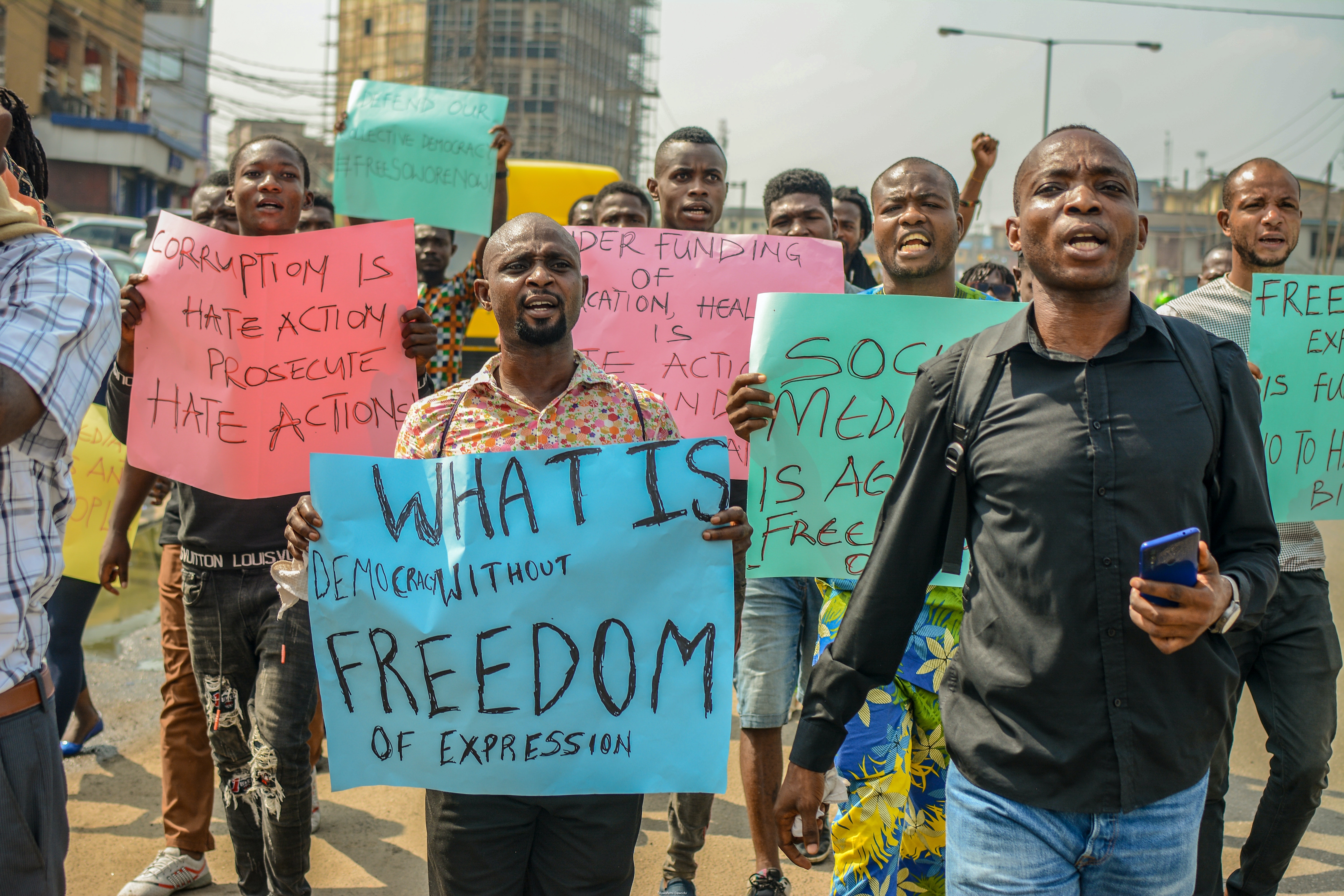
In early June, the Nigerian government announced that it had banned the use of Twitter in the country. This followed the media platform’s decision to delete a tweet by the Nigerian president, Muhammadu Buhari, on the grounds that it violated the platform’s rules.
The Attorney General of Nigeria, Abubakar Malami, vowed to prosecute violators of the ban, a threat that he later recanted.
This raises the question of whether the ban is legal. In my view it isn’t. Under the current constitutional dispensation, the Nigerian government lacks the legal competence to unilaterally ban twitter or prosecute violators of the ban.
It is possible for the Twitter ban to be pressed into one or two of the permissible grounds of limitation under section 45 of the Nigerian constitution. However, examination of the facts surrounding the ban show that, at the very least, the ban fails the test of legality. For one, it was announced by the country’s Minister of Information at a press conference rather than being effected through a law of general application as required by Section 45 of the 1999 Constitution.
In this article, I interrogate the limit of governments’ regulation of border-less technology companies in Nigeria. I discuss the legal issues arising out of the ban. I also set out the importance of the right to freedom of expression, the right most implicated by the ban, and the scope of its protection under Nigeria’s legal framework.
Impact of the ban
The ban has serious implications for the political, economic and social wellbeing of Nigerians. At the political level, many see the decision as an attempt to gag the media as well as ordinary citizens. This does not bode well for human rights and democracy in Nigeria.
In a democratic state, freedom of expression is central to political rights and the basis of all freedoms. In Nigeria, democracy and freedom of expression is enshrined in the country’s 1999 constitution. This means that sovereignty belongs to the people. It also means the people have a right to participate in the government and governance.
At the economic levels, reports indicate that about 39 million Nigerians have twitter account. Many use the platform for businesses and networking. The ability of this category of people to make a decent living will be gravely affected.
It has also been predicted that the ban will affect foreign investments in Nigeria’s technology sector.
At the social level, Nigeria is already in the doldrums of insecurity and criminality. The ban is bound to fuel civil discontent, increase unemployment and exacerbate the already fragile security situation in the country.
The legal question
The right to freedom of expression, like most other rights in Nigeria’s 1999 Constitution, is not absolute. The freedom of expression provisions of the constitution contain clauses which set out when the right can be derogated or restricted.
First is the prevention of disclosure of information received in confidence, the maintenance of the authority and independence of courts, the regulation of telephony, wireless broadcasting, television or the exhibition of cinematograph films.
The second is the imposition of restrictions on the freedom of expression of public office holders at the federal or state levels, members of the armed forces or Nigeria Police Force or other government security services or agencies established by law to keep official and state secrets.
The reading of the permissible grounds for limitation contains no colour or shade of authority to ban Twitter in Nigeria.
There is also the general limitation clause in section 45 of the Nigerian constitution. The section allows fundamental rights to be limited in the interest of defence, public safety, public order, public morality or public health. It also permits limitation of fundamental rights to protect the rights and freedom of other persons.
This limitation must, however, be by “a law that is reasonably justifiable in a democratic society”. And it requires three conditions.
First is the requirement of legality – there must be a law of general application authorising the limitation.
Second, is the requirement of proportionality. This means that the means or methods employed to limit rights must be proportionate to the objectives of the limitation.
The third is one of necessity. That is the least restrictive or invasive means or methods must be employed to achieve the objectives of limitation.
Weak grounds for prosecution
Government is on an even weaker footing when it comes to arresting and prosecuting violators of the ban. Section 36 (8) and (12) of the 1999 Constitution is very clear on this. It states that no one can be held guilty of a criminal offence as a result of any act or omission that did not amount to an offence under any law at the time the act or omissions was done.
Under section 36 (12), no person can be convicted of a criminal offence unless that offence is defined and the penalty prescribed in a written law.
Essentially, no act or omission can amount to an offence under the current constitutional dispensation in Nigeria in the absence of a written law. After a perusal of the existing law, one is hard pressed to find any law specifically proscribing the use of twitter or VPN in Nigeria.
It is therefore no surprise that the Nigeria’s Attorney General recanted his earlier threats to arrest and prosecute people, although he still insisted that the Nigerian government would deal with any Nigerian company or entity that helped twitter escape the ban.
The Twitter case has exposed the governments vulnerability in unilaterally regulating or trying to police social media platforms that don’t have borders or frontiers. In addition, the impact of the ban on the political and socio-economic lives of the people is likely to be severe.
My view is that the Nigerian government should try and resolve its differences with Twitter and open up the civic and digital space. This will allow for the much needed dialogue for a more stable and prosperous Nigeria.


