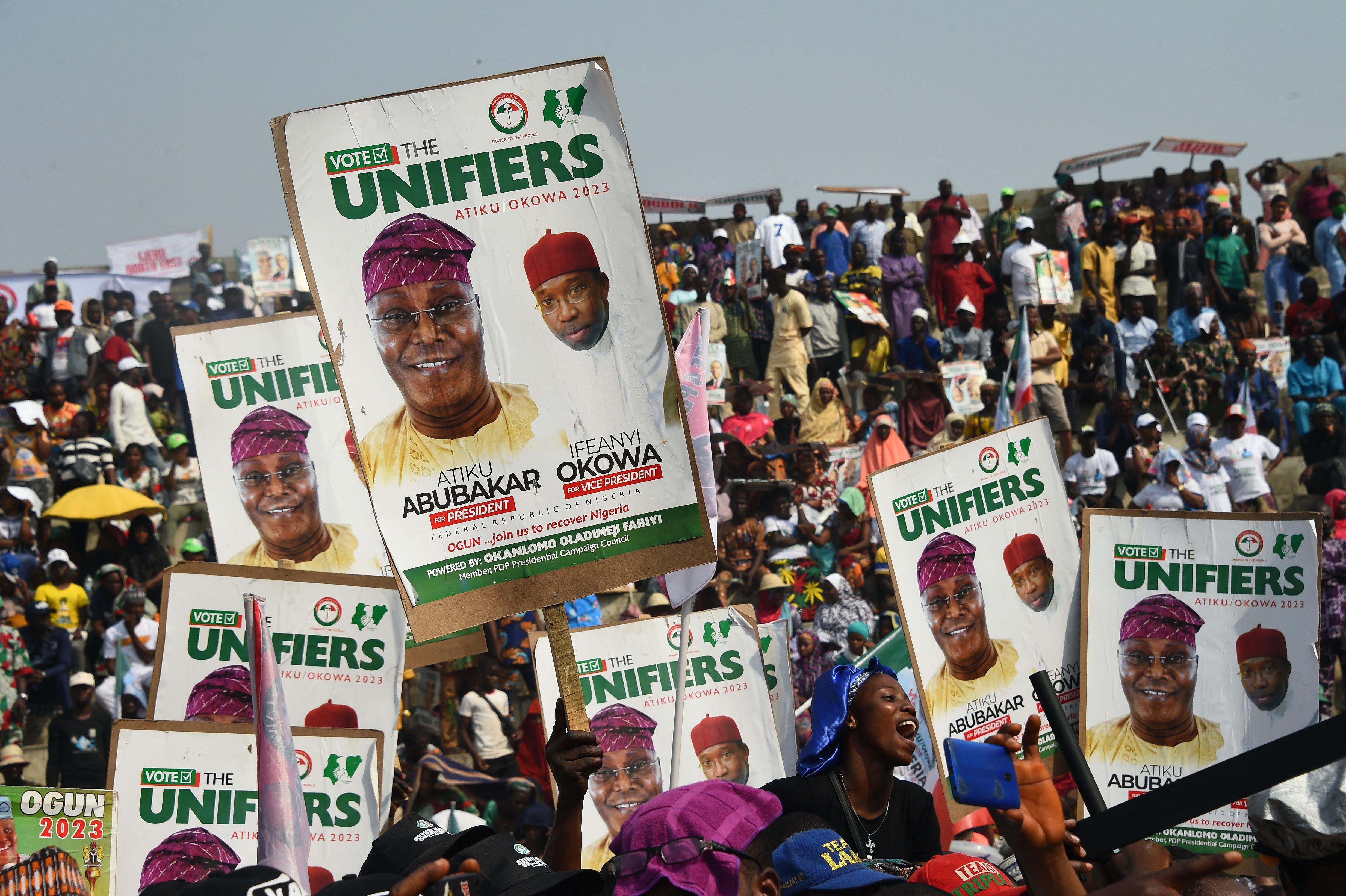
One of the issues that has generated great concern among voters in the run up to the Nigerian presidential elections is religion.
Many Nigerians see the mixing of religion and politics as an impediment to progress and development. This idea can be traced to Europe. The Middle Ages were a time when religious authorities and political authorities clashed in European states, resulting in instability. The need to separate religion from politics thus became normalised in western political thought by the early 20th century. Over the years the idea found its way into other societies.
Recent studies have shown that, in fact, the relationship between religion and politics isn’t always unproductive. Religion embeds some doctrines such as love and obedience to political authority that support secular authorities and the development process. And religious authorities and their followers have the capacity to be tolerant.
Still, the experience in multi-religious societies where religious communities vie for resources and power does point to some dangers for peace, development and democracy.
This has become apparent in the build up to Nigeria’s 2023 presidential elections. For instance, the Christian Association of Nigeria and the Northern Christian Elders Forum have cautioned against the nomination of Muslim vice-presidential candidates by the All Progressives Congress and the Peoples Democratic Party.
Religious bodies’ interest in who wields the power of the state is not out of place. But the extent of their intervention can portend serious dangers for the state.
These dangers have severe implications for the election and its outcome. The legitimacy and power of the state could be challenged. Religion claims to be based on divine authority, which it considers to be superior to that of the state. This threatens the state’s legitimacy, given that its authority derives from the people and the constitution.
Six dangers
Religion’s inroads into politics in Nigeria aren’t new.
Since the return to democratic governance, religion has influenced how state power is captured. This can be seen in the political statements of religious institutions, their choice of candidates and the inclination of candidates to turn to their religious communities for support.
The trend continues in 2023, with slight variations.
Firstly, leading candidates have appealed to their faith communities, as in the past. Perhaps what is new comes from the All Progressives Congress candidate, Bola Tinubu; he is a Muslim and his wife a Christian. Rather than appealing to one faith community, Tinubu is seeking support from two. Normally, this should promote religious tolerance. But a religiously diverse family that controls state power might not be immune from competition for influence from each religion.
Secondly, there has been an outcry from some quarters about the fact that the ruling All Progressives Congress is presenting voters with a “Muslim-Muslim ticket.” The party’s presidential and vice-presidential candidates are both Muslim.
The last time this happened was in 1993. In that poll Nigerians overwhelmingly voted for Moshood Abiola and Babagana Kingibe – possibly because Abiola broke through the religious divide through philanthropy and business investments. Today, having a similar ticket is risky.
Thirdly, fuelling the anger about the Muslim-Muslim ticket is the escalation of terrorist attacks by Boko Haram in north-east Nigeria. Both Muslims and Christians have been victims of the terror. But the popular impression among Christians is that they have been the most targeted for persecution and Islamisation.
Fourth: religion is a way of life for many people in Nigeria. It has a direct impact on their social and political decisions. The danger here is that a religious community could insist on voting one of their own members into office even though the candidate is generally considered to be a misfit.
The fifth danger is that inter-religious conflict could be ignited if one religious group rejects the candidate of another, or if a politician mobilises his religious community against his opponent in another religion.
Religion could also be used to mobilise ethnic support against political competitions from other groups. Nigeria is not only multi-religious but also multi-ethnic. The country has witnessed many incidents of conflicts along ethno-religious line. The civil war of 1967-1970 was the most catastrophic.
Lastly, there’s the threat that citizens could be excluded from the political process. If a religious community, by virtue of numbers, is allowed to dominate the political space, it could prevent minorities from having a say and being represented in government. Nigeria has substantial numbers of indigenous religious practitioners and a growing atheist community. Any of them might feel excluded by the dominant Muslim-Christian politics.
Mitigation strategies
One way to mitigate these threats is for the constitution to properly define the position of religion in the electoral process.
The Nigerian public and the political parties have worked out a temporary system called “religious balancing.” With this informal system, a Muslim candidate stands for election with a Christian deputy, and vice versa.
But this time the ruling party is fielding two Muslim candidates for the upcoming election. The constitution needs to address the issue. It recognises the religious diversity of Nigerians but is silent on the religious identities of political office holders.
It is also important to incorporate the leaders of a variety of religious communities into government and political parties. Religious leaders can educate their followers to support any politician irrespective of their religious differences.
Religious tolerance is also necessary. Tolerance promotes inter-religious understanding, which in turn helps people to respect each other’s political choices.
Mixing religion with politics does not bode well for the ongoing tension in many parts of the country. These tensions could seriously damage the already fragile Nigerian state.


