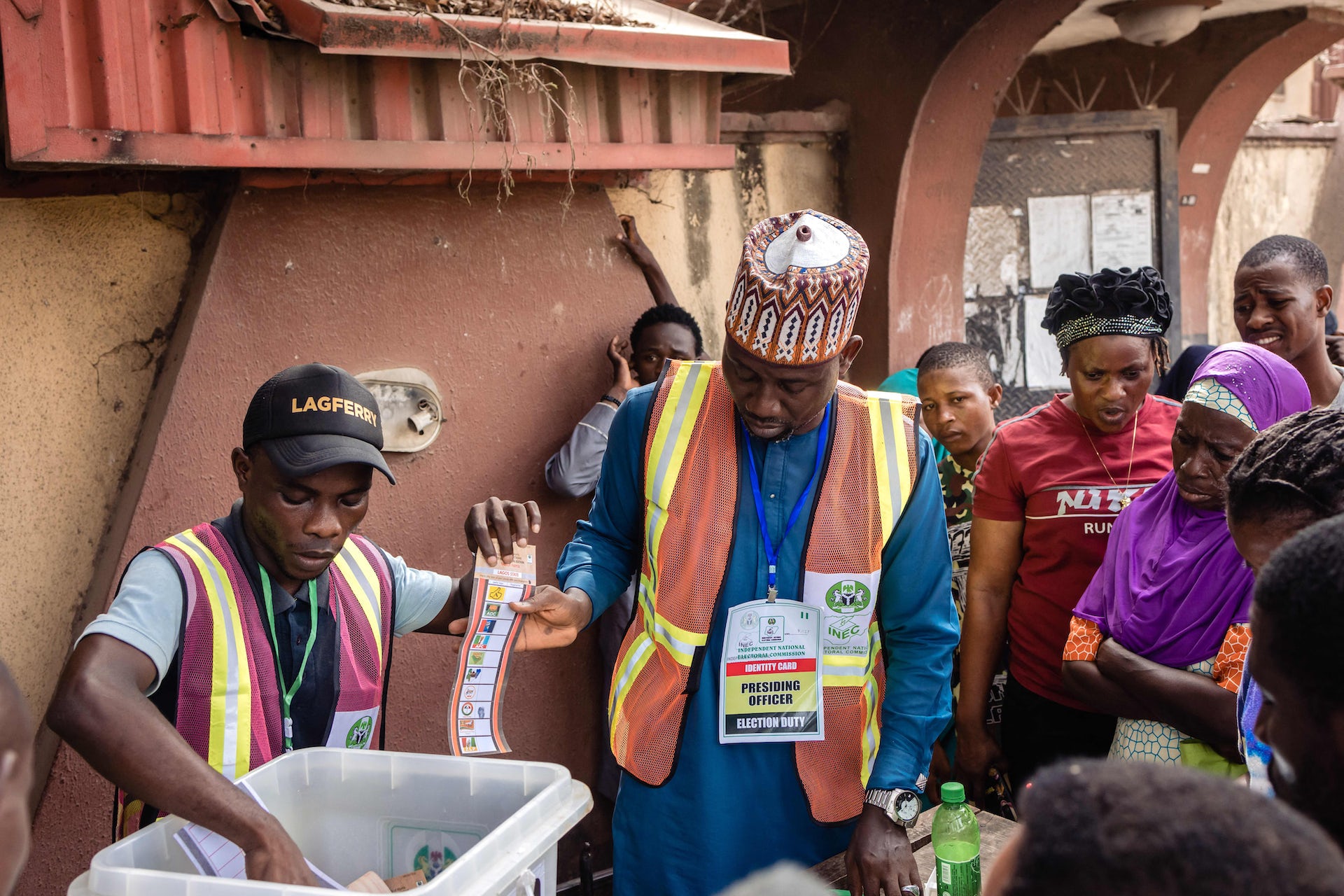
Nigerians will see their new president-elect, Bola Tinubu, sworn in late May. A number of court cases are still being pursued against the election outcomes from votes cast earlier this year, but these aren’t expected to affect the inauguration.
As a political scientist who studies elections and observed the elections, I believe there are five takeaways from the elections that need to be addressed before the next general elections in four years’ time.
These are the persistence of violence ahead of, and during, polling; the suppression of people’s right to vote; ethnic tensions; a low turn out; and that Nigeria needs to accept that technological advances won’t fix the flaws in its electoral process.
Electoral violence has not gone away
Nigeria’s elections are still prone to violence. Nigeria has a long history of violence during elections and it sadly manifested again in 2023. A newspaper puts deaths from the 2023 elections at 39 while the European Union at a media briefing claimed 21. Official figures have not been released by either the police or the electoral commission.
Violence marred the elections in parts of the country: Lagos, Delta, Kogi and Kano States. Violence was also recorded in Enugu and Ebonyi States. The EU election observation mission also noted how violence disturbed voting in some areas.
In Enugu, the Labour Party senatorial candidate for Enugu East was killed 72 hours before the February elections.
Read more: How to poll 93 million voters – the challenge of pulling off Nigeria’s presidential elections
.
Voters’ suppression was the name of the game
Closely related to violence was suppression of voters. Also known as deliberate disenfranchisement of eligible voters, this is a strategy designed to influence the outcome of an election by discouraging or preventing voters from voting.
The increased use of technology in Nigerian elections has reduced the kind of rigging that was traditional; such as ballot box snatching and stuffing, multiple voting, over voting, alteration of results, and other related electoral malfeasance.
From the first republic – 1 October 1960 to 15 January 1966 – rigging has characterised elections in Nigeria. A similar thing occurred in 2003 and 2007 elections. Alternatively, some Nigerian politicians have resorted to voter suppression to undermine their political rivals. This happened in the governorship and state assembly elections in Lagos State. Voter suppression was also recorded in Abia, Borno, Delta, Edo, Enugu, Kaduna, Kano, Kebbi, Kogi, Nasarawa, Ogun, Sokoto, and Rivers States.
Ethnic politics on the rise
The elections further heightened ethnic resentment and tension, especially in Lagos State. Ethnic politics has been a bane of Nigeria politics for long.
The Labour Party, a relatively unpopular party, defeated the ruling APC in Lagos State during the 25 February presidential election. The party had only one governor who won after appeal in 2009 before 2023 elections.
Though Lagos is cosmopolitan, the Labour Party is perceived to be largely Igbo and this led to attacks on some of its members in Lagos.
Some APC members like Musiliu Akinsanya threatened Igbo voters in Lagos State. Akinsanya is the chairman of Lagos State Parks Management Committee, a Lagos State agency. He is also an associate of the president-elect, Bola Tinubu.
Read more: Nigerian elections: 5 major challenges facing the country’s next president
.
Low voter turnout
While over 93 million voters registered, only a little over 25 million voted in the presidential election.
Voter turnout refers to the percentage of people who actually take part in an election relative to the total number of registered voters. Although the 18 March state-level polls were more localised elections expected to heighten voters’ eagerness to participate in the process, the reverse was the case as voter participation further dipped compared to the February presidential election across Nigeria. While the official figure of the total votes cast is still being awaited, media reports show that the 18 March elections were characterised by lower turn out.
The one week postponement of the election due to the reconfiguration of the Bimodal Voter Accreditation System used in the presidential elections for the governorship elections could have also dampened prospective voters’ enthusiasm.
In an earlier article, I identified five reasons why the voter turnout was low. Insufficient voter education and logistical challenges were some of the reasons.
Technology is not enough
The outcome of the elections showed also that the deployment of technology is not enough. While voter accreditation was largely carried out with the Bimodal device, the electoral commission’s failure to carry out real time transmission of the presidential election results created room for alleged result manipulation. Despite the electoral body’s assurance that its decision to deploy the Bimodal Voter Accreditation System for voter accreditation and real time transmission of results to its result viewing portal was irreversible, the latter was disregarded. While the accreditation system was used, results were not transmitted to the viewing portal. It is not surprising that this is one of the issues before the presidential election tribunal in a petition filed by the Labour Party.
Conclusion
Conscientious effort should be made to arrest the unpalatable outcomes of the 2023 general elections. Perpetrators and financiers of electoral violence should be arrested and diligently prosecuted in order to deter others who see violence as a viable pathway to electoral victory. Political leaders should also tone down their vitriol to whittle down the charged political atmosphere that is capable of rail-roading Nigeria to the 1994 Rwanda experience.
The electoral body should stick to the provisions of relevant electoral laws on balloting, collation, tallying, transmission and announcement of results in order to boost voters’ confidence in the electoral processes.


