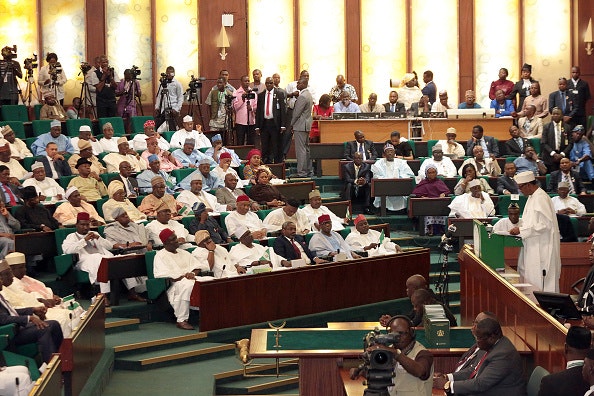
Nigeria has very few women participating in politics. Only seven out of 109 senators and 22 of the 360 House of Representatives members are women. And only four out of 36 deputy governors are women. The country has never had a woman state governor. To create gender balance, the country’s lower house – the house of representatives – is planning to create an additional 111 seats for women at the country’s national assembly. Ogechi Ekeanyanwu, from The Conversation Africa, asked Damilola Agbalojobi, political scientist and gender specialist, for insights.
Will creating additional seats for women make a difference?
Quota systems provide opportunities for more women to stand for election, help women pull down barricades between them and the public, and give political parties incentives to target women’s votes. But they’re not enough.
Electoral quotas fall into three broad categories: party quotas, legislative quotas and reserved seats. Party quotas are the measures voluntarily adopted by political parties to make room for a certain proportion of women among their parties’ candidates. Legislative quotas are measures passed by national parliaments requiring all parties to nominate a certain proportion of female candidates. Reserved seats policies make room for women in political groups. The goal of this system is to ensure a minimum representation threshold is met.
So, if we go by what some countries have done, reserved seats could be seen as a good way to get more women into politics or elected positions. Rwanda and France are good examples. In 2003, Rwanda adopted a new constitution that reserves 30% of parliamentary seats for women and requires political parties to ensure that women hold at least 30% of elected internal positions. France and 48 other countries have statutory quotas or reserved seats for women.
As at 2020, most African countries have at least one gender quota in place, including 13 countries that reserve specific seats for women in parliament as opposed to legislated candidate or political party quotas.
And as at 2021, 26 countries around the globe had reserved seats in the lower or single house.
I don’t consider the creation of additional seats an efficient way to get more women into politics. At face value, it is a way to save women the challenge of having to compete with men for the existing seats. In reality, it is crucial to adopt distinct approaches that deal with the underlying barriers women face in conducting successful campaigns and getting elected.
Read more: Nigeria has few women in politics: here’s why, and what to do about it
The interconnected barriers include lack of trust among women, the fear of success or rejection, fear of popularity, violence inherent in politics and importantly, the entrenched, obnoxious sociocultural structures and patriarchy.
All these need to be tackled to ensure that women get into office. If these challenges are not dealt with, the seats will be available and there will be no women to occupy such positions.
Many scholars have identified quotas as viable tool to increase the selection and election of women. For instance, one study found that quota systems fast tracked gender parity.
However, there is a school of thought that believes it is important to look beyond numbers and to assess the impact of an increased number of female representatives on political outcomes, which will help us see whether only numerical increase is the solution.
What would be a better strategy?
A better strategy is to ensure that within the existing system and the number of seats available, electoral gender quotas are implemented to make room for a particular percentage of women. In Spain, for example, there is a legal requirement for candidates presented for electoral position to comprise at least 40% of each sex. Mexico also has a voluntary quota system that consists of at least 40% of the same gender at the party level. It also has legislated quotas at the legislative level.
I consider creating additional seats for women to exclusively occupy inferior to ensuring that within the existing seats, women are given a minimum number of seats to occupy.
Can Nigeria afford an even larger National Assembly?
No. Not at the moment. The addition of more than 100 seats means that the Nigerian legislature of 360 will match or rival its counterparts in much larger economies such as the US, Germany and Canada. Also, Nigeria has the second highest paid legislators in the world.
The exorbitant costs incurred by parliament and government as a whole contribute to a situation in which running costs are higher than the development expenditure. There has been a rising public clamour for the reduction in cost of governance to shore up the struggling economy.
It would be unrealistic to create more jobs at the top at a time when ordinary citizens are being forced off their jobs or have none at all.


