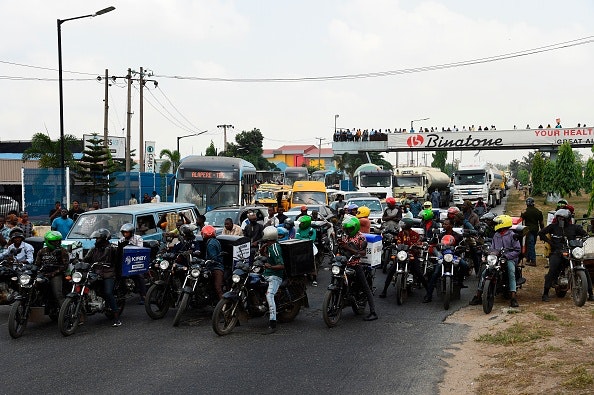
Lagos has witnessed a growing number of commercial motorcyclists in recent times, transporting people and goods in and around the state. Many of these operators moved in from northern Nigeria, where authorities banned the use of motorcycles – notoriously used by Boko Haram insurgents, bandits and kidnappers to carry out attacks. In Lagos, these motorcyclists – popularly known as okada – aren’t always popular and face periodic restrictions. Ogechi Ekeanyanwu of The Conversation Africa spoke to Chidi Nzeadibe, an urban development policy expert, about how the sector has become established and how to approach the problems it sometimes presents.
Why are there so many commercial motorcycles in Lagos?
Motorcycle taxis began to operate in Nigeria in the cities of Calabar and Yola in the late 1970s and the 1980s, and spread to Lagos. This trend spread when the federal civil service was reduced in the 1970s and people lost their jobs. As the economy declined and the city population grew, people had to find other ways to survive, including operating okadas. Private motorcycles were converted to commercial use.
The insurgency that has coursed through northern Nigeria since 2009 has been implicated in the rise of the okada economy. This is because of the way it has displaced people and destroyed livelihoods. Media reports have also pointed to the occasional use of motorbikes by insurgents to launch terror attacks. In essence, the okada economy is both an enabler and outfall of the insurgency. A recent study argues that displacements and the resultant migration to southern Nigeria have driven an increase in people making a living from okada in southern Nigeria, including Lagos.
What are the consequences?
There have been reported clashes between the motorcycle taxi operators and police officers as well as transport union workers over rights to operate in some routes and places. Okada operators have also been accused of committing crime and allowing criminals to escape.
Such negative branding has led sub-national governments to take steps to regulate or ban the operation of motorcycle taxis in their territories. Between 2010 and January 2016, more than 20 of Nigeria’s 36 states partially or completely banned them.
But populist politicians sometimes mobilise okada riders to support their political ambitions, and seem to sympathise with them. Such romance often fizzles out soon after electoral mandates are secured.
Actors in the motorcycle taxi economy tend to attract public attention in Nigerian cities because there are enough of them to cripple the local economy. A case in point was a protest by okada operators in Ikorodu, Lagos, in 2020 as a result of ‘multiple taxation’ and perceived high-handedness of local authorities. The result was widespread economic disruptions and citizens’ frustrations, made worse by traffic congestion because of major roadworks at that time. Operators are also known to use this clout to engage with authorities to influence policy.
There have also been associated problems such as accidents, noise, air pollution, crime and insecurity. And there is a perception that okada is a misfit in ‘modern cities’. They are seen as a nuisance by riding against traffic, ignoring red lights and causing congestion and accidents.
On the other hand, the bikes offer certain transport advantages: easy manoeuvrability, ability to travel on poor roads, and responsiveness to demand. They also create work for people.
And then, there are the security implications.
For instance, the US consulate general in Lagos recently issued a security alert about crime and insecurity being fuelled by operators of motorcycle taxis. They noted that men on motorcycles follow vehicles until they stop at a traffic light or intersection. They then approach the vehicle and rob the occupant.
One study explains how the Boko Haram insurgents use motorcycles to access targets, breeding fear and insecurity. This is evidenced in recent demands by bandits to the Kaduna state government to provide motorcycles as part of ransom for the safe release of kidnapped university students.
What can be done to reduce the number of accidents involving okada?
Regulation of okada transport through use of identification vests can instil a sense of responsibility. Restricting them to suburban areas, and mandatory use of safety gear such as helmets by the operators and passengers, can also help to reduce the impact of road accidents. Some of these measures have been applied in neighbouring countries.
It may also be effective to use “horizontal interventions”, where people enforce rules in their self-interest rather than because of the fear of sanctions from authorities. Training and sensitisation could be done through the operators’ collective associations.
How should government respond to the number of motorcyle operators in Lagos?
Rather than seeing the okada economy as an impediment to development, governments should treat it as an opportunity for resettling displaced populations and a vehicle for job creation. It’s also an important response to the mobility needs of many Lagos residents. The government could adopt a more inclusive policy approach which empowers the informal economy. Rather than emphasising ‘state regulation’, it could recognise the informal actors’ groups as channels of engagement in development policy. With such responsibility, they would constitute a check on members’ behaviour.


