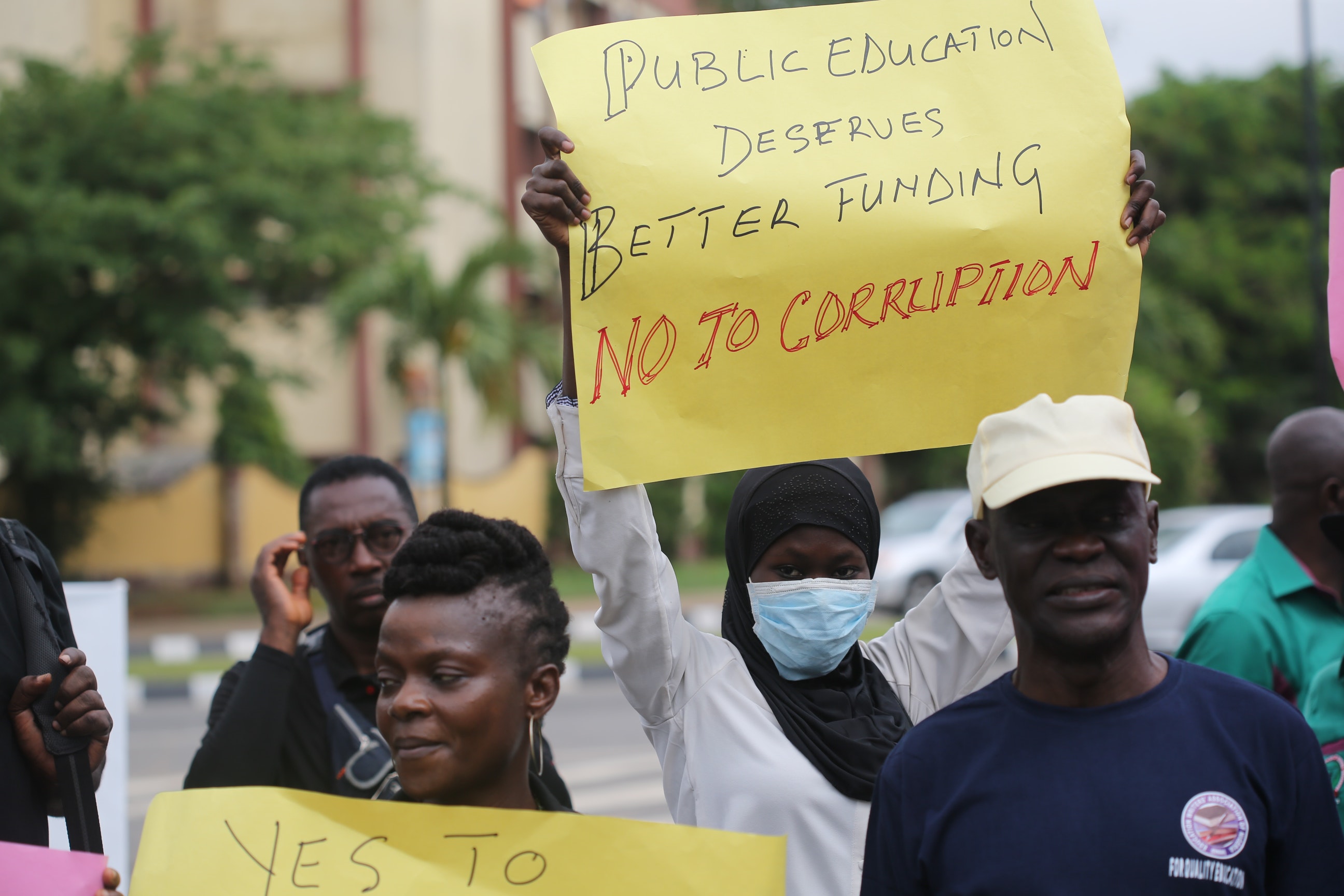
Lecturers in Nigerian public universities have embarked on strikes 16 times since 1999. Cumulatively, the public universities have lost about 50 months of their academic calendar to these actions in the last 23 years.
The reasons for the strikes generally relate to funding and salary issues.
Nigeria has 217 licensed universities. The federal government runs 49 and another 57 belong to state governments. The remaining 111 are run by private operators. In January 2022 there were over 100,000 lecturers, the majority of them members of the Academic Staff Union of Universities. The country has a total of about 2.1 million university students. The Conversation Africa asked historian Ayodeji Olukoju, a former university vice chancellor, to explain the protests and their impacts.
What impact have the strikes had on students?
Without prejudice to the justification for the strikes by university teaching and non-teaching workers, they have cumulatively disrupted the training of the workforce. The academic calendar is the immediate victim and the normal duration of academic programmes has been elongated. This has implications for the career plans of students and staff.
Students stay longer in school, lose valuable years, and defer or forfeit post-graduation opportunities. The uncertainty and disruption subject them to financial, material and psychological stress.
These challenges affect their academic performance and, by extension, the quality of their degrees.
Striking staff themselves pay a steep price. Institutional staff exchanges, research activities, sabbatical and study leave, and promotion prospects suffer setbacks. They are denied wages each time government applies the no-work no-pay policy. However, these wages are eventually released after the suspension of each round of strikes.
The national economy pays a high price for the disruption of a sub-sector that provides its workforce. Potential graduates are held back from applying their needed skills in the economy. Overstaying students take up resources that their sponsors could have used elsewhere.
On the other hand, private universities have taken advantage of the strikes in public universities by using the uninterrupted academic calendar as their unique selling point. This is evident in the increasing number of private universities, which grew from 50 in 2014 to 99 in 2022.
Are strikes effective for industrial disputes in the university system?
Strikes are weapons of last resort. But if the country is not alive to its best interests of providing a good education system that runs on a stable calendar and produces high quality, globally competitive products, the union should focus on the welfare of its members, who earn slave wages in a modern economy. A professor earns around US$1,000 per month.
Is it right to create new state and federal universities if existing ones aren’t well funded?
The government has created multiple universities and converted colleges of education and polytechnics into full-fledged universities. This amounts to an abuse of the university system and a lack of understanding of how it works. These “universities” were established without rigorous planning.
There is a stark difference in the planning, execution and funding that produced the regional universities at Nsukka, Ile-Ife and Zaria.
It appears that the decreeing of universities is a distribution of political patronage completely at variance with the idea of a university. These mushroom universities are never well funded, staffed or equipped, especially as they are added to older and equally poorly funded and governed institutions.
Some state governors win political support by siting these toy universities in politically strategic places to win elections. They can always get infrastructure for them by tapping into the Tertiary Education Trust Fund. This is an intervention agency set up by the Nigerian government to provide supplementary support to public tertiary institutions from the 2% education tax paid by registered firms in the country.
But there’s still a paucity of qualified staff (holders of PhD degrees, grant winners and scholars with reputable scholarly publications) and irregular payment of poor salaries.
Should universities be shut for a few years to allow for a fresh start?
We cannot afford to shut down the university system. The damage will be irreparable. There will be an exodus of highly qualified scholars and researchers. That happened in the 1980s and 1990s and the system hardly recovered.
What is required is to stop issuing licences to operators of private universities and creating emergency universities.
An inventory of all university teachers and staff is needed to determine how many there are and how they are distributed by rank, discipline and location.
When the gaps are identified, they should be addressed by way of more rigorous quality controls and benchmarking, targeted training, funding, and providing facilities and equipment.
Policy guidelines should be developed to guide Nigeria’s tertiary education sector with strategic plans of 10, 20 and 50 years.
The country’s universities should be ranked using objective criteria to identify the top five and top ten to be developed into postgraduate training centres. These should have only a 40% undergraduate and 60% graduate student enrolment. The top universities in countries like the US skew student enrolment towards postgraduate programmes. This is why research from such universities propels their countries to greatness. In Nigeria, the University of Ibadan has been operating on that model for the last decade. But it has been undermined by the lack of facilities and restriction on recruitment of qualified staff to replace staff who retire.
The ranking criteria should include quality of staff, carrying capacity of facilities for staff and students, comparative advantage and course offerings.
The other institutions should be colleges for the training of bachelor degree holders.


