North-South research partnerships must break old patterns for real change:
Since the 1940s major world powers like the US, the UK and the United Nations have made moves to spread their scientific, economic, industrial, and human rights progress to countries and regions that are seen as less developed, vulnerable or deprived in one way or another.
This has taken the form of a substantial, varied – and largely well-intentioned – contribution of huge financial and human resources from the global north to the global south. Today the flow of aid money, resources, and increasing global morality and mobility is building ever broader pipelines between these different regions.
And yet from where we stand as individual researchers, with funding and passion to share, we see an unsettling and consistent characteristic of this development history. The global north has experienced a gradual increase of economic strength and environmental protection, through jobs, career development, cheap goods and services.
Meanwhile, the global south has undergone a sustained degradation of autonomy, fertile land, food security and cultural literacies. All this has occurred through an imposition of foreign ideas, materials, ideologies and knowledge systems.
Despite all the good intentions, and the promises and provision of funding and expertise, global challenges persist and in some cases, have increased. As academics in social justice research, we are working in relation to a world of increasing social fragmentation and ecological vulnerability. This is happening “on our watch”; at the hands of our methods and practices and paradigms of research and professional practice.
That’s why we’re trying to do things differently. The Sustainable Futures in Africa Network, funded by the Global Challenges Research Fund, was formed in 2016. Our aim is to resist becoming another project within this trajectory of north to south research and development. We’re working to resist “business-as-usual”. The network has hubs in Nigeria, Uganda, Botswana, Malawi and the UK.
What we’re doing is taking a completely different approach to research by ditching old techniques and approaches and breaking research moulds that have become entrenched over the past eight decades. For example, we’re pioneering ways of engaging with communities that allow them to contribute their traditional knowledge and co-design the research agenda.
Our practices allow us to genuinely and ethically communicate and collaborate with communities, colleagues, and stakeholders. This is especially crucial when it comes to different knowledge systems. For example, in Nigeria soil scientists are engaging with spiritual beliefs that inform communities of the meaning of gold found in their soil. These ideas conflict with what is known in terms of Western science, and yet they serve a real purpose, have real impacts, and are “true” and “factful” to the communities that live according to such beliefs.
Different approaches are imperative if development initiatives are to buck the worrying trends that have cemented inequality and lessened sustainability.
How we work
Collaboration between the global north and global south too often follows a tick-box approach. A named global south partner ticks a box to indicate that a project is complying with Official Development Assistance criteria. A local translator ticks a box to indicate that local people are being consulted. A meeting in the country of a Southern partner indicates that the work must be collaborative in nature.
Typically the results will confirm the (Northern) “expert’s” hypothesis and support monocultures of the mind. What should be true collaboration, then, results in everyone thinking the same way.
Much formal funded research conducted in the name of development and social justice begins with the great promise of expertise and resources. This merely serves the validation and purpose of the “expert”, a person who is typically from the global north or a university setting.
We do things differently. We begin by acknowledging our own implications in the issues we address: we ask how our own practices, assumptions and behaviours contribute to the very inequities and issues we seek to improve. We prioritise creating a safe and honest common ground where new knowledges can be shared and new solutions can be co-designed.
For example, in Uganda we engaged in fieldwork to study water and food security issues using a “no method” approach with no predetermined research design. This meant no questionnaire or sampling technique. Instead the team spent time with families in their homes, listened to them and allowed the communities to direct the research enquiry.
Our ideas and expectations were confounded. The extreme problems these communities faced were largely due to the misplaced aid and intervention of previous projects. By listening, and bringing our own knowledge to the table, we were able to understand these communities as complex spaces of social, cultural and ecological needs.
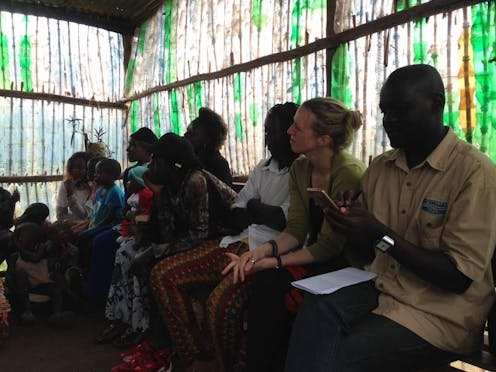
Another difference lies in the way the network shares insights with its stakeholders. There are no shiny reports crammed with tables and graphs, sent to external offices so that a box is ticked. Rather, policy makers, researchers, and community members are brought together in common spaces – such as a community hall constructed entirely from recycled plastic water bottles and a timber frame in an urban slum in Kampala – so they can engage differently with the factors, people and places at play in a given issue.
Change is crucial
These experiences have proved to us that decisive changes to the traditional methodologies of collaboration are necessary. Without change, the trajectory of growth and development in the world will remain consistent with what’s happened over the past 80 years: the north will keep getting richer and the south, poorer. It’s time to abandon well-trodden paths and forge new approaches.
This article was co-authored by Dr Deepa Pullanikkatil, who recently completed a residency at the University of Glasgow funded by the Engineering and Physical Sciences Research Council, UK. She is the co-founder of Abundance (www.abundanceworldwide.org).

Mia Perry receives funding from the Global Challenges Research Fund within the UK Research and Innovation Institution and the Scottish Funding Council
Source: The Conversation – Articles (AFRICA)
Read more on The Conversation.
Join the fun: Add Your event | Submit a Press Release | Add your listing.


