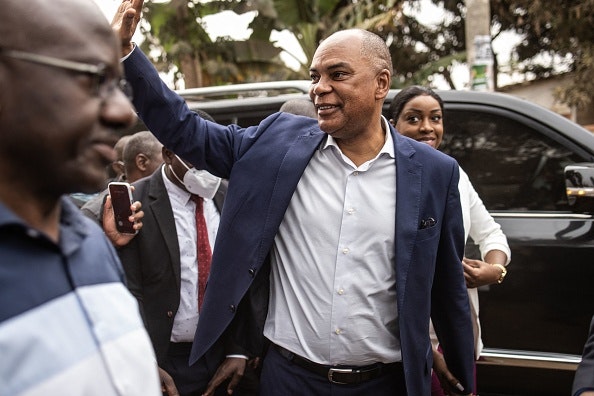
Angola’s elections were, for the first time, a tight race between the governing People’s Movement for the Liberation of Angola (MPLA) and a coalition led by its historic rival, National Union for the Total Independence of Angola (UNITA). The coalition, UNITA-FPU (United Patriotic Front) included independent candidates from other opposition parties and formations.
Preliminary results from civil society parallel counting, led by the Civic Movement Mudei, have given a landslide victory to the UNITA coalition, at least in urban centres. For its part, the government-controlled National Electoral Commission announced provisional results that gave a thin majority (51%) to the ruling party.
Members of civil society, as well some analysts, believe the electoral commission is a partisan body. This means that it will not give the MPLA under 50%. But the mood in the streets of Luanda, Lobito, and other major cities is that UNITA won.
Citizens and analysts alike knew this poll was going to be highly contested. President João Lourenço’s popularity has been at an all-time low while the opposition had been galvanised by a charismatic leader, Adalberto Costa Júnior. And, for the first time in Angola’s history, there’s an almost united opposition front.
Moreover, with 60% of the electorate younger than 25 years old, new voters had come of age for whom neither the MPLA old slogans, nor the spectre of the civil war (1975 -2002) held much sway. Moreover, for the first time, Angolans living abroad could participate.
At the same time, given its historic trajectory as the party that ruled Angola since independence, it was clear that the MPLA would not accept any result lower than 50% of the votes for itself. Nor would João Lourenço want to go down in history as the president who lost power for the ruling party.
Yet, even with a thin majority, the loss of the absolute (two-thirds) majority in parliament – and of the capital, Luanda – has to be seen as a significant defeat for the MPLA.
A ruling party holding on tight
During the electoral campaign, not once did the sitting president raise the possibility of a defeat and transition. Instead he chose to treat the opposition and his civil society critics as paid stooges of mysterious outside forces and enemies of the Angolan people.
UNITA, on the other hand, grew increasingly confident in its victory in the past months, making it also more difficult for the opposition and its supporters to simply accept the official results, as the party did in 2017, much to the dismay of its adherents.
Given how tightly the MPLA controlled the electoral process – from the partisan composition of the electoral commission to control of the judiciary (including the crucial Constitutional Court and the media – to the organisation of vote-counting, a fabricated result giving the MPLA above 50% of the vote was to be expected.
Voting day was nevertheless calm and ordered across the country, with a fast and easy voting process overall. This, despite complaints that some polling stations opened late, and that opposition delegates to the stations did not get access to the voter rolls. Moreover, in some stations, the police stood closer than the 100m required by law.
Civil society mobilisation
Civil society – led by the Civic Movement Mudei – organised parallel counting of results across the country, as did UNITA.
Scores of chiefly young voters stayed outside polling stations until the evening. They insisted that, as decreed by law, results of the station be posted outside the station.
Results were photographed by phone, and sent on to Mudei at provincial levels to collate. However, there were reports of polling stations refusing to post the results. Some staff spoke to reporters saying the electoral commission had barred them from doing so. At the Lisbon consulate, captured on video, the consular staff fled among insults of incensed voters.
Nonetheless, first results from Mudei’s parallel count on election day gave UNITA a significant lead of 53% across the country, with 43% for the MPLA. The same evening, the electoral commission hastily called a press conference (with no attendees) and declared a 60.6% lead for the MPLA, with UNITA trailing at 33.8%.
It, however, did not explain where these results came from. This was similar to the results announcement in the 2017 elections. Yet even in the hastily presented official results, UNITA carried the capital Luanda — where one third of the population live — by a wide margin (63%).
In the meantime, provisional official results published on 25 August evening – a day after the vote – gave 51.07% to the MPLA and 44.5% to UNITA. However, on the evening of 26 August, UNITA called a press conference, where Adalberto Costa Júnior announced the party would not accept the results published by the electoral commission.
UNITA presented the results from its own, slower, but more complete parallel count . These showed substantial discrepancies to the official tally, with Costa Júnior calling for an independent, international commission to check and reconcile the results of the two counts.
Tense times ahead
Angola’s young voters are awaiting developments with hope and fear. For the first time in history, an opposition win seems possible, but it is highly doubtful whether the regime will accept it. Much will depend on the rural vote, where the MPLA is strong — or more in control — and where a parallel count will be more difficult.
Yet, excited by the projections of the parallel counts, the urban youth are demanding transparency, and are unlikely to accept any official result that is not verifiable by publicly posted polling station results. At the same time, is also doubtful whether security forces, hitherto loyal to the ruling party, would remember their “republican duty” and support a transition, if confirmed.
The coming days will be tense and decisive, and the result is yet unclear — yet regardless of the ultimate outcome it is clear that Angola has irrevocably changed.


