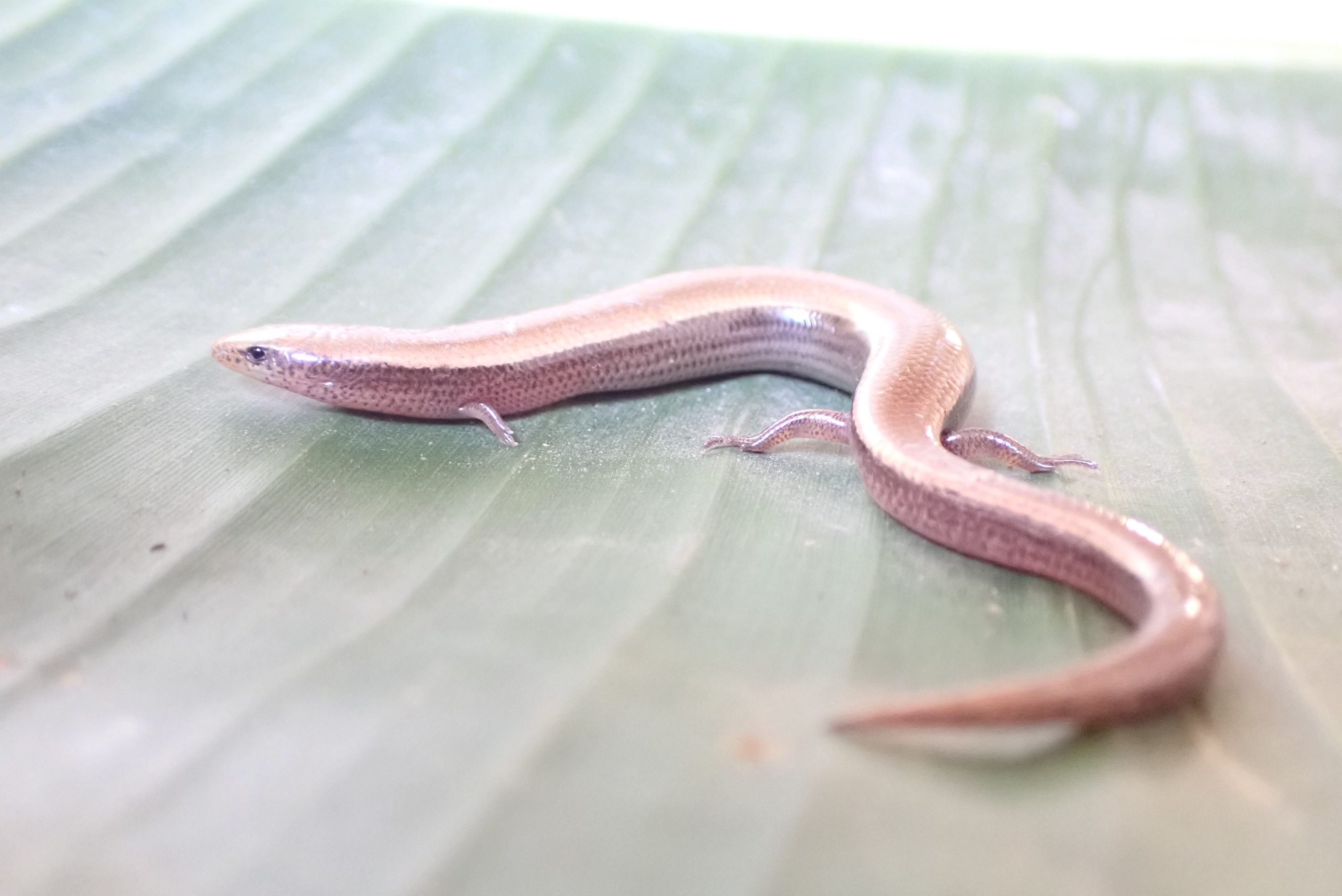
It’s been more than 100 years since a live montane skink, Proscelotes aenea, was last spotted. Since then, it hasn’t been clear whether the lizard was extinct or just very good at hiding.
But, thanks to a combination of field work and detective skills, we can now announce that Proscelotes aenea is alive and scuttling around the sandy soils of Lumbo, Mozambique. This is an exciting result for our research project, Extinct or Shy. The project highlights what happens when there isn’t a great deal of data available about species in poorly sampled areas: species might be assumed to be extinct when they’re not, so their presence may not be taken into account when countries make conservation decisions.
Our journey to find the elusive montane skink has also highlighted why scientists’ field notes are so important. We used field notes made more than a century ago, as well as a tantalising clue in a naturalist’s autobiography, to narrow down where the skink might be found.
It’s a good reminder to modern researchers to make their fields notes as detailed as possible for future readers. After all, a species that is common at one point in time may not always be so in the future. Any “clues” that might guide researchers years, decades – or even centuries – from now are crucial.
Hunting for written clues
The last time the montane skink was recorded by scientists in Lumbo was in 1918. Naturalist Arthur Loveridge collected six specimens during a two-month stay in the area. In his field notes (contained in a hard-to-find book), Loveridge wrote that the skinks were found while “the land was cleared of stumps to make tent space for a British camp”. He gave a vague description of that land: at the “British Campsite” – a military base set up during the East African campaign of the First World War – in Lumbo, 3km away from Mozambique Island. There were no coordinates or other reference points to locate the camp site.
Using only these descriptive notes, Wilson Monia, Abdulrabe Jamal and Ali Puruleia, the students responsible for our project’s field work, conducted local interviews that took them to a more inland military base.
Read more: Search for elusive skinks is filling gaps in Mozambique’s biodiversity data
It seemed unlikely that this was the seaside site Loveridge wrote about, given its distance from the water. Further online searches didn’t turn up any reference to this campsite; no botanical records were available in online databases that referred to the site in further detail.
The clues we needed turned up unexpectedly in a short passage in Loveridge’s autobiography, Many Happy Days I’ve Squandered, where he briefly describes his stay in Mozambique. The skinks were not mentioned, but he did describe his daily routine. It was a single sentence that led the trio of researchers to the montane skink:
The camp itself was on a kind of peninsula; on the farther side of Lumbo Bay there were acres of mud flats covered by mangrove trees.
After a quick look on Google maps, the team immediately found this site and set up new traps. Within two weeks we had found the montane skink; the students have so far recorded four individuals.
In 1918, Lumbo was most likely predominantly covered inland by savanna and by mangrove on the coast. Today it is home to around 20,000 people – double what it was 50 years ago, so far more densely populated than it was during Loveridge’s time. Travelling through the area, you’ll see tar roads and cement houses; there are farms and wetlands, but very little native vegetation remains.
More work to come
The project is now collecting important ecological information to map and assess the species. The montane skink is listed as “data deficient” by the International Union for the Conservation of Nature. Once more data has been provided, the species may be assessed as range-restricted or threatened; both these categories require countries to put certain protections in place to support the at-risk species.
Read more: We used 60-year-old notebooks to find out why male hippos have bigger tusks than females
Finding the montane skink doesn’t mean that Extinct or Shy’s work is done. The team is also trying to find another species, Boulenger’s legless skink (Scolecoseps boulengeri). There’s even less information about this species than there is about the montane skink; so far our searches have been unsuccessful.
Detail is key
One of the biggest lessons to take from this work is that rich detail in field notes is crucial. The level of detail researchers use in their field notes today varies wildly; some provide minimal detail while others document weather, soil type, associated species, micro-habitat and much more. And, although field notes can be stored in online back-ups, a significant number undoubtedly still sit on shelves, in attics and in moving boxes as researchers progress through their field seasons and careers. This comes with a risk that the data can easily be lost forever.
When it comes to reptiles like skinks, many modern surveys are conducted using both trapping and active search methods. Explicitly describing how many of each species are recorded, as well as where and how they were obtained, can provide valuable details for studies that aim to reproduce earlier results.
This is increasingly important in areas that are rapidly changing due to urbanisation, expanding agriculture and that are experiencing adverse effects of climate change.
It was a description of a campsite that led us to find the montane skink again after 100 years without a scientific record in the area. We hope that in the future field biologists, with support and encouragement from editors and journals, will include such relevant information alongside species checklists in their scientific publications.


