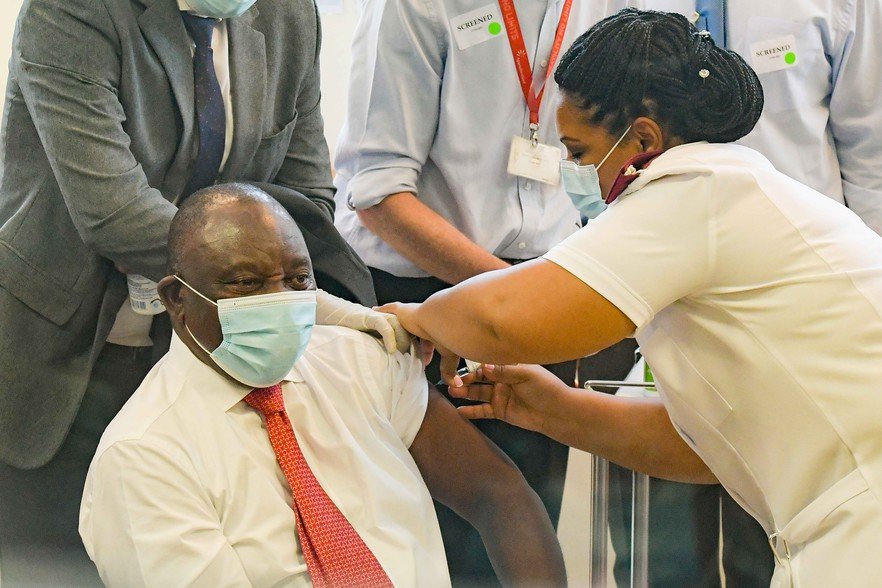
President Cyril Ramaphosa getting vaccinated on 17 February. Archive photo: Jeffrey Abrahams
Nearly 170,000 people received their first vaccine dose in the first week of the official rollout. That’s not bad, but we have to scale up quickly. After all, the health department has had months to plan this.
Taking into account the Sisonke study and several other clinical trials that have been run in South Africa, somewhere in the region of 700,000 people have now been vaccinated, more than 1% of the population. Soon the Covid-19 vaccine programme will be South Africa’s biggest ever.
The state set a target of vaccinating 700,000 health workers this past week (apparently later revised down). It didn’t come close to this and was never likely to. But we have to ask: why are so many patient-facing health workers not yet vaccinated, after having had months to do so on the Sisonke study, which had about 20,000 unused doses at its end?
What is a reasonable target?
The health department’s target is 40 million people by the end of February 2022. That’s 140,000 vaccines a day, seven days a week, or 980,000 a week, more than five times what we managed last week. It’s a tall order but it’s good to be ambitious. The UK has been vaccinating well over 400,000 people daily. We won’t come close to that but at least we should try to scale up as fast as we can.
What is a reasonable target that we unequivocally should expect the government to stick to? According to the Minister of Health, we had 975,000 Pfizer vaccine doses in stock at the beginning of last week. By the end of June we will have received 4.5 million Pfizer doses in total and there will also be 2 million Johnson & Johnson doses. (More will arrive thereafter.)
If this is accurate, then vaccine stocks currently far exceed what is being used. Would it not be reasonable to set this goal: use every dose in stock within two weeks. That would mean averaging about 130,000 doses daily to use this stock by mid-July.
There’s no reason to keep any vaccines in stock; we need to use what’s available as quickly as we can. Second doses will arrive, and if they don’t there will be an outcry against Pfizer.
How the vaccine process works
A health worker at a care home explained to us how a typical vaccine site works. The home used the Pfizer vaccine which requires two doses several weeks apart (current advice is three weeks, but longer intervals are showing good results).
The vaccines were delivered to the site from a vaccine distribution centre in a cooler box with a thermometer that checks that the temperature doesn’t rise above 8°C.
At the site the vaccine is checked off against a master vaccine list to see that the batch is correct.
There are four stations.
At the first station the vaccine doses are prepared. The vaccine comes in 0.2ml vials. The vaccine preparers mix the vial with 1.8ml of saline, so that the entire solution is now 2ml. Then each dose of 0.3ml is drawn into a syringe. The process, which includes waiting for the vial to reach room temperature, takes about 15 minutes. While it may sound complicated, the health worker assured us this is not a complex task for health workers to do. One issue is that while you’d expect to get about six doses per vial, this seldom happens. There are sometimes air bubbles, little bits of spillage, and vaccinators likely err slightly above 0.3ml per dose. So for the most part one gets five doses per vial.
Once constituted, vaccines can sit for six hours in a cooler box with an ice pack before they have to be used.
At the second station people coming for vaccination are checked against the government’s EVDS system to see if they are registered. They also give consent. If they aren’t registered, then an administrator registers them. This is also where the second-dose is scheduled for several weeks later. Dealing with the EVDS system, according to our health worker, is by far the biggest bottleneck in the system.
At the third station, people are vaccinated.
At the fourth station, people sit and wait about 15 minutes. This is to check that they don’t have an extremely rare allergic reaction.
Removing bottlenecks
Registration system
We question whether the EVDS registration system, the biggest bottleneck at vaccine sites, is necessary.
Most people over 60 have not registered. For example, by 5 May, only a quarter of people over the age of 60 in the Western Cape had registered. It is likely that the registrations are heavily skewed to middle-class people with decent IT access.
Also vaccine sites require electricity and decent internet access to use the EVDS system. What is going to happen during load-shedding?
The EVDS is not even necessary for scheduling second doses. People can get a little card with the date range they should try to get their second dose. It’s then their responsibility to do so. (The second Pfizer dose is identical to the first, so there’s no additional complications with the second dose.)
If the health department insists on using the registration system it must find ways to register more people and optimise its use. It is a positive sign that the National Department of Health has given the Western Cape Department of Health and private sector sites more control over scheduling of vaccinations. We need more such flexibility.
Use personnel efficiently
There were six professional nurses at the site described above. Our health worker believes two to three nurses would have been sufficient as not all tasks need qualified nurses. If we’re to scale up to thousands of vaccine sites across the country, this will put an enormous strain on the health system. Fewer staff, and nurses in particular, need to be involved for each person vaccinated. Obviously large vaccination sites with the above system replicated several times over must have more health workers.
Weekends
The health department’s daily updates suggest that few people are vaccinated on the weekend. With more private sector facilities coming onboard in the next few weeks, this should improve. But this is an emergency and the health department should find ways to get more public facilities operating on weekends, even if that means paying overtime.
Vaccine sites where people gather
We must prioritise people over 60 and those with co-morbidities, but that doesn’t mean that they exclusively should be vaccinated at the moment. As we said previously, priority queues or exclusive times for elderly people are a good way to favour them, as well as offering vaccines at social grant collection points.
But vaccine sites should be set up in shopping malls, at taxi ranks and other large gathering points. Every care institution should be prioritised. We need to get every prisoner and prison staff member vaccinated as soon as possible. Other imaginative ideas have also been suggested, such as using the IEC, with its experience of processing millions of people, to run vaccine sites.
© 2021 GroundUp. This article is licensed under a Creative Commons Attribution-NoDerivatives 4.0 International License.
You may republish this article, so long as you credit the authors and GroundUp, and do not change the text. Please include a link back to the original article.
We put an invisible pixel in the article so that we can count traffic to republishers. All analytics tools are solely on our servers. We do not give our logs to any third party. Logs are deleted after two weeks. We do not use any IP address identifying information except to count regional traffic. We are solely interested in counting hits, not tracking users. If you republish, please do not delete the invisible pixel.