More than 1.5 million years ago, a new era dawned for our human ancestors, Homo erectus: the Acheulean culture. This period was marked by the ability to produce large cutting tools, mainly handaxes, manufactured using different kinds of rocks and used for a variety of activities.
These tools were all longer or wider than 10 cm and clearly shaped for different purposes. The previous “culture” – referring here to an archaeological industry – was the Oldowan, which dated from 2.6 million years ago up until at least 1.7 million years ago. Oldowan tools were small and medium-sized flakes, detached from a cobble or a block of raw material.
The Acheulean is considered a turning point in human evolution. That’s because it marked a new level of technological complexity linked to the appearance of Homo erectus, who become able to sculpt a block of stone to shape large objects with one or more standardised characteristics, such as a pointed form. This innovative skill first emerged on the African continent between 1.8 million and 1.6 million years ago, in East Africa. It appears to have reached South Africa somewhere between 1.6 million and 1 million years ago.
Until now, it’s not been clear when the Acheulean appeared in North Africa; estimates have suggested it was around 1 million years ago. Our research, conducted at an archaeological site called Thomas Quarry I in Casablanca, Morocco, changes this. We used the latest technologies in geology and dating methods to establish that the Acheulean likely first appeared in North Africa around 1.3 million years ago.
This is important information. It adds to scientists’ understanding of when Homo erectus spread across the African continent from its homeland (East Africa) and which cognitive and technological level allowed the species to disperse.
Technological advances
Two main Acheulean sites have been discovered in North Africa. One is Tighennif, near Mascara in Algeria. Thomas Quarry I (and specifically its unit L in the lower part of the stratigraphic sequence) is the other. Stone artefacts at both sites had been dated back to about 1 million years ago before our research.
Thomas Quarry I was one of several quarries opened in Casablanca at the dawn of the 20th century. They were to be used as construction sites, but it soon became apparent that Thomas Quarry I represented an exceptional geological, palaeontological and archaeological heritage. It became globally famous in 1969 thanks to the discovery of a human fossil dating to the Middle Pleistocene, about 500 000 years ago.
Since 1978, a joint Morocco-France research programme, “Préhistoire de Casablanca” has led to many more discoveries. In 1985, the first evidence of early Acheulean industry was found in two archaeological layers of Unit L.
First analyses suggested an age for this evidence of around 1 million years old. Since then, technology has advanced a great deal and our interdisciplinary team composed of Moroccan, French, and Italian scientists was able to use various approaches to pinpoint the site’s age.
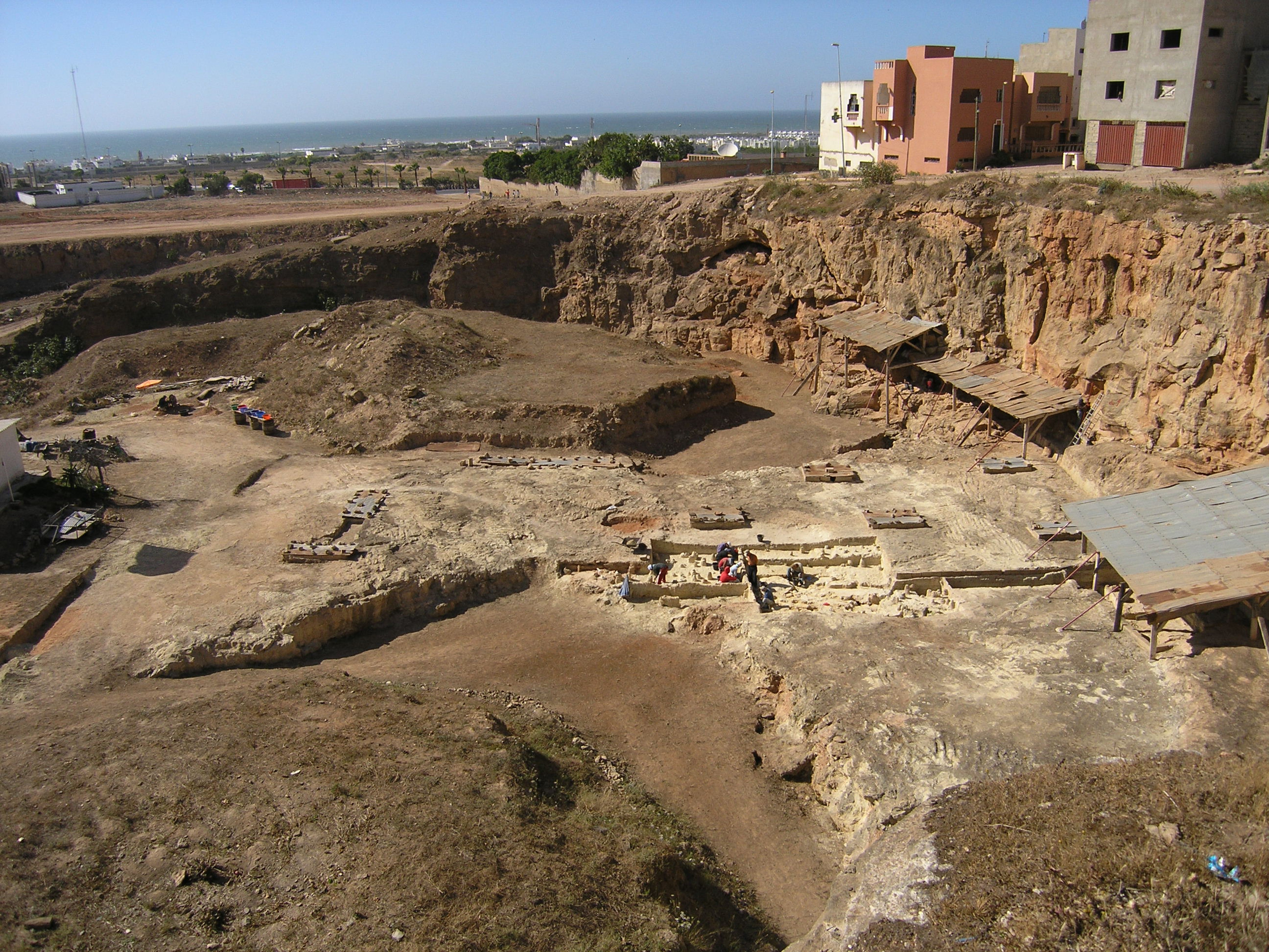
We used two main kinds of technology in our work. One was magnetostratigraphy, which registers the polarity of the Earth’s magnetic field at the time a stratum was deposited. This process dated our research area, Unit L, at more than 1 million years ago. We also geochemically analysed the sediments to see when they were first deposited, which is a good way to refine the age model. This approach generated two sets of dates: either between 1.3 and 1.35 million years ago, or between 1.29 and 1.23 million years ago.
Read more: Finds in Tanzania’s Olduvai Gorge reveal how ancient humans adapted to change
By combining and analysing all our data, we were able to propose an average age of 1.3 million years ago for the site. This, we believe, is when the Acheulean had already appeared in North Africa.
Technical know-how
Another exciting element of our work was ascertaining how Homo erectus diversified their tool-making practices in different parts of Africa. Around 5,000 artefacts have been found in Thomas Quarry I’s Unit L, among the largest collections from the epoch.
Most of the tools are of quartzite, a rock largely abundant in the Casablanca cobble beaches; there are large handaxes and picks, as well as cleavers (though these are rare). These share several technological traits with their East African counterparts and are rather typical of the early stages of the Acheulean.
Read more: Archaeology in West Africa could rewrite the textbooks on human evolution
But there’s a technical process that is, as far as we can tell, unique to the North African site. In parallel with large cutting tools, knapping (the process of breaking or chipping flint and other kinds of stone) produced micro tools of flint such as very small elongated flakes using the bipolar-on-anvil technique – using a hammer to strike a cobble, which is positioned on a stationary anvil.
Use-wear analysis to understand their use is underway. Our hypothesis is that these micro tools with a very sharp cutting edge like that of flint were used for extreme precision works. However, such technology is unexpected for these ancient periods, especially in an Acheulean context typically characterised by the production of large cutting tools rather than by micro-tools like this one.
It demonstrates that Homo erectus had the technical know-how to create new solutions when the need arose. They weren’t just making tools: they knew how to diversify their tools as necessary.


