Palaeontology: a way of reaching into the past to build lessons for the present:
South Africa has an unparalleled fossil record of prehistoric life. It also holds a key position within the African nursery of humankind. And so, the country’s palaeontology tells the story not just of those who live in it, but of every person living on earth.
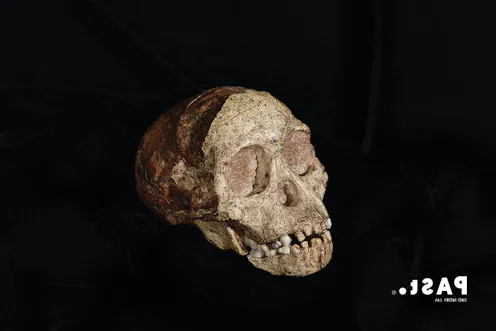
Public and private investment has been crucial in driving some of South Africa’s most important fossil finds of the last few decades. Take the story of Little Foot. She’s a near-complete 3.67 million year old skeleton; a pre-human adult found, excavated and reconstructed over the last 20 years in the Sterkfontein Caves near Johannesburg. Little Foot is the country’s oldest fossil hominid. She is also by far the most complete skeleton of an Australopithecus ever found.
But she may never have been discovered without major financial investments into palaeontological research. With major funding from PAST, Little Foot was discovered and excavated by Ronald J. Clark of the University of the Witwatersrand.
PAST was created in 1994 to raise corporate support for research at Sterkfontein, which was on the verge of shutting down because it didn’t have enough funding.
Since then, the government, universities and PAST’s corporate and foundation sponsors have invested a growing amount of money into the study of South Africa’s fossil heritage.
Some may question why money is being spent on exploring the past – especially in a country that faces so many pressing challenges. But this sort of work is about more than just supporting an academic exercise in chronicling ancient events. It offers lessons that can change attitudes and responses to the most fundamental issues facing South Africa and societies everywhere. These lessons relate to discrimination, particularly that based on race, and the rapid, human-induced loss of natural environments and biodiversity.
Our shared heritage provides an essential tool for securing a just and sustainable future. Palaeontology teaches us that we are all from one. Ignoring lessons from the 3.8 billion years of life’s prehistory, which preceded the brief 5,200 years of written history, would be an astonishing folly. Seeking further knowledge about our ancient heritage today is an investment in leaving a legacy of prosperity for future generations.
Shared origins
The lessons from our distant past are based on two facts. First, all of humankind shares a common origin in Africa. Second, all living beings – including humans – share a common origin. These facts are conclusive. They have been demonstrated by tens of thousands of fossil finds and corroborated independently by genetic studies of extant species.
These facts offer a compelling and profound way to think about and act on human diversity and our place in nature.
Physical differences among people from different places have been used to divide humans into races. To many, these groupings are presumed to be biologically superior or inferior to one another. Yet our shared origins have resulted in a remarkably strong – 99.9% – similarity between any two people’s genetic makeup. That’s regardless of their appearance and where they come from.
The few traits that differentiate regional populations often reflect adaptations to the new environments encountered during humankind’s prehistoric expansion out of Africa. For example, variations in skin colour result from adaptation to mainly latitude-dependent differences in ultraviolet radiation from the sun. This forms a continuum that can only divide people into arbitrary categories.
Humans and nature
Just as all people share a relatively recent origin, all living beings share a far more ancient origin. All have inherited – with modifications – DNA from the single-celled Last Universal Common Ancestor (referred to as LUCA) that lived over three billion years ago.
A growing tree is a useful way to envision the origin and diversification of life on earth: LUCA is positioned at the base of the primeval seedling; the leaves of the mature Tree of Life represent the millions of extant species, and their twigs and then branches retrace lines of descent as they coalesce toward and on to the trunk and LUCA.
As part of this tree, humans owe our existence to the same natural processes as any other species. In no way do we have dominion or supremacy over it.
But we have the power, intelligence, technology and large numbers to severely deplete biodiversity on a global scale. This understanding has perhaps never been more important given our current rates of destruction.
Palaeontology reveals that natural catastrophes have resulted in five worldwide mass extinctions over the last 540 million years. The most recent, 66 million years ago, claimed the non-avian dinosaurs and about three-quarters of all other species.
Today’s extinction rates are higher than in the aeons since the dinosaurs’ demise. We are on pace to reach the 75% species-loss threshold for a sixth mass extinction in as little as three human lifetimes.

Robert Blumenschine and PAST receive funding from the Dept of Science & Technology / National Research Foundation, Standard Bank, JP Morgan, the Claude Leon Foundation and the National Heritage Council.
Source: The Conversation – Articles (AFRICA)
Read more on The Conversation.
Join the fun: Add Your event | Submit a Press Release | Add your listing.


