Implementation of the 2018 peace agreement in South Sudan lags significantly behind its mandated schedule. One of the reasons for this slow progress is establishing a unified military command structure. This was to be done within the first eight months of signing the pact.
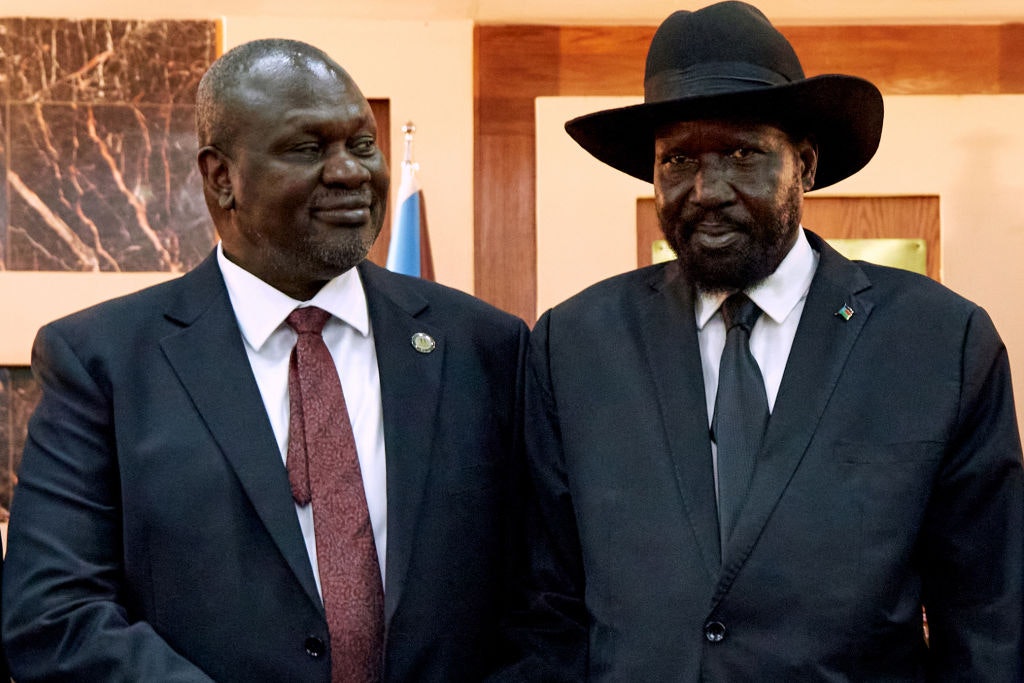
The 2018 peace deal was established to bring an end to South Sudan’s five-year civil war. Under it, a unity government was created by President Salva Kiir and his former deputy Riek Machar. A fallout between the two leaders in 2013 sparked the country’s descent into war. Under the terms of the agreement, Machar was sworn in as first vice president.
The peace deal’s transitional period started with the establishment of the unity government and was to last 36 months. The government was formed in February 2020 after the Sudan People’s Liberation Movement in Opposition (SPLM-IO) – aligned to Machar – and other opposition groups joined it.
The peace agreement also mandated a unified command of the country’s armed forces. Kiir and Machar recently agreed to a 60-40 split of leadership positions – in favour of the president – in national security institutions.
But this unifying process has been slow and not without its difficulties. Examples from countries like Cote d’Ivoire show that it can be a fraught process that, if not handled well, can undo efforts at consolidating a comprehensive peace agreement like the one signed in South Sudan.
Rocky road
Recent events put a nervous tremor through South Sudan’s peace efforts.
On March 23, 2022, the Sudan People’s Liberation Movement in Opposition decided to withdraw from the security mechanisms set up as part of the 2018 peace deal.
The decision raised fears that efforts towards a unified security forces could be derailed. To avoid large-scale violence, the international and donor community immediately responded, condemning the attacks and calling the movement to rejoin the security mechanisms.
This they did within a couple of weeks.
With the reinstating of security mechanisms and the resumed talks between Kiir and Machar, South Sudan seems to be back on track to implementing the 2018 peace agreement.
However, this mending may not guarantee a smooth pathway for peace and stability, as the process is moving ahead very slowly, with some viewing the three-and-a-half-years since the deal was signed as a stalemate.
The process, which is only now getting under way, is expected to be completed within the transition phase, which ends in February 2023.
Yet, many hurdles remain.
For instance, about 78,500 registered combatants of the Sudan People’s Liberation Movement in Opposition are still in military camps and training sites that lack food, medicine, shelter and equipment.
This has had both military and political ramifications for the movement, and has weakened Machar politically.
Read more: South Sudan: root causes of ongoing conflict remain untouched
Militarily, more commanders of the opposition movement have joined the South Sudan People’s Defence Forces. Politically, the movement was split into two with the creation of the Sudan People’s Liberation Movement in Opposition [Kitgwang]. This has resulted in continued fighting between the two groups.
Unifying armed forces
It is important to be cautious of the lofty timeline given for unifying the country’s command structure. Creating unified armed forces took four years in South Africa, over five years in Mozambique and seven in Sierra Leone.
The creation of a professional armed force can continue after first-accord elections, as was observed in South Africa, Mozambique and Sierra Leone. However, armed forces that are not fully professionalised can easily interfere with the electoral process.
In Cote d’Ivoire, the elections in 2010 took place in parallel with the military reform process. When the election outcome became disputed, the country returned to full-scale violence, with forces loyal to the various presidential candidates taking sides.
The current situation in South Sudan is very similar to the situation in the Cote d’Ivoire in terms of establishing professional armed forces.
The place of trust
Machar is militarily weak and politically marginalised. This could be seen as a good thing for Kiir and the ethnic group he represents, the Dinka. But it will not necessarily lead to peace and stability.
The implementation of the 2018 peace agreement has gone through uncertainties. Nevertheless, Kiir and Machar have managed to save the process by recommitting to its implementation.
Yet, they have a very short window of time to implement critical provisions in the agreement and rebuild trust to solidify the success of this process.
One of the barriers to a successful peace process is the lack of trust that the signatories have in each other and their mutual commitment to implementing an agreement. Yet, trust-building is not instantaneous. It is done by enacting a series of reforms that respond to the needs of the respective constituencies the leaders represent.
Read more: Building trust must take precedence in South Sudan peace process
Due to the back-and-forth nature of these reforms, implementing peace is often not popular with the group that traditionally tends to benefit from the status quo. However, the trust built through this process contributes to stable peace, as my research has shown.
This stability, however, can be threatened by stalled implementation processes, which generate mistrust and beget violence.
South Sudan’s peace and stability depends on Kiir and Machar stopping the politics of brinkmanship. They worked together for an independent country for the South Sudanese in 2011. It is time for these two leaders to show that they can also work together for peace and the functioning state that all South Sudanese deserve.


