Minerals are an important part of our everyday lives. They’re in the mobile phones we use, the cars we drive and even in the food we eat.
Phosphorus is a mineral with many uses. It is extracted from rocks called phosphorites and used in fertiliser, animal feed, as a food additive, in detergents and in herbicides, as well as in various other industries. But it can also be useful in an entirely different way: to help scientists learn more about how our climate, the oceans and the environment have changed over long periods of time.
Southern Africa is an important region for phosphorite mining. As a geologist, I have spent years studying the phosphorite deposits of southern Africa, particularly those of offshore Namibia, to gain a better understanding of how they form and how they are related to both past and modern environments, and map their changes.
Studying these deposits gives scientists information about how past environments change. That, in turn, gives us informed estimates on how climates and environments will change in the near future. This is important for the sustainability of our lives, environments and the ecosystems we depend on.
Namibian deposits
Phosphorites form in different ways. Some are sedimentary – they form from pre-existing sediments that are cemented together over time and harden, or they precipitate from a pre-existing source. Others are igneous, meaning the rocks form from volcanic or magmatic activity. Guano deposits are another source of phosphate, either through cave deposits where bat droppings accumulate or from the accumulation of bird droppings.
Rising demand for phosphate, amid decreasing reserves of this non-renewable resource, piqued interest in southern Africa’s extensive offshore phosphorite deposits during the first decade of the 21st century.
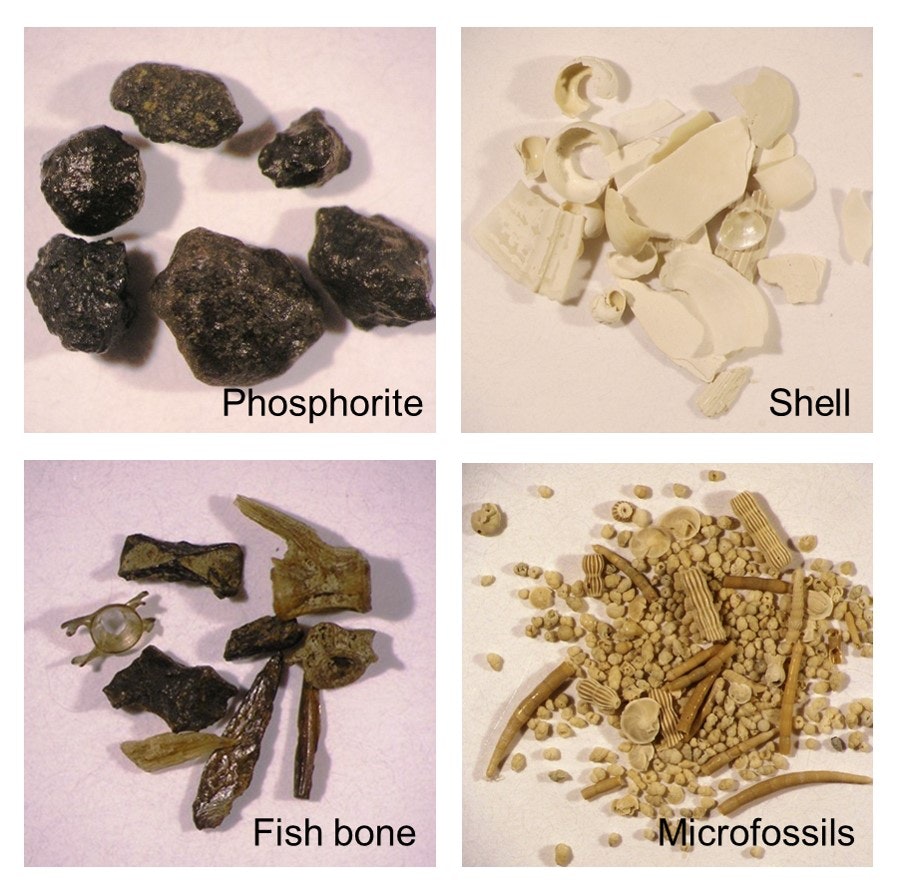
The Namibian phosphorites are marine sedimentary; they are brown to black and look either like sand-sized grains, small pebbles or rock fragments. They’re found with fossil material, such as whale bone, fish bone, the remains of sponges and echinoids (sea urchins), bivalves (such as clams), marine gastropods (sea snails), as well as the fossils of small marine organisms, called ostracods and foraminifera.

The offshore Namibian phosphorites started forming 7 million years ago. The deposits in which these phosphorites are found can tell us a great deal about how the marine environments along western southern Africa have changed since then.
I looked at the internal structures of these phosphorites under a microscope. This revealed concentric bands that may represent different episodes and repeated cycles of formation at different ages. Many of the phosphorite grains also contained the remnants of fossil material or other minerals (such as quartz and glauconite) in the centre of its structure. This means that the phosphate precipitated from or grew around the non-phosphatic nucleus.
So, how did these deposits form?
Formation
Between 5 and 7 million years ago, the Benguela Upwelling System, a highly productive marine system that runs along the western ocean of southern Africa, began off Namibia. Upwelling is the process where sea surface waters are replaced by colder, nutrient-rich water from below, and the Benguela Upwelling is regarded as one of the world’s most productive upwelling systems. This means that there is a high amount of organic matter available to support a functioning marine ecosystem.
The age of the initiation of the Benguela Upwelling System is consistent with the oldest offshore phosphorites found in the area. The later, higher concentration of phosphorites that are younger than 5 million years old indicates the intensification of upwelling along Namibia’s ocean margin.
Upwelling delivered phosphorous to the surface waters; the mineral was taken up by marine primary producers – organisms in the ocean that convert light and chemical energy into their food source – and delivered again to the seafloor as these organisms died. Microbial activity on the sea floor released more phosphorus, which created supersaturated conditions that led to the formation of phosphorus-rich minerals. This repeated cycling caused the phosphorus-enrichment in these marine deposits.
The fossils mixed in with the phosphorites reveal that the region’s climate started shifting around this time: sea levels dropped as the ocean became colder and upwelling intensified. The fossils that have been found with the phosphorites indicate that marine fauna that adapted to warmer waters became fauna that were adapted to shallower water depths and ocean conditions that became colder. This is also consistent with fossils and marine terraces that have been found on-shore.
These fossils and geologic structures indicate that the sea level was much higher 3 million years ago and gradually lowered with time. This was also a time period in which the carbon dioxide levels were at similar levels as they are today.

Important information
This is a good example of why scientists study ancient environments. By knowing what happened when carbon dioxide levels increased millions of years ago – in the case of Namibia and South Africa, higher sea levels – we can determine how environments change with these types of conditions. The marine environments in which phosphorites are found can therefore provide us with important information on past, current and future climate and environmental change.


