Politics and poverty caused past conflicts in East Africa — not climate change:
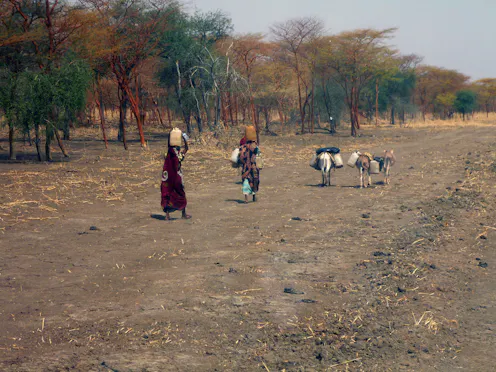
It seems obvious that climate change has – and will – cause human conflict and the mass movement of people. Look at the effects of the droughts in Syria, Darfur and Ethiopia. The former UN Secretary General Ban Ki-moon even described the ongoing war in Darfur as one of the “first climate wars”.
Various media have even started using terms such as “climate refugees” and “environmental migrants” to describe people fleeing their homes from these climate-driven conflicts. But is there any evidence for this link between climate change and conflict? There certainly isn’t any consensus in academic literature.
Africa is one of the most vulnerable continents to the effects of climate change. The UN Refugee Agency reported that over 20 million people were displaced in Africa in 2016 – a third of the world’s total. The World Bank predicts that this could rise to 86 million by 2050 because of climate change.
East Africa in particular is predicted to experience a dramatic increase in unpredictability of seasonal and inter-annual rainfall. This is particularly challenging given that the region is heavily dependent on agriculture which is highly sensitive to climate changes. In some countries, like Ethiopia and Sudan, agriculture accounts for more than 50% of Gross Domestic Product (GDP). Agriculture is a sector which has high climate sensitivity.
East Africa is also a region with a long history of conflict and displacement. Sudan and Somalia are current day examples. This makes it a good test case for the climate-conflict hypothesis.
In our recent paper, my student Erin Owain and I tested this link using East Africa as our focus.
Our study suggests that the failure of political systems is the primary cause of conflict and displacement of large numbers of people. But we also show that climate change can potentially exacerbate situations where social and political systems are fragile. Climate change can play a role in forcing people to migrate.
No single factor
To test the climate-conflict hypothesis, we focused on the ten main countries in East Africa: Burundi, Eritrea, Ethiopia, Kenya, Mozambique, Rwanda, Somalia, Sudan, Tanzania, Uganda and Zimbabwe.
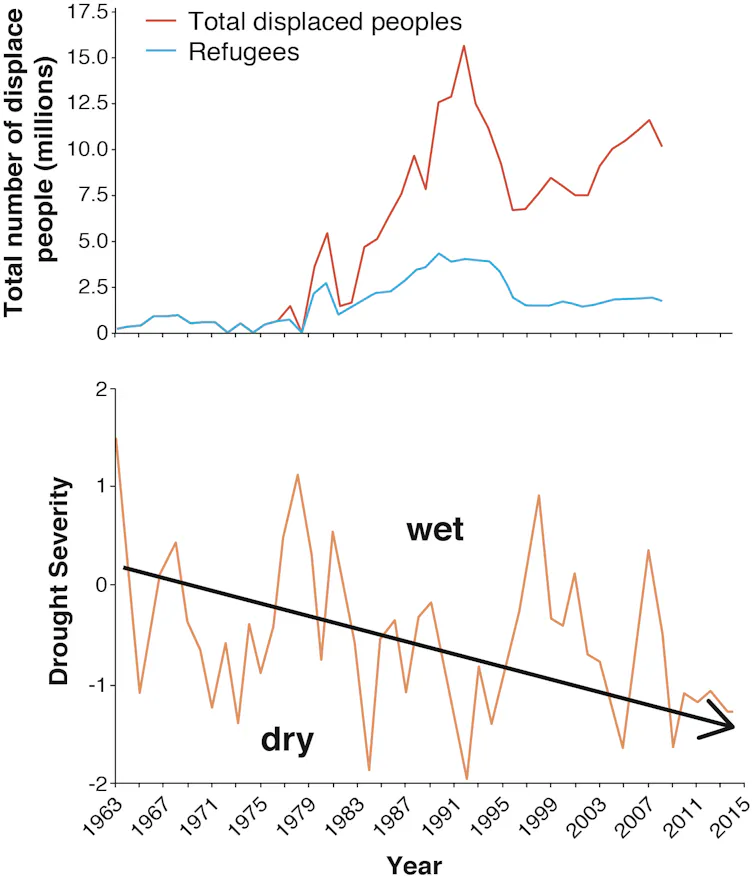
We used a new database that records major episodes of political violence and number of total displaced people for the past 50 years for each of the ten countries. We then used statistics to compare these records both at a country and a regional level with the appropriate climatic, economic and political factors.
Our study found that the evidence from East Africa is that no single factor can fully explain conflict and the displacement of people. Instead, long-term population growth, short-term negative economic growth and extreme political instability seem to be primarily linked to conflict. This echoes research done in 2015 that suggested socio-political factors were more important than climate change.
Things were different for refugees who were forced to cross borders between countries. Refugees make up a maximum of one third of the total people displaced in East Africa showing that most people are displaced in their own country. But in contrast to total displaced people and conflict, variations in refugee numbers, were found to be significantly linked to the incidence of severe regional droughts. And these droughts can in turn be linked to a long-term drying trend coming with climate change.
So, even though displacement of people is linked to poverty and poor governance, it takes extreme weather events to force those people across international borders.
The case for stable government
We argue that with good stable governance there is no reason why climate change should lead to greater conflict or displacement of people, despite the World Bank’s dire predictions. International water disputes provide one reason to be optimistic. The UN reports that, over the past 50 years, there have been 150 international water resource treaties signed compared to 37 disputes that involved violence.
We conclude that adaptation to climate change must prioritise good governance above all else. Robust political systems can protect citizens against extreme weather events and if disasters happen, these systems can ensure that people affected have adequate access to water, food, sanitation and shelter. Good governance is about protecting and looking after the most vulnerable people in society.

Mark Maslin is a Professor at University College London, Founding Director of Rezatec Ltd, Director of The London NERC Doctoral Training Partnership and a member of Cheltenham Science Festival Advisory Committee. He is an unpaid member of the Sopra-Steria CSR Board. He has received funding in the past from the NERC, EPSRC, ESRC, Royal Society, DIFD, DECC, FCO, Innovate UK, Carbon Trust, UK Space Agency, European Space Agency, Leverhulme Trust and British Council.
Source: The Conversation – Articles (AFRICA)
Read more on The Conversation.
Join the fun: Add Your event | Submit a Press Release | Add your listing.


