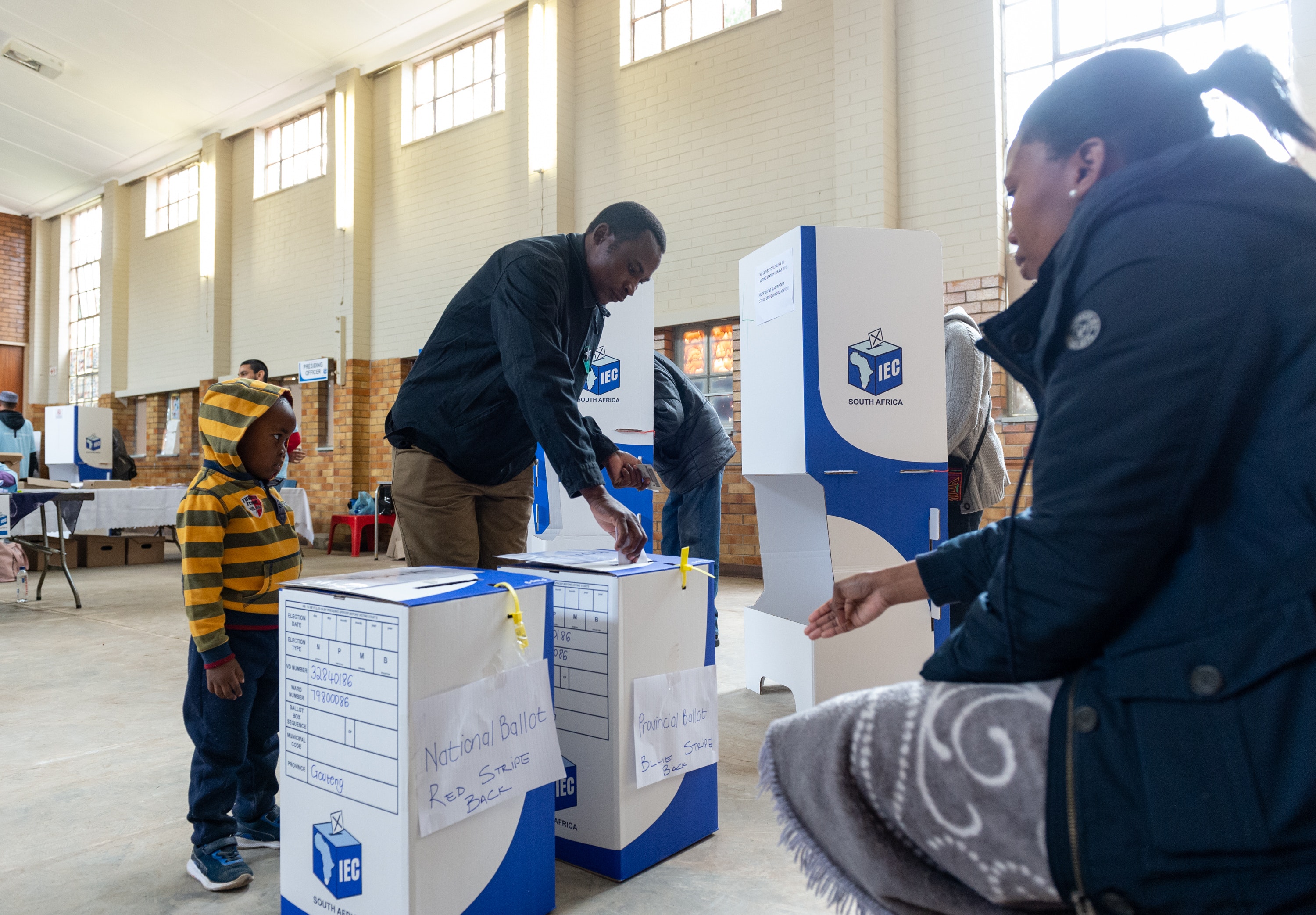
The COVID-19 pandemic has affected the way elections are conducted across the world. South Africa, too, is faced with an unprecedented situation of having to decide whether to postpone its municipal elections, scheduled for 27 October.
President Cyril Ramaphosa gave almost six months’ notice by announcing 27 October 2021 as the date for the elections on 21 April 2021. The constitution requires that an election be held within 90 days of the end of the term of office for local government. Since the last local government elections were held on 3 August 2016, an election must be held by 1 November 2021 to comply. No provision is made for discretion to postpone the elections in the constitution or in legislation.
But, as the Electoral Commission of South Africa started preparing for elections, some political parties flagged the challenges of holding elections during the COVID-19 pandemic. The commission then constituted an inquiry, headed by former deputy chief justice Dikgang Moseneke, to ascertain if the elections would be free and fair if held in October.
The inquiry found that there was a possibility that elections in October might not be free and fair. It suggested they be postponed to February 2022. Based on this report, the electoral commission applied to the Constitutional Court to have the elections postponed. The judgement is expected soon.
The challenges facing the electoral commission were highlighted in a submission we made to the inquiry. The task facing the court is to first determine if the elections will be free and fair if held in October. If it finds not, then it must decide whether it has the authority to postpone the elections.
The right to vote
The right to vote is a right that underpins South Africa’s democracy. It is also a founding provision of the constitution. The Constitutional Court has reiterated on many occasions the importance of this right. It has indicated that the right to vote is linked to the realisation and protection of other rights, including the right to dignity. Therefore, the right itself protects more than just the act of voting.
It is linked to the general right to free and fair elections. The state is obliged to fulfil the right. In terms of sections 181 and 190 of the constitution, read with the Electoral Commission Act, the electoral commission must ensure this.
The principles of freeness and fairness do not only pertain to the workings of the commission. The right to free and fair elections may, for instance, also be undermined where political parties are being treated unfairly or if they cannot campaign due to restrictions by the state.
So, what is at stake is the individual’s right to vote, and the right to free and fair elections. In this context, the electoral commission, and now the Constitutional Court, must look at the risks the COVID-19 pandemic poses, and consider if elections can be free and fair.
Voting day
We made a submission to the inquiry in June 2021 on the various measures that can be taken to lessen the spread of COVID-19 during the election.
In our report, we allude to the measures other countries took to lessen the spread of COVID-19 during elections. Firstly, there were various special voting arrangements, such as early voting, postal voting, proxy voting, and home and institution-based voting.
Countries like Lithuania and the Czech Republic even had “drive-by” voting stations for people in quarantine. Israel established dedicated polling stations for quarantined voters.
While not all of these suggestions can be transplanted to South Africa, it does indicate that “out of the box” solutions are possible.
Secondly, the World Health Organisation provides guidance on how to conduct elections during the pandemic, such as physical distancing, mask-wearing and hand sanitising.
Campaign
The right to free and fair elections includes enabling parties to campaign to inform the electorate of their candidates, and to do general voter education. The Constitutional Court has drawn the link between the right to vote and the right of access to information.
Campaigning is, therefore, an integral part of the right to vote, and to free and fair elections. Campaigning activities can be challenging during COVID-19. Restrictions promulgated to deal with the pandemic might unduly limit the right to free and fair elections.
While it is imperative that political parties adapt the way they campaign, limiting campaigning to digital or telephonic options may disadvantage people who do not have easy access to these options.
Methods of campaigning in a COVID-19 compliant way include:
-
only permitting outdoor campaign events,
-
requiring screening,
-
ensuring that there is enough space to implement social distancing,
-
ensuring enforcement of non-pharmaceutical interventions (mask, sanitiser), and
-
recommending that vulnerable people don’t attend these events.
Most of these measures are already contained in the Disaster Management Act, but enforcement may be problematic. A solution may be for the electoral commission to oversee the process, with sanctions for non-compliance.
Under COVID-19 conditions
Sixty percent of adults support the postponement of this year’s local government elections, according to a January 2021 survey by the University of Johannesburg and the Human Science Research Council. This correlates with international research.
It indicates that the fear of infection at the polling station is a significant concern, seemingly depending on whether the country is experiencing a surge or decline in cases.
Most countries have chosen to proceed with elections in a COVID-19 compliant way. The question is what the criteria are for free and fair elections during COVID-19, and if based on these criteria, elections would be more free and fair in February 2022.
Having higher rates of vaccinations might be a reason for postponement, but might not be realised by February 2022. Experts have suggested that in order to have herd immunity, 67% of the population needs to be vaccinated. But experts have already warned that herd immunity is unlikely to happen. Does that then mean no election will be considered free and fair?
In our report, we benchmarked the electoral commission’s proposed interventions against the World Health Organisation’s recommendations. In general, the commission seems to have complied with those recommendations. For instance, it has considered increasing the number of polling stations, queuing outside, regulating the flow of people and the number of people in the venue as well as sanitising and social distancing. Extended hours and physical barriers could be extra measures to implemented.
Free and fair is final question
The electoral commission did not have its usual voter registration weekends because the level of lockdown regulations in place from 28 June to 25 July and still in place since 26 July did not permit it. While registration weekends are not required by law, it can be argued that their absence prevented more people from registering, affecting whether the elections could be free and fair.
In the end, the question that must be asked is if elections can be free and fair if held in October. If the answer is yes, then that is the end of the question. If the answer is no, then the question is whether the elections should take place despite the COVID-19 risk, or should be postponed. This is the difficult question that the Constitutional Court is being asked to rule on.


