Private security in Africa: time to regulate the bad and harness the good:

A familiar scene plays itself out daily whenever I visit my local 24-hour convenience store in the northern suburbs of Cape Town. Despite the early hour, there is a flurry of activity. A fleet of blue and white-striped cars parked in the lot tell me that the city’s traffic officials are also in the vicinity. The South African Police Service make an appearance – two officers furtively dart in and out of the convenience store for their discounted coffee and leave in their brightly marked white pickup truck.
And last, private security – a fleet of them. A couple of them weave through the crowds in their bulletproof vests, their handguns strapped to their cargo pants, while the rest sit in their bright vehicles across the road. They do this every morning. They never seem to be off duty, always visible, always present.
Seeing this over and over has made me reflect on what “policing” actually means in Africa, and in particular the role of private security which, in many respects, provides more of a foundational order of safety than any forms of public policing on the continent
Very few countries on the continent keep consistent and reliable tabs on the size and nature of the private security industry. But it can safely be argued that the industry is deeply embedded in policing Africa – and that it is on the rise.
But private security is highly contested and beset by a number of problems. These include poorly paid guards with few or no benefits, skills or training who operate in conditions which are substandard and even dangerous.
The industry has been linked to criminal entities and accused of human rights abuses. It is accused of being either unregulated or under-regulated. Above all the industry has been charged with perpetuating inequalities in security provision, as only those who can afford it will benefit from it.
The future of private security is beset by two main challenges. The first is a conceptual one: is it a public or a private good? Is private security seen as a relevant player in policing?. And the second challenge is a regulatory one. What forms of regulation would be required to align private security with the public interest?
Contested terrain
Private security is involved in a broad range of activities across the continent centred on protecting space, people, and assets. Their activities range from safeguarding communities to protecting ships at sea.
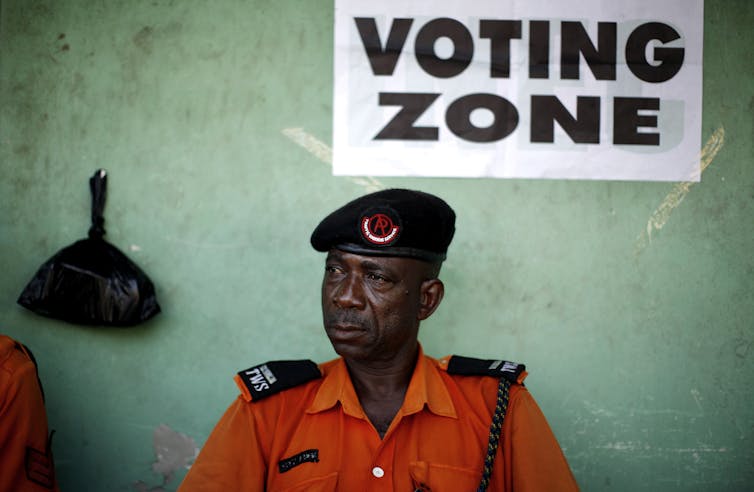
Private security companies range from tiny operators to those that employ thousands. One example is G4S, one of the largest on the continent with operations in 24 African and with 120,000 employees.
In South Africa the number of businesses in operation is just under 9,000, according to the Private Security Regulatory Authority. Almost two million security guards are believed to be in circulation, about half a million of whom are on active duty.
Many countries in Africa have reported an exponential growth in the industry over the past couple of decades In South Africa the number of companies have doubled in the last 12 years and now outnumbers the public police force by three to one.
There are many more examples across the continent – as numbers of private security personnel outnumber and outperform their public counterparts
Public good?
There is a conceptual problem around private security. Western scholarship has conceptualised public policing as a service that provides a public good to citizens by being democratic, effective, accountable and equitable
Alternatively, private policing is conceptualised as only offering a private good, benefiting only those who can afford it.
In fact the reality is far more complex. It is clear from research conducted on African policing in a range of countries that the public police more often than not provide policing that isn’t a public good because it’s corrupt, politicised or hostage to political patronage.
And some research shows that in fact the private sector may offer policing for a public good.
It’s therefore not appropriate to link public or private policing with the provision of public or private goods because, in reality, public goods policing can be provided by a private entity if the conditions are right.
But what are these conditions? How can we harness the capacity of private security on the continent? And what needs to be in place for policing – both private and public – to provide for the public good and not solely private or vested interests?
The answer lies in regulation.
Innovative regulation
What forms of regulation would be required to align private security with the public interest? We cannot rely on state regulation alone – as the state may often be complicit in perpetuating the bad aspects of the industry – through, for instance, patterns of state ownership of private security companies and the industry being used to perpetuate political and criminal patronage.
What this means is that we should consider innovative possibilities in aligning private security to the public interest in ways that promote safety.
There are plenty of examples we can learn from if we’re willing to remove our conceptual blinkers and recognise the value of private forms of policing and work towards transforming and regulating the bad aspects and harnessing the good aspects.
These are the issues that need to be addressed if we are to fully appreciate the capacity of the private sector in a way that benefits the continent, rather than undermining it.

March to August 2017 – funding received from the National Research Foundation.
Source: The Conversation – Articles (AFRICA)
Read more on The Conversation.
Join the fun: Add Your event | Submit a Press Release | Add your listing.


