Promise of right to housing remains elusive in democratic South Africa:
South Africa’s Constitution protects everyone’s right to access adequate housing. This principle was spelled out in law when the Court issued a landmark ruling in 2000 that stipulated the most vulnerable people – “those living in extreme conditions of poverty, homelessness or intolerable housing” – should be given priority access to housing.
A new law to effect this was passed in 2001. But, 17 years later, the law hasn’t been implemented. The main reason is that the country’s municipalities still don’t have adequate plans setting out the time frames in which they will provide adequate housing for thousands of people in desperate need.
The most recent data shows that there are about 3.3 million people living in informal settlements. This includes those living in temporary relocation areas.
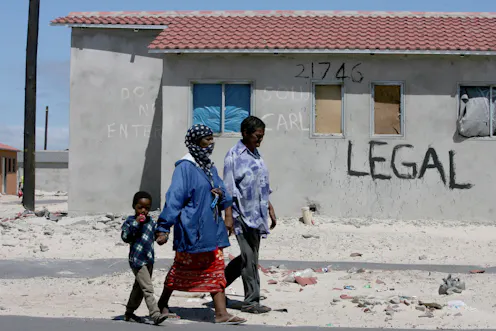
Tens of thousands of South Africans are living in emergency housing areas known as “temporary relocation areas”. These were established by municipalities as emergency housing for displaced people. But they have proved not to be temporary at all. In fact some relocation areas have grown in size. This has left both the people who were originally moved into them on a temporary basis, as well as newcomers, in a situation of limbo.
This reveals an epic failure by local, provincial and national governments to deliver social housing, as required by the Constitution. This unresponsiveness of government needs scrutiny by the South African Human Rights Commission, which is constitutionally mandated to promote, protect and monitor the realisation of human rights in the country, including access to housing.
And Parliament, in its oversight capacity, should hold government to account for its failure to provide housing for the most vulnerable as espoused by the 2000 landmark judgment.
Relocated, and abandoned
One relocation settlement is Blikkiesdorp, a poverty stricken community 30km east of Cape Town. Blikkiesdorp was established in 2007. It was meant to provide temporary shelter for 650 displaced, indigent people. A decade later, the city still has no definite plans to provide adequate housing for those people. The number of residents has since swelled to 15 000 in about 3 000 dwellings.
A similar situation is also found in Johannesburg, where 118 households were evicted from the Marie Louise informal settlement in 2001 and placed in temporary relocation areas. Although the move was only supposed to be for 18 months, this community is still without adequate homes seven years later. This, despite the courts ordering the City of Johannesburg to provide them adequate basic housing. As with Blikkiesdorp, there are still no precise time-frames for when this community will receive adequate basic housing.
In Durban, the Jadhu Place informal settlement was devastated by a fire in 2008 which displaced 600 households. A decade on, these residents remain in temporary shelters. They don’t know when they will be properly housed.
All these situations violate the Constitutional Court’s 2000 ruling and subsequent legislation. They also go against the policy guidelines the Court provided in 2008 for emergency housing.
Who has failed?
South Africa’s Constitution obliges the government – specifically the Department of Cooperative Governance and Traditional Affairs, which is responsible for municipalities – to provide social housing for indigent South Africans.
Since the landmark Grootboom case, the Housing Development Agency has provided National Policy Guidelines for emergency housing programmes.
Places like Blikkiesdorp were supposed to be a short-term housing solution. But, a decade later, its residents still live in the area. They endure poor basic services like water and sanitation. This is contrary to the 2008 court judgment that provided guidance for dignified temporary housing.
In 2016, the then-mayor of Cape Town demanded that her officials present her, in two weeks, with a plan which would set out time-frames for the rehousing of Blikkiesdorp. Two years later, the city has confirmed there are currently three housing developments for Blikkiesdorp but “poor contractor performance” has caused indefinite delays.
The South African Human Rights Commission is constitutionally mandated to take steps to secure appropriate redress where human rights have been violated – such as is happening in Blikkiesdorp. It confirmed in a report in 2015 it was aware that people relocated to temporary areas end up living there forever.
But it has done nothing to ease the plight of people like those living in Blikkiesdorp.
What needs to happen?
Communities that are relocated to temporary areas are deemed to be “vulnerable” by the Constitutional Court, and need to be provided with adequate housing as a matter of priority.
Local government is compelled by policy guidelines which provide clear steps how this should be done. There are three steps to be followed.
The first is relocate to a temporary area, then maintain the place adequately and, lastly, relocate the affected people to permanent housing. Importantly, the community must be involved in setting the time-frames for the allocation of permanent housing.
Staying indefinitely in a temporary housing area is a relegation of just administration principles as set out in the Promotion of Administrative Justice Act. Actions by government that materially and adversely affects the rights or legitimate expectations of any person must be procedurally fair.
The Human Rights Commission and Parliament are the custodians that should ensure the government upholds its constitutional obligations to provide adequate housing.
Blikkiesdorp and other displaced communities have a right to fair administrative action in line with their legitimate expectations. The Human Rights Commission needs to prove its worth and hold the government to account on time-frames to provide adequate housing for these people – and others in a similar situation. This should preferably be complemented by parliamentary oversight.

Soraya Beukes is affiliated with The Dullah Omar Institute at the University of the Western Cape.
Source: The Conversation – Articles (AFRICA)
Read more on The Conversation.
Join the fun: Add Your event | Submit a Press Release | Add your listing.


