Proper child care helps poor working women — and it can boost economies:
On March 8 each year trade unions and women’s rights organisations mark International Women’s Day by calling for policies and legislation that better support working women. Such calls relate to wage equality, maternity leave and early child care programmes.
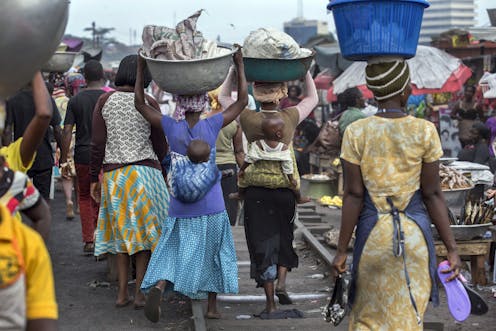
But these demands tend to overlook the needs of some of the most vulnerable: the millions of poor working women in cities in developing countries who are forced to take their kids with them to work or miss out on better paid opportunities because they’re caring for young children.
Some women take up work out of their homes – from stitching clothes to making snacks to sell at a market – to take care of their children. The earnings may be lower than in formal employment, but they have no other option as both decent work opportunities and quality child care services are rare in poor urban areas.
Across 31 developing countries, less than 1% of women living in poverty have access to a child care service.
Low-cost and unregulated child care services may exist, but are often still too expensive for women informal workers. Public child care services may not be available in informal settlements or poor urban areas. City plans don’t set aside enough designated spaces for child care centres either near workers’ homes or their places of work.
Ultimately, women informal workers earn even less when they have young children in their care. A new report by UN Women has found that, across 89 countries, women are 22% more likely than men to live in extreme poverty during their prime reproductive years (ages 25 – 34). Women are also less likely to receive a pension or will have lower benefit levels than men.
Adequate and quality childcare is not just a critical need for the children involved. It also determines women’s participation in the labour force and the type of work they can take on.
A coherent policy response is needed to bring together women informal workers and their organisations with municipal authorities, urban planners, early childhood development experts and relevant national ministries. There is no doubt that quality public child care services are expensive to set up and run. Yet the returns on investment are great.
In South Africa, for instance, UN Women estimates that a gross annual investment of 3.2% of Gross Domestic Product into child care services would extend universal coverage to all 0-5-year olds. It would also create 2.3 million new jobs and raise female employment rates by 10%. These new jobs would generate new tax and social security revenue of up to USD$ 3.8 million. These gains offset some of the costs to the state and can reduce inequalities brought on by spatial, class, gender and racial or ethnic segregation.
Women workers demanding change
Women are now calling for change. Informal workers organisations in collaboration with trade unions representing formal sector workers are organising a global campaign for quality public child care services.
Home-based workers, domestic workers, street vendors, market traders and waste pickers are engaging municipalities and governments from Lima to Bangkok, calling attention to their child care needs. They’re also organising to find their own solutions when the state does not listen.
In India the Self-Employed Women’s Association, a trade union representing close to 2 million women informal workers, runs a child care cooperative for its members in Ahmadabad. The Market Traders Association in Accra, Ghana manage a child care centre in a major market for traders, street vendors and others who have to bring their children to work.
However, all of these child care services also require support from a country’s government to be sustainable and remain accessible to the working poor.
We conducted a study on these issues for Women in Informal Employment Organizing and Globalizing (WIEGO), a global research-policy-action network focused on securing livelihoods for the working poor in the informal economy.
One Brazilian waste picker said: “Without day care, I can’t work. When there is no day care, I don’t work.”
Some child care centres in poorer areas may be affordable, but manage this only by not employing enough staff. A street vendor from South Africa told us:
The caregiver had too many children to look after…I used to receive calls notifying me that my child is sitting alone outside our home. The child had left the care facility without the caregiver’s awareness.
Child care for a brighter future
Of course, the provision of quality public child care services is no silver bullet. But it is urgently needed: a quarter of the world’s urban population – close to 1 billion people – lives in slums today without access to basic services and social security.
The number of urban dwellers is expected to double in South Asia and sub-Saharan Africa over the next two decades; more and more people will seek homes in slums and informal settlements. Quality public child care services guarantee a better and healthier future for children in these areas and elsewhere, and the many women who work and care for them.
One street trader we interviewed in Accra, Ghana, had managed to enrol her son in pre-school while she continued to work, secure in the knowledge that he was cared for. She knew just how valuable this was, saying: “I take my child to the school to get a bright future – I don’t want him to be like me.”
Rachel Moussié co-authored this article and the research it is based on. She is the Deputy Director of the Social Protection Programme at WIEGO and leads the Child Care Initiative supporting informal workers’ access to quality child care services as part of social protection systems. For further information please write to childcare@wiego.org.

Laura Alfers is affiliated with Women in Informal Employment: Globalizing and Organizing (WIEGO)
Source: The Conversation – Articles (AFRICA)
Read more on The Conversation.
Join the fun: Add Your event | Submit a Press Release | Add your listing.


