Quarter century study on ageing in South Africa offers new perspectives:
In 1992 a decision was taken to establish a health and socio-demographic surveillance system in a remote rural area in South Africa. The idea was to try and anticipate the kinds of health system reforms the country would need as it prepared for the end of apartheid, and the building of a new democratic state.
The decision followed the realisation that there was no reliable information for planning a health system that could service all South Africans. Under apartheid health provision was skewed towards white people who represented only 13% of the country’s population.
Leading academics set up the surveillance system which now covers 31 villages and 120,000 people in rural north eastern South Africa. The project involved recording every member of every household – residents and temporary migrants – and regularly updating every birth, migration in and migration out, and death, as well as cause of death.
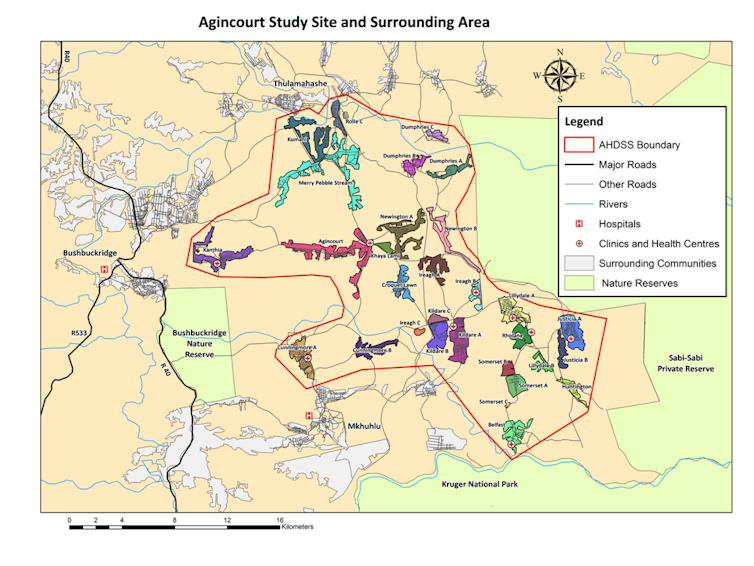
We also recorded education and household assets as a measure of socio-economic status, social grants, labour migration, among others.
Known as Agincourt, this project is now one of the longest running surveillance surveys on the African continent. The Agincourt Research Centre has developed a robust research infrastructure that undertakes work that is locally embedded and globally resonant, and is responsive to intractable health and development challenges confronting rural South and sub-Saharan Africa.
The centre has been producing interdisciplinary research aimed at addressing inequalities and enhancing health, well-being and economic prospects for people throughout their lives.
Research done over the past 26 years captures the dynamic transitions underway in the community. It provides insights into changes across people’s lives, helps to evaluate interventions, and provides information for local, provincial and national policy and planning.
As part of the project, a partnership was created six years ago to measure health and ageing specifically. Called Health and Aging in Africa: Longitudinal Study of an INDEPTH Community (HAALSI), it involves the Harvard Centre for Population and Development Studies and South Africa’s Medical Research Council/Wits University Rural Public Health and Health Transitions Research Unit (Agincourt). The study is funded by the National Institute on Aging, of the National Institutes of Health in the US.
This project is nested within the Agincourt longitudinal research infrastructure that can capture trends at a population level, and changes over time at an individual level. This has helped provide critical insights into how health risks and social influences earlier in life affect the outcomes at later stages of live.
Why it matters
Health, population and social transitions are underway across the world. Africa too is being affected. Given that we are all living longer, healthy ageing has become an important goal. This is so that we remain socially and economically productive and engaged in society.
Less appreciated is that the quality of later life is largely determined by behaviours and experiences earlier in life. Hence the vital importance of the social determinants of health. These include schooling and education, employment and income, environment and access to natural resources as well as social networks.
In addition, pensions and other non-contributory social grants are critical policy instruments that carry benefits for the health and well-being of older people and their families, particularly children.
The nature and pace of change is proving to be rapid. This is particularly true in rural settings which is why it has been vital to build a strong evidence base for policy making.
It also matters because an ageing population affects countries in multiple ways. In South Africa, some of the biggest effects have been the increasing costs of health care. This is because longer life expectancy has meant that there are growing numbers of people on antiretroviral therapy. This, in turn, has led to many having co-morbid conditions that can be challenging to manage medically. These include noncommunicable conditions such as diabetes and hypertension.
This has put increased pressure on an already strained fiscus to sustain a growing community that is eligible to receive state-funded pensions.
There are other ways in which an ageing population affects a country. Older people play a critical role when families and communities are under severe stress. This has been particularly marked in South Africa during the HIV/AIDS epidemic. This was a time when older adults shouldered major responsibilities for child care, for school-going children and for sustaining household livelihoods.
The role of older people in child care in rural households remains vital. This is because an increasing number of women of child-bearing age are migrating far afield for employment (whether intermittent, seasonal or year-round).
The research
Community-based surveillance research rests on stable long-term relationships. These need to be nurtured and fostered. We’ve enjoyed the support of our host communities since the unit’s inception in 1992. Community consent for all research activities was obtained from both civic and traditional leadership, and verbal or signed consent continues to be obtained at household and individual level.
Our fieldworkers are trained to conduct informed consent and answer questions from potential participants with sensitivity. We have a public engagement office and staff hold village meetings every year. In these meetings they give feedback on village specific data from the community surveillance as well as results from specific research projects nested within the surveillance platform.
We strive hard to preserve and strengthen respectful working relationships with local communities, to reinforce productive local and provincial stakeholder interaction around research findings and to maintain the confidentiality of the data generated.
The research that’s been done has provided insights into all aspects of ageing.
In particular, insights have been gleaned on the impact that ageing has on health through the HAALSI project. The baseline survey and biomarker collection for the project was conducted in 2014/15 in men and women aged 40 years and older. A second round was completed in 2019, and a third wave of data collection is planned for 2021.
Baseline data was made publicly available in 2017, and can be analysed by researchers and students anywhere in the world.
This data has been integrated with cause of death data from the Agincourt longitudinal survey. This has enabled researchers to examine the interrelationships between physical and cognitive functioning, lifestyle risk factors, household income and expenditure, depression and mental health, social networks and family composition, HIV infection and cardiometabolic disease.
The research produced through these combined projects has provided valuable insights into major policy interventions over the past 20 years. The most important contribution has been the research-based evidence that debunks the fallacy that future health and well-being is ordained by adulthood. The research output has enabled policy makers to understand where interventions – biological and social – can make a difference along the life course.

Kathleen Kahn receives funding from the South African Medical Research Council, Dept of Science and Innovation SA, and the National Institute on Agin, USA.
Stephen Tollman receives funding from the SAMRC, Dept of Science and Innovation SA, National Institutes of Health USA, UK Medical Research Council, and (previously) Wellcome Trust UK. He is affiliated with the SA Population Research Infrastructure Network (SAPRIN) and INDEPTH Network of population-based health and socio-demographic information systems.
Source: The Conversation – Articles (AFRICA)
Read more on The Conversation.
Join the fun: Add Your event | Submit a Press Release | Add your listing.


