British monarch Queen Elizabeth II’s passing has elicited many polarised responses, in the process allowing the ghosts of the past to resurface.
A Nigeria-born US professor, Uju Anya, tweeted a scathing criticism of the British monarchy, recalling her family’s traumatic experience of colonialism in Nigeria. US billionaire businessman Jeff Bezos wasted no time in joining others on Twitter to pour scorn upon Anya.
Many defended Anya, but soon her university distanced itself from her remarks, demonstrating the influence that the founder of the digital retail company Amazon has.
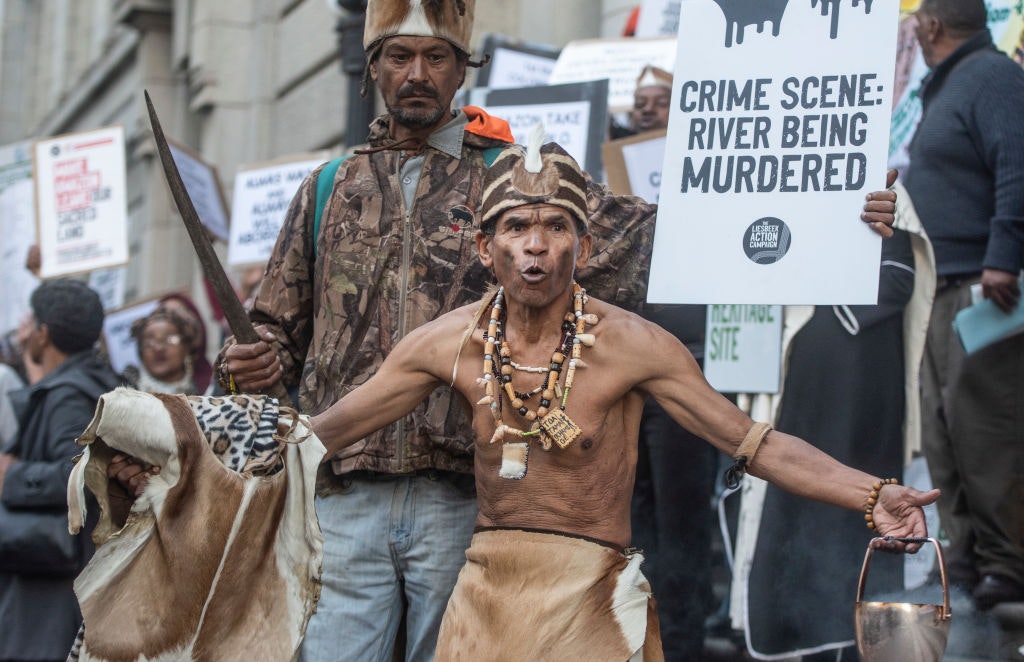
There are a few layers to unpack here here. Amazon finds itself in the middle of controversy in Cape Town, South Africa. The company’s South African headquarters is being constructed on the Liesbeek River, a site of historical and sacred significance to indigenous people of southern Africa. Here precolonial hunter-gatherers were subsisting off the environmental commons, likely making little negative impact on the natural environment. The Liesbeek River is also a site of resistance against colonial dispossession.
From a heritage perspective, much is at stake here for marginalised people. The case – by a local civic organisation along with various indigenous Khoi leaders opposing Amazon’s development – remains tied up in court. Construction is reportedly continuing at the site despite them winning a court interdict against it.
For a scholar like me who has written about copyright, piracy and the ownership of ideas, it is interesting that one of the blueprints for what we now know as colonisation was commons enclosure. In essence, commons enclosure is one of the first steps towards what we now call the privatisation of public resources.
This was the policy the British empire, along with other Western colonisers, brought to Africa, where common land and resources – like the Liesbeek River site today – were enclosed and claimed to serve elite interests. A history of commons enclosure shows how this happened and why the passing of Elizabeth II evokes such painful histories in Africa.
The first enclosure movement
The enclosure of common fields in England between the 1500s and 1700s pushed commoners who lived off the commons – communal land or commonly shared natural resources for purposes like subsistence farming – into a wage labour system by cutting off one of their means of subsistence.
Scottish legal scholar James Boyle talks about this as the first enclosure movement. People were pushed off the commons in order to benefit the elites, the landed gentry. As the country shifted from feudalism to capitalism, commons enclosure helped create a large working class.
The first enclosure movement became a blueprint for what we now know as colonialism, which generated vast amounts of wealth for the likes of the British royals. Africans were characterised as uneducated, unsophisticated children. Scientific racism was used to argue that Africans were not fully evolved, allowing colonisers to justify dispossessing Africans of their commons.
Africa, seen collectively as a commons, came to be enclosed by colonisers who imposed an individualist model of ownership and wealth accumulation at the expense of indigenous people who were living off the environmental commons – like the Liesbeek River.
In this way the west denied black people of their rights. Contract law, property law and intellectual property law were certainly not designed for enslaved and dispossessed Africans.
Commons enclosure also kickstarted the shift to industrialisation – a move from farming to manufacturing that some scholars call colonial modernity. Industrialisation produced numerous social ills that have led to the environmental crisis that the planet now faces. Commons enclosure not only continues to dispossess indigenous people, but it has set off a climate catastrophe.
The environmental commons
In the late 1960s an article by conservative US ecologist Garrett Hardin, Tragedy of the Commons, was used to justify commons enclosure. Hardin implied that commoners were not educated enough to be trusted with managing the environmental commons responsibly.
The only solution would be to abandon “the nightmare of the commons”, which he equated with a system of management devoid of clear rules or sensitivity towards finite natural resources. The stakeholders entrusted with managing the commons were effectively elites, the landed gentry.
This helped to justify the annexation of large tracts of land and resources for big commercial projects. The commons came to be gentrified. Gentrification happens when wealthier newcomers take over a working-class area, displacing those who once lived there. This often takes the form of “revitalising” neighbourhoods, effectively pushing up property values and municipal rates and taxes. Working class owners and tenants are driven out of these neighbourhoods.
It is ironic that Amazon takes its name from the South American rainforest that plays a crucial role in replenishing Earth’s oxygen supply. For many generations, indigenous people in the Amazon lived off the environmental commons in relative harmony within and off an ecosystem that sustains the entire planet. Today the Amazon rainforests are at the mercy of environmental degradation due to industrialisation.
The second enclosure movement is digital
Commons enclosure continues in new ways today. Boyle described the first enclosure movement in order to compare it to what he called the second enclosure movement. This is the enclosure of the digital commons.
The earlier versions of what eventually became the internet were actually produced by the logic of the commons, by gift culture. A broad pool of hackers contributed to its development and many of the protocols upon which the world wide web was built were actually open, and not necessarily proprietary. But the digital commons has become enclosed by proprietary software development at the hands of global media and technology monopolies. There are red flags about these monopolies’ accountability for violating user data privacy.
Amazon is one of the monopolies that drives the digital enclosure movement. There are also lingering questions about the company’s impact on the environment and its approach to employees who attempt to unionise.
History clearly comes into play with a site like the Liesbeek River in Cape Town where Amazon is trying to build its headquarters. The site is a key part of the story of the first enclosure movement. Since the fall of legislated apartheid, it is suburbs near the river like Observatory, Salt River, Woodstock, District Six and BoKaap that have became gentrified.
For many people who subsist in South Africa’s informal economy, homelessness, “sleeping rough” and informal settlements are the only options. Both national and provincial governments’ economic policies enable ongoing racialised class inequality. If the colonial occupation of Cape Town and the apartheid state’s Group Areas Act did not succeed in pushing black working-class people out of the city, then gentrification surely will succeed. If it goes ahead, the Amazon development is assisting in this regard.
Bezos’s response to Anya’s critique of the British monarchy reminds us how the intersections of power allow the logic of the first and second enclosure movements to reinforce each other.


