Ramaphosa dodges critical decisions, raising the question: is he a lame duck?:
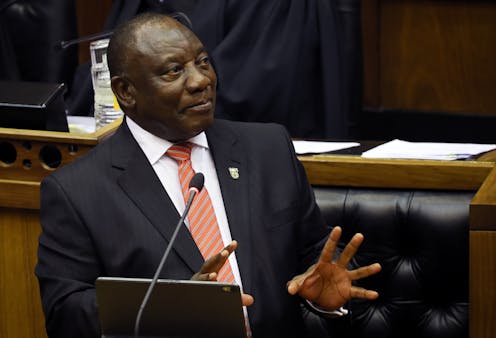
Is it possible that South Africa’s Cyril Ramaphosa has become a “lame duck” president? This often happens towards the end of a leader’s term, especially when a successor has already been identified. But Ramaphosa is not even halfway through his first term.
That I even ask the question suggests that I have doubts that Ramaphosa is making the necessary decisions. By that I mean catalytic decisions that will define the legacy of his presidency and the fate of the country.
Ramaphosa has the misfortune of being president at the most challenging time in the life of post-apartheid South Africa. Economic activity is at its lowest, with growth this year estimated at below 1%.
The country’s tax agency will collect R250bn below what was forecast in the 2019 budget over the next three years. And unemployment – at 29,1% – remains a grave concern, although perhaps not as immediate a danger as dwindling revenues. South Africa has a massive welfare safety net – from free education and health to monetary grants – which has cushioned the country’s poor against the ravages of unemployment.
But because the tax agency is collecting less – the result of companies closing and jobs being lost – the little that goes into public coffers should be spent prudently. Is it being spent prudently?
The answer is a resounding no. Nor does the president’s state of the nation address offer much comfort. It showed that he has a preference for less contentious matters that attract praise. And there were such easy wins in the speech. They included relaxing regulations for independent producers to generate energy, and allowing municipalities to procure renewable energy. Students were promised more accommodation and aspiring business people should expect a state bank that will provide affordable loans to start a business.
These are all commendable measures, unlikely to attract any derision – at least not immediately. But the country’s problems will not be solved through safe decisions. This is a “decisive moment”, as the president himself acknowledged, that requires equally bold moves and vocal support for cabinet ministers carrying out his instructions.
The state of the nation address showed, once again, Ramaphosa’s proclivity to avoid tackling contentious issues. Examples abound, but one of the most telling is his handling of the crisis at the national airline, South African Airways.
Bungling big decisions
South African Airways has been surviving on government bail-outs. After the previous CEO, Vuyo Jarana, quit in exasperation in June 2019, government eventually conceded that the airline was unsustainable in its current form. Tito Mboweni, the finance minister, thought the airline should simply be shut down, or sold to a private owner. But government figured that it could still be salvaged. Its preferred course of action was to put it through business rescue.
The understanding was that the rescue practitioners would do whatever was necessary to turn the national airline around.
But when it came to actually doing what was necessary to rescue the airline, the rescue practitioners soon began to realise that they didn’t have carte blanche. This became clear after they’d announced the cancellation of unprofitable routes, a step taken to reduce operational costs.
Khensani Kubayi-Ngubane, the minister of tourism, disagreed with the decision. Some of the cancelled flights, she protested, would harm the tourism industry. The minister’s protestation was understandable – she was protecting her own territory. What was bewildering was Ramaphosa agreeing with her.
As the president he ought to have a broader appreciation that cutting costs would ease pressure on the airline’s finances. Moreover, the president should know that decisions like this hardly please everybody. A president, who has to balance various interests against each other, goes with the decision that guarantees the maximum results.
Read more: Public approval is Ramaphosa’s only defence against his enemies in the ANC
The president didn’t even provide a viable alternative plan. In his state of the nation address he said only that the “business rescue practitioners are expected to unveil their plans for restructuring the airline in the next few weeks”. It’s not clear from this whether the plan will be formulated entirely by the practitioners.
Government’s discomfort over the reduction of routes suggests that it wants to determine what the plan should be. This shows its reluctance to allow the practitioners to do what is necessary, however unpleasant, to make the airline commercially viable.
But finding funds to bail it out once more looks increasingly unsustainable. The latest injection – a R3.6bn loan from the Development Bank of Southern Africa – can’t be repeated. And any decision to take additional money out of government coffers will negatively affect other things.
As it is, the minister of finance has the unenviable task of finding money for all the things the president has promised. But Mboweni won’t be able to source money for students and aspirant entrepreneurs without denying others. And he’s likely to have to deal with an even more crippled national power utility as Eskom loses income when consumers –- especially companies and municipalities – opt for independent producers of energy.
And assuming Mboweni does find money somewhere, will the president come to his defence when he’s attacked?
Formidable foes
It is difficult to sustain a fight against formidable foes all alone without support. Mboweni appears to be showing signs of resilience against severe criticism from the left wing of the party. But Pravin Gordhan, minister of public enterprises, doesn’t seem to be doing as well. Since taking over this portfolio, Gordhan has exposed widespread maladministration and corruption in state-owned enterprises, and led the call for prosecutions.
Yet, after repeatedly supporting the restructuring of the airline, he also backtracked when business rescuers cut down on routes. This suggests he is taking a lot of strain, and may be capitulating. It’s not surprising as his detractors even include the country’s deputy president, David Mabuza.
Mabuza is unhappy that Gordhan has bypassed the governing party’s deployment committee when making appointments to boards of parastatals. The committee was partly responsible for appointing unscrupulous individuals that looted parastatals and its current head, Mabuza, is not known for propriety. But Ramaphosa has not been vocal in his public support for Gordhan.
Ramaphosa appears not to have realised that routine decisions are akin to inaction, no different from being a lame duck. Lack of support will alienate allies, which will leave him vulnerable to detractors. Without ardent supporters Ramaphosa may not even conclude his first term. He has formidable enemies.

Mcebisi Ndletyana received funding from the National Institute of Humanities and Social Sciences. He is affiliated with CASAC.
Source: The Conversation – Articles (AFRICA)
Read more on The Conversation.
Join the fun: Add Your event | Submit a Press Release | Add your listing.


