Ramaphosa has started the clean up job. But can he turn the state around?:
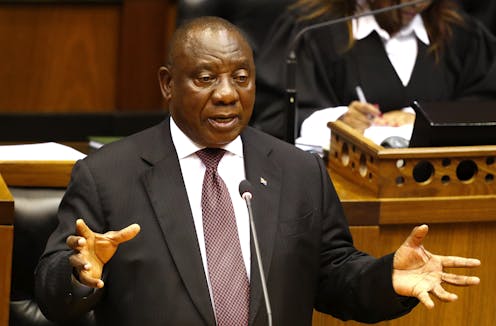
South Africa’s new President, Cyril Ramaphosa, is presently receiving numerous plaudits on how he’s handling the transition from the troubled Jacob Zuma presidency.
Zuma’s generals have been scattered, his underlings fleeing the battlefield. Nkosazana Dlamini-Zuma, against whom Ramaphosa fought for the leadership and under whose wing Zuma thought he would be able to shelter had she won, has been brought into the cabinet and safely neutralised.
The ousting of Zuma has also had a dramatic impact on the major opposition parties. Both the Democratic Alliance (DA) and Economic Freedom Fighters (EFF) have been deprived of their strongest electoral attraction.
The DA is now in a state of major disarray, attempting to resolve its various internal squabbles. For the moment at least – it seems to be heading towards a bloody nose at the 2019 election.
The EFF has played the brief post-Zuma moment more skillfully, most notably by getting the ANC to back its motion in parliament, albeit with amendments, in favour of expropriation of land without compensation. But Ramaphosa has responded in kind by subtly extending an invitation to the EFF to rejoin the ANC, a ploy which will continually compel it to justify its continuing existence, especially if the ruling party continues to steal its policy clothes.
Meanwhile, Ramaphosa continues to bask in the admiration of whites and seems likely to bring disaffected elements of the black middle class back into the ANC. He has brought back hopes of better days for a previously despondent South Africa.
He is master of all the surveys, Mr Action and Mr Clean.
Yet the new president is no fool. He knows that his major challenge, after the depradations of the Zuma years, is to work towards making what he termed in his inauguration speech, a “capable state”. This revolves around addressing challenges of governance, the party as well as the economy.
Low hanging fruit
Ramaphosa has had little option but to first turn to addressing immediate problems within the state. The early steps have been relatively easy. The most straight forward task has been to shuffle the cabinet. By doing so he was able to expel or marginalise ministers known for their loyalty to Zuma or their incompetence, while bringing in replacements of known ability and integrity.
He has also moved swiftly to address crises at major parastatals, notably at the power utility Eskom and South African Airways to prevent them defaulting on their loans to banks and other creditors. With new boards now in place, emergency measures have been taken to prevent financial meltdown.
Likewise, Ramaphosa has given notice that he is determined to restore the South African Revenue Service to its former glory. Getting rid of the top brass, notwithstanding the resistance of Zuma’s point man, the commissioner Tom Moyane, should not be too difficult. But, as within the parastatals, it is the problem of what to do with Zuma cronies at lower levels of management that is likely to be more difficult and more time consuming.
Zuma cronies who have been embedded in state organisations for a long time will have set up procurement linkages that will need to be examined closely. This will provoke resistance, some of it overt, much of it covert, for whatever the cronyistic patterns of procurement, they will have been celebrated as black empowerment. Their disruption will be stigmatised as reactionary. Pravin Gordhan, the new minister of state owned enterprises, will probably have to get tough, and the fights could get nasty.
ANC politics
The other set of challenges which Ramaphosa faces have to do with his party, the ANC. His narrow victory at the party’s national conference was only secured because he did a deal with David Mabuza, then Premier of Mpumalanga, now promoted to deputy president.
Ramaphosa will, in time, find that this kind of backing was instrumental. Loyalty will come at a price, and Ramaphosa will have to play his cards carefully.
He may have to make alliances with a lot of party power holders he doesn’t like. This may include ceding control of certain provinces to party barons so that their patronage patterns are left intact.
This is a problem because, as Ramaphosa knows, some provincial governments, such as the Eastern Cape, are grossly inefficient. They are staffed by people who simply lack the capacity to do their jobs – but who have strong connections with local party bosses. Disrupting such networks will take determination and courage, and will meet politically costly pushback. Expect little to be done this side of an election.
The economy
Perhaps Ramaphosa’s most formidable challenge is how to kick start economic growth. He has been lauded as the man who, with experience in both the trade union movement and in business, can bring labour and capital together around a new consensus.
It’s a nice idea, and one boosted by Ramaphosa’s smooth talk of convening a summit around the economy. But if it is going to be more than just another talk shop, he is going to have to do an awful lot of arm twisting. Both sides are going to have make concessions.
South Africa’s major corporations have been sitting pretty for years. Despite the horrors of the Zuma years, the stock market has boomed. The country became a low investment, high profit economy, characterised by the power of huge cartels.
Ramaphosa has to convince them that they have to get out of the comfort zone, warning that if they don’t, levels of inequality and unemployment are such that South Africa may explode. Capitalism is going to hit big trouble if they don’t look beyond the short-term bottom line and commit to serious levels of investment, combining this with major commitments to labour-intensive employment and training.
The president is also going to have the difficult job of convincing the unions that they have a greater responsibility to address unemployment. To date their emphasis has been on securing higher wages for their members (that’s what unions do) and they have succeeded in getting the government to implement a minimum wage.
But these wins have come at a cost. For example, central bargaining has resulted in wage agreements with big firms that have imposed massive costs on small and medium sized businesses.
While no one wants a low wage economy, Ramaphosa would need to convince the unions that something has to give if problems like this are going to be addressed.
Ramaphosa’s easiest task will be to win the next election. But history will judge him on his ability to do something much bigger: rendering the South Africa state one that is not only capable, but genuinely developmental.

Roger Southall does not work for, consult, own shares in or receive funding from any company or organisation that would benefit from this article, and has disclosed no relevant affiliations beyond their academic appointment.
Source: The Conversation – Articles (AFRICA)
Read more on The Conversation.
Join the fun: Add Your event | Submit a Press Release | Add your listing.


