Ramaphosa saves the ANC’s bacon. But this could be its last chance:
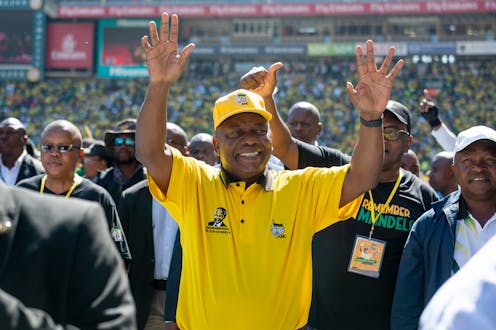
The African National Congress (ANC) will govern South Africa for another five years. But this sixth victory of the democratic era since 1994 was hard-won. For the first time in a national election its share of the vote dropped beneath 60%. This suggests both a normalisation of South Africa’s electoral landscape and an increasingly competitive multi-party democracy.
On arrival at the national results centre in Pretoria on Thursday, with around 60% of the votes counted, the party’s chair Gwede Mantashe expressed his anxiety to me about the outcome: “We need 60%”, he said.
I responded by saying that the evidence suggested the ANC was heading for 57% or 58% and that this represented an upturn of their fortunes after the dramatic dip to 54% in the 2016 local government election. It was, I said, therefore a very good result. He appeared to accept my logic. Mantashe is a supporter of President Cyril Ramaphosa and is currently the minister of mineral resources.
The pivotal issue for Election 2019 was whether the outcome would give Ramaphosa more political space within the ANC to drive his reform programme forward. Since he ousted Jacob Zuma from power in February 2018, having won a very tight race to succeed Zuma as leader of the ANC at its five-yearly national elective conference the previous December, Ramaphosa has begun to execute a complicated turnaround strategy.
Read more: South Africa’s poll is more about battles in the ANC than between political parties
But the job is half done. So far he’s appointed several commissions of inquiries to expose the rot of what he called “nine lost years”. This paved the way for the appointment of competent, honest men and women to lead key state institutions such as the SA Revenue Service and the National Prosecuting Authority that had succumbed to the Zuma-enabled project of “state capture”.
Yet the Zuma faction within the ANC has not been vanquished and so Ramaphosa has had to drive with at least one eye on the rear-view mirror. His own party has been a drag factor. Would Election 2019 deliver a sufficiently big victory for Ramaphosa to shake them off?
The optimal outcome
Some have argued that were the ANC to win 60% or more in this election, it would have given the party a blank cheque for further larceny. But a below par score beneath 56% would have weakened Ramaphosa and provided ammunition for his opponents within the party to attack him and undermine reform plans. These include the much-needed unblundling of the state-owned power utility, Eskom, which represents a major risk factor for South Africa’s sluggish economy and its beleaguered public fiscus.
A 57% or 58% outcome for the ANC could arguably represent an ideal outcome for the country. The people would have reprimanded the party for its reprehensible conduct over the last decade and, as many of its leaders were conceding yesterday, its failures to deliver good public services. At the same time it would give Ramaphosa the opportunity to claim a victory and, thereby, the fresh mandate he needs.
This indeed appears to have been the outcome.
More popular than his party for the first time since Nelson Mandela in 1994, and more trusted than the leaders of the opposition, Ramaphosa can claim to have saved the ANC’s bacon.
How the opposition fared
Election 2019 was also a referendum on South Africa’s appetite for the sort of populist politics that has prospered around the world in recent years. The local version is Julius Malema and his militant Economic Freedom Fighters (EFF).
The exponential growth that the party promised on its campaign trail has proved elusive. The six million young (18-29) people who chose not to register to vote certainly represent a potential untapped market for Malema, to build on the 1.5m or so who voted for the EFF this week. But for the time being South Africa has rejected a populist alternative in favour of more of the devil it knows.
The biggest opposition party, the Democratic Alliance (DA), had a very poor election. It lost votes from its right flank to the Freedom Front Plus – an Afrikaans party – and failed to gain them from the middle ground. As a result, overall it has stagnated. Its share of the vote overall may even drop – despite the fact that the conditions for challenging the ANC were so conducive.
Questions will inevitably be asked of the DA’s leader, Mmusi Maimane. Was he tough enough to cope with the existential ambivalence that undermined its ability to define a clear value proposition to the electorate?
The DA had hoped to add to its progress in the local elections in 2016 when, with the help of the EFF, it drove the ANC out of city hall government in Pretoria and Johannesburg. Both fall within the Gauteng province, South Africa’s economic hub. In the national poll the DA appears to have failed to prove its case in the region where the ANC looks set to hang onto its majority – albeit by its fingernails.
ANC decline
The ANC’s domination has been in decline since 2009. In four successive national and local government elections since Zuma entered office that year, the ANC’s share of the vote has fallen.
The party’s leaders know it, but find it hard to accept. As Mantashe moved on from my conversation he turned back for a second:
But we would still like 60% – it’s an ego thing.
The ANC’s ego may not have been stroked by South Africa’s electorate on this occasion. On the contrary, it has fired a shot across the bows of Nelson Mandela’s party. A quarter century after Mandela became South Africa’s first black, democratically elected President, the ANC’s hold on power has weakened. Now it must continue to cleanse the body politic of the contamination of the Zuma years.
Ramaphosa will need to use the victory to turn the reform platform he has built over the past year into a springboard for economic growth and job creation. Both are urgently needed.
Otherwise, the lesson of Election 2019 is clear: next time the electorate will say enough is enough and turn away from the ANC.

Richard Calland is a member of the Board of the Open Democracy Advice Centre and a Member of the Advisory Council of the Council for the Advancement of the South African Constitution (CASAC). He is also a partner in The Paternoster Group: African Political Insight and co-director of the African Climate Finance Hub.
Source: The Conversation – Articles (AFRICA)
Read more on The Conversation.
Join the fun: Add Your event | Submit a Press Release | Add your listing.


