Ramaphosa’s to do list: seven economic policy areas that will shift the dial:
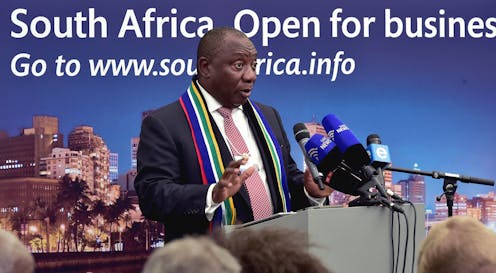
South Africa’s new President, Cyril Ramaphosa, seems to have a lot going for him. His early new broom sweeps clean gestures have been incisive and the market indicators are responding well. A plethora of good news has come his way in the weeks since he was sworn in.
The rand has remained strong, and with it the steadying of the inflation rate – at 4% the lowest it’s been in three years. This in turn allowed the South African Reserve Bank to cut interest rates by 25 basis points. Few things benefit a feel good effect better than downward movement in interest rates.
And business confidence is looking up. This could mean that companies use their high cash balances to invest.
Most critically, global credit rating agency Moody’s maintained South Africa’s investment grade rating and upgraded the outlook of the country’s sovereign debt to stable. And while one of the other top three rating agencies, S&P, didn’t upgrade its sub-investment grading, it doubled its growth forecast for 2018 from 1% to 2%.
Also auspicious is the trajectory of the global economy, if Trump’s trade war can be contained. The prospect of continued economic growth across Africa and the huge improvement in the southern African environment with new leaders in Zimbabwe, Angola, Mozambique and South Africa, are also positive.
But Ramaphosa will have to do much more to rekindle growth, address deep inequalities and tackle corruption in the private and public sectors. Above all he must address policy uncertainty. This is affecting a range of key sectors from energy to telecoms, water mining and land.
The Ramaphosa government can’t do everything at once. There are seven key areas that South African’s new president should focus on to make some headway.
The to do list
Fiscal stability:
One critical challenge is maintaining macroeconomic stability – that means keeping the budget deficit within reasonable bounds and yet supporting economic expansion. So, he needs to be sure that any increases in government expenditure support growth and development.
But this won’t be easy given that the government has landed itself with a massive public sector wage bill. Costs have gone up dramatically as a result of higher wage settlements as well as employment going up from 2.5 million go 3.2 million under Jacob Zuma.
It will be hard for Ramaphosa to bring this back under control given that he also needs to win over the labour movement in his mission to build a new social contract between government, labour and business.
At the same time, government has to attract capable professionals to deliver on its promises to replace talent lost during the frustrating Zuma years. Ramaphosa and his team will need to work hard to make public service an admired career proposition.
Re-industrialisation:
Ramaphosa has promised to getting industry going in South Africa again. This requires three key conditions:
-
A relatively competitive currency (the rand should not get so strong that imports are favoured against domestic products).
-
interest rates must be low enough to encourage investment, especially by small firms.
-
Real wage rates must be linked to productivity increases – if wage increases run ahead of productivity growth, domestic producers will lose out to international competition.
Ramaphosa might run into some difficulty here too given that he’s promised to forge a “social pact” with labour and industry. Striking deals between competing interests might get in the way of delivering these three key drivers.
But if he does, South Africa would have taken a real step towards a democratic developmental state, as Mauritius did in the early 1970s and Ireland in the late 1980s. Both countries made social pacts in which government supported investment, business committed to investment, and labour agreed to limit wage demands to increases no greater than productivity increases. The result was sustained growth over several decades.
State owned enterprises: Ramaphosa has already made some bold moves by firing executives from key entities such as the state power utility Eskom and South African Airways. But tougher decisions will have to be taken. Operations will have to be rationalised and policies overhauled in key sectors such as energy, information and communication technologies, water and transport.
Urban land: Reallocating land in urban areas could reduce inequality and erode the spatial legacy of apartheid. Poor workers and their families continue to live great distances from places of work. Better located, safe and secure homes for workers and their families, and better public transport will improve livelihoods and lower employment costs. Access to suitable and secure urban homes would be a massive step forward for many, and a huge contribution to the reduction of inequality.
Small business: Government needs to act in a far more consistent, committed and coordinated way to support the small business sector. Currently responsibilities are split over several ministries. It also needs to ensure that the dead hand of state monopolies and private oligopolies are lifted. Underpinning this should be a stronger commitment to supporting investment in new research and development.
Skills: Education – and skills – should be a central focus.
The greatest intervention to support skills development and reduce inequality in the longer term would be to take early childhood development funding seriously.
Secondly, the general quality of basic education is failing the country. This needs to be addressed. And the World Economic Forum has downgraded South Africa’s competitiveness ranking for the relatively low number of university graduates it produces. This needs to be reversed.
The commitment to free higher education for capable students from poor backgrounds is a bold step forward, but the universities need more and smarter investment in their capacity.
The skills training environment remains deficient, and needs a better relationship between the demand and supply (employers and training institutions) to get it to work efficiently. And a wiser policy on the skilled immigrants would help a great deal in the interim.
Policy certainty: More certainty is needed about policies on mining, land and black economic empowerment to encourage new investment.
Tough road
Ramaphosa has started brilliantly, in spite of the terrible state of the African National Congress (ANC) and the weakness of too many government institutions. Getting to serious, inclusive growth is going to demand a great deal of work by skilled policy makers working within effective social partnership agreements.
In view of the limited resources available to the government and considering the fragility of the ANC, he will need to prioritise and move systematically through the issues, all the while ensuring that his government maintains sufficient support.

Alan Hirsch does not work for, consult, own shares in or receive funding from any company or organisation that would benefit from this article, and has disclosed no relevant affiliations beyond their academic appointment.
Source: The Conversation – Articles (AFRICA)
Read more on The Conversation.
Join the fun: Add Your event | Submit a Press Release | Add your listing.


