In August this year, Yves de M’Bella, a media personality in Côte d’Ivoire, brought a male guest, Kader Traoré, onto his prime-time entertainment show to demonstrate how a man might assault a woman. The segment, which was taped in front of a studio audience, was broadcast on Nouvelle Chaine Ivorienne, a private TV station. The stated objective was to educate people about rape.
Viewers were subjected to Traoré, with the aid of a female mannequin provided by M’Bella, mounting a callous and obscene simulation of an attack. During this demonstration, M’Bella helped to adjust the mannequin and asked his guest questions that were insensitive and insulting to victims, including about whether they enjoyed being raped. The host then topped this grotesque show off with a request for Traoré to advise women on how they could avoid being raped. The guest obliged with the usual victim-blaming tropes (for example, “don’t go out late”) that make girls and women responsible for the behaviour of male rapists.
The demonstration and accompanying exchange were dotted with laughter from within the studio.
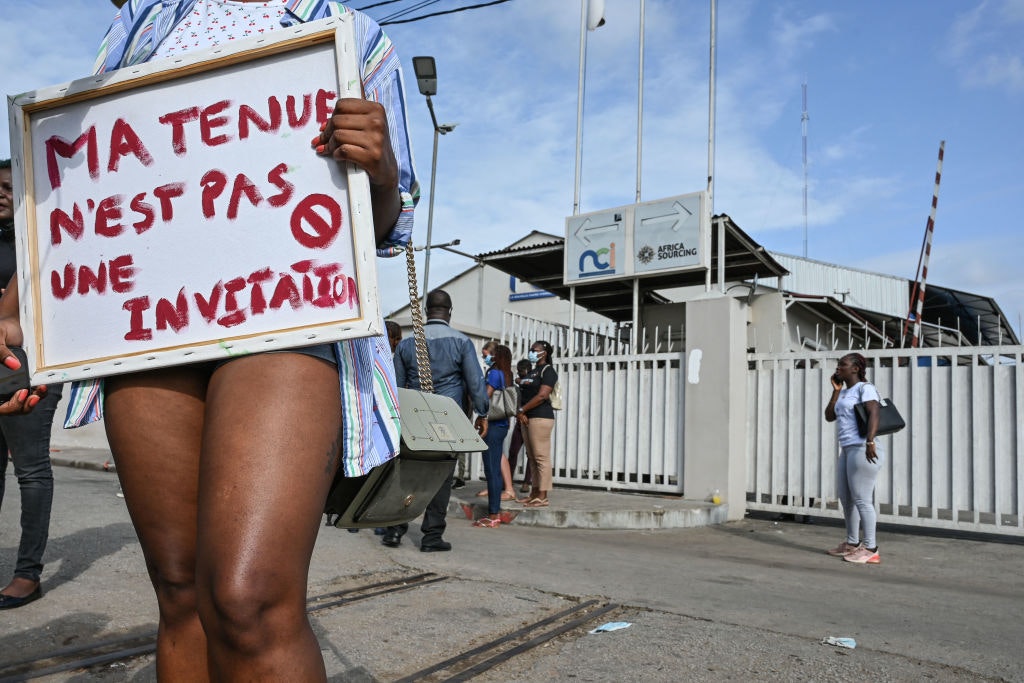
In September, a court in Abidjan handed down a 12-month suspended prison sentence to M’Bella, along with a two million FCFA (US$3,600) fine for “rape apology” and “offence against decency”. His guest received a two-year prison sentence and a 500,00 FCFA (US$900) fine. This followed widespread condemnation of the segment, especially by women’s organisations and women’s rights activists. They argued that it had trivialised rape, was re-traumatising for victims, and promoted rape culture.
Indeed, the TV demonstration was a showcase of rape apology and rape myths that are very familiar and pervasive in many societies. Through their words and actions, the duo displayed attitudes that trivialise the offence and shield rapists, by holding victims responsible for the actions of their attackers.
Through my research in Côte d’Ivoire, I’ve documented the harms that result from such attitudes.
These attitudes serve to fuel rape culture and stigmatise victims. They also discourage many survivors from disclosing the assault, from accessing healthcare, and from pursuing justice.
Rape culture
In research carried out in Abidjan and Bouaké in 2014 and 2015, I interviewed 21 female survivors of sexual violence and the parents of minors who had been raped. This was for a study of the state’s response to gender-based violence. One objective of the research was to understand why some cases were reported to the police and gendarmes while others were not. In the country’s 2011 Demographic and Health Survey, about 5% of girls and women surveyed reported that they had experienced sexual violence.The majority of cases in the country were settled informally.
A key finding of my research was that the primary reason women did not disclose rape to the police – even though they overwhelmingly wanted the rapist arrested and prosecuted by the state – was because they did not want people to know they had been raped. They worried that they would not receive support from their community and would instead be mocked, gossiped about, stigmatised, and ostracised.
The women feared that their relatives would blame them for the assault and that people in their community would subject them to ridicule. One survivor in Bouaké captured this fear:
when people know you’ve been raped … they point fingers at you … and it prevents you from having relationships and people keep their distance a bit from you.
This fear of blame discouraged many from disclosing the assault not only to the police but also to relatives and friends. And this blaming and stigmatising of victims had devastating consequences. This rape culture served to silence them and protected rapists. It discouraged survivors from accessing healthcare and pursuing justice. It also affected their ability to work and socialise. Several women told me that if they had the money, they would relocate to new neighbourhoods to escape the victim-blaming, mockery, and trivialisation of their experience.
The police and gendarmes
My research revealed that police and gendarmes’ responses to sexual violence had improved in Côte d’Ivoire since 2011. Due to reforms introduced after the conflict, police officers and gendarmes were more likely to refer cases for prosecution and were less likely to re-victimise survivors. Nonetheless, some law enforcement officers still exhibited these harmful attitudes. A 21-year-old woman in Abidjan described her experience:
He {a police officer} came out and asked me, ‘Do you know what you are saying about this young man is serious? Do you know they are going to send him to prison? Why do you really want to do this? Did he really sleep with you?’ … So, you are saying I can stand up and come before all these people to say I’ve been raped? First, they are going to look at me, talk about me, point fingers at me … I didn’t want to pursue the matter.
A few of the women interviewed did not want to file a report because they did not think the police and gendarmes would believe them. Out of 17 complaints eventually filed, 5 had resulted in an arrest and conviction as at the time of interview, with one conviction overturned. Only 4 of the 17 women who filed a complaint said they were satisfied with how police and gendarmes handled their cases. This underlines the need for major reforms in the criminal justice sector to further improve how law enforcement officers treat rape survivors.
Hope
However, the study also offered hope.
Women were likely to disclose rape to the police when the people closest to them believed their account and encouraged them to file a complaint with the police. This support also led some to visit a health facility for treatment. Having support from family and friends was also important for the emotional wellbeing of survivors.
Most survivors changed their mind about not reporting rape to the police after speaking to a male relative or friend. This finding underlines the need for individuals to serve as allies to rape survivors and for society to reject rape myths and apologies.
The rape demonstration on M’Bella’s programme shows that there is more work to be done in changing attitudes. That demonstration was a product of the noxious attitudes towards sexual violence that are found in many societies across the globe. The swift condemnation by women’s rights activists in Côte d’Ivoire is a model to follow and reflects the anti-sexual violence work done by African women’s movements.
But most of the harmful behaviour is more subtle. There is therefore a need for robust conversation and education at all levels, including in pre-tertiary schools, in which people challenge ideas about male domination and fiercely uphold all girls’ and women’s rights to live free of violence.


