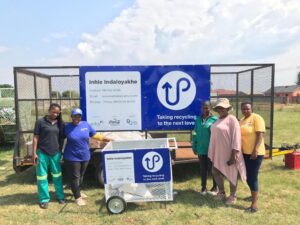
AN innovative pilot project being trialled at recycling buy-back centres across South Africa is yielding positive results just over a year in, helping grassroots businesses integrate into the formalised waste recycling sector.
Project Up, an initiative of the PET Recycling Company (PETCO) with funding support from The Coca-Cola Foundation, uses BanQu blockchain technology to digitise and record transactions between the buy-back centres and waste pickers. For the first time, buy-back centres are able to digitally track the sorts of materials coming in and the value of those materials to their businesses, while waste pickers, for their part, have digital proof of the revenue they receive for the recyclate they sell.
Interim data indicates that the introduction of the technology is not only helping to integrate the informal recycling sector with the formal recycling sector, but is also helping grow the volumes of recyclable plastics and other materials purchased by the buy-back centres.
“I thought the app would be a lot of work, but it makes things much more efficient with regard to data capturing, and the ins and outs and operations of my business, which I think is more important than anything,” said Refilwe Ramadikela, chief executive of Hendrina Recycling in Mpumalanga.
Through the use of the blockchain, South Africa is building a national digital record of recyclables which are collected by waste pickers and sold to buy-back centres, who in turn sell the materials to recycling companies.
By providing a permanent record, buy-back centres give waste pickers digital – and legitimate – proof of the revenue they receive for the recyclate they sell, while buy-back centres benefit from detailed data on the kinds of materials they receive and the value of those materials to their businesses. This knowledge enables them to pinpoint potential new recycling streams to focus on to grow their revenue.
“It allows us to have longevity because we know how to read the data. What are our trading volumes and how do we maintain them? If we drop, what can we do better? We can go back through our historical data records online and see what worked. I gained business insights that I didn’t think I needed but which have come in very useful,” Ramadikela said.
By providing digital evidence of the types of recyclate prioritised and collected by waste pickers – from the data inputted by the buy-back centres – buy-back centres and waste pickers can offer producers statistical proof of the sorts of products that are easily absorbed into the circular economy, and those that are not.
According to PETCO vice-chair and Coca-Cola’s sustainability director for Africa, David Drew, one of the key benefits of the BanQu system is the insights it provides into the waste economy.
“With over R10-million worth of transactions representing over 4 000 tonnes of recyclables, we are beginning to reach a point at which our data has sufficient scale and diversity to provide a credible basis for analysis. By looking at this data, we can not only begin to understand the market better but also use these insights to support and grow the informal waste economy,” said Drew.
He said one of the more important relationships to understand was how factors like price and demand affected collection.
For instance, the recycling industry has long known that bottles made of clear or blue PET – polyethylene terephthalate – fetch a high price for waste pickers than green or amber PET. Interim BanQu data clearly shows the impact of this price differential on collection rates.
“The BanQu data shows that while clear or blue PET is estimated to represent around 85% of the beverage bottle market, it represents 92% of the post-consumer PET collected and traded on BanQu. This suggests that the price premium translates into a higher collection rate for clear bottles versus green and amber PET bottles.”
While price was a key driver of collection rates, Drew said it was also clear that this was not the only relevant factor.
“The BanQu data also consistently shows that K4 cardboard represents the highest fraction of recyclables traded in terms of both volume (46%) and value (32%), which are both higher than cardboard’s approximate share of the packaging market (26%). This is interesting because the pricing of K4 is generally very similar to that of amber PET and significantly less than clear PET.
“In contrast, aluminium beverage cans are typically the most valuable recyclable traded but represent only around 1% of volume and 3% of the value. As such, we can conclude that price is not the only factor driving collection, with factors like availability, tradability, and consistency in demand for materials playing an important role in determining what is collected and what isn’t.”
Improved data is just one benefit of the project; another, surprise benefit has been the improved working relationships between buy-back centres and waste pickers. Ramadikela said that many waste picker clients now prefer to work exclusively with her centre.
“Because I can identify if a regular client has been bringing less and less material, I can reach out to them to find out what’s happened.”
Another Gauteng-based buy-back centre, Sakhikamva Projects, had been trying to move away from a manual system when BanQu “came to the rescue”, said owner Zolani Fololo.
“We were desperately in need of a digital system like this, which gives you detailed daily reports and shows you everything you need to know. We grabbed it with both hands, and it fitted like a glove.”
Explaining how his team quickly learned to capture details accurately and look for reports using the technology, Fololo said: “It was so simple. We were able to start using it within a day.”
While some waste pickers were initially hesitant, they became excited about it after receiving SMS receipts for their transactions, helping to build a permanent digital record of their earnings, Fololo said, adding: “They now have records of what they are doing and they can see how much they make each month.”
As a result of the technology, he said his business could offer a streamlined service which was engendering loyalty and enabling waste pickers to sell their recyclables and return to collecting as fast as possible.
“My business is growing due to efficiency, transparency, and simplicity. I would say growth ranges between 20 to 30%. That’s where BanQu has put us,” he said.
According to PETCO CEO Cheri Scholtz, the data coming out of Project Up allows for a better understanding and ability to support the informal collection value chain – responsible for an estimated 60% of all PET plastic, aluminium can, and paper collection nationally.
“Project Up has enabled us to bring buy-back centres and waste pickers into a more integrated and formalised network that ensures transparency of pricing and traceability of the materials that are bought and sold.
“It’s another step we are taking in helping to ensure more equitable earnings for the vulnerable informal sector. By November 2022, PROs like PETCO will be mandated to compensate waste pickers for their collection services and Project Up has assisted us in preparing for that.”
In addition, she said the emerging data would help to identify where bottlenecks occurred in sourcing feedstock for recyclers and in delivering more targeted interventions for stimulating the collection and recycling of PET.
BanQu founder and CEO Ashish Gadnis said that prior to using the technology, waste pickers were completely disconnected from the formal sector.
“When they sell their material to an independent buy-back centre, the waste picker would at most receive a paper receipt for the material that they had sold – their only record proving their existence in the recycle value chain,” Gadnis said.
“With BanQu, waste pickers, buy-back centres and PROs like PETCO are connected in an integrated network, allowing for transparency and traceability of all materials bought and sold between two connected parties in the value chain.
“This also provides increased visibility to ensure waste pickers are being paid in an equitable manner.”
CLICK HERE to submit your press release to MyPR.co.za.
Press Release Views: 76


