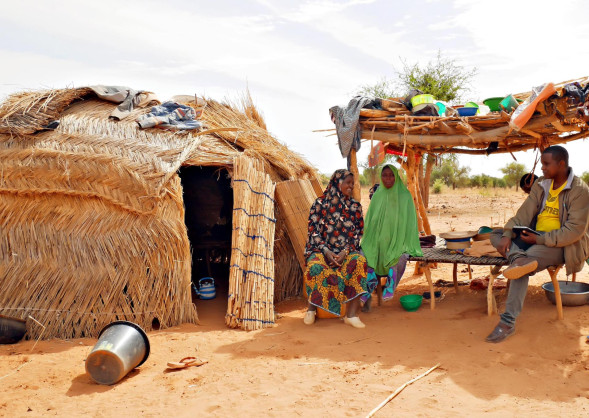
At the Africa Borderlands Centre, we have reached an important milestone. Primary research is now concluded on a large-scale study of farmers and pastoralists that began last October. More than 1,000 respondents in borderland communities in eight African countries participated in our survey sharing their experiences, risks, resilience strategies and aspirations.
The ultimate goal is to enrich our understanding of their circumstances, as relayed to us in the voices of the borderland communities themselves, to improve our effectiveness as development partners. This called for an in-depth research process that was detailed enough to elicit data and information on the complexities of life in border areas – regions that are often beyond the reach of government services.
In addition to the large-scale survey, our research consultants, the West African Network for Peacebuilding (WANEP) in West Africa and Infotrak in the eastern Horn of Africa, conducted focus group discussions with farmers and pastoralists in each country. They interviewed key figures who offered valuable big-picture lenses on governance issues, such as the roles and responsibilities of local and municipal authorities and traditional and religious leaders. Alongside this process, communication teams captured scenes of everyday life in photos, videos and audio clips.
In each border area of the eight countries selected for this study – Burkina Faso, Mali, Niger and Nigeria in West Africa, and Ethiopia, Kenya, South Sudan and Uganda in the eastern Horn of Africa – we made a point of realizing gender parity among survey respondents so that the perspectives of women and men would be equally centred.
Months of fieldwork, data collection and diligent data cleaning and validation have now brought us to the analytical stage of the process. As our team of data scientists, research advisors and policy officers settle down to pore over the results of the research, we take this opportunity to reflect on some of the challenges and lessons learned over the past several months.
Moving targets, shifting conditions
When planning for this study began more than a year before fieldwork with a literature review, we were faced with a slew of ‘known unknowns:’ changes in migratory patterns among borderland dwellers; security and terrain conditions that might exist come research time; and the reliability (or unreliability) of internet access in each area; to name a few. It meant planning meticulously for a wide range of contingencies and options to ensure that the research could still achieve its objectives.
Field teams were dispatched to site visits equipped with Plans A, B and C, often in the end having to resort to a hybrid Plan D, depending on the conditions they found upon arrival. Sometimes they would discover that a certain nomadic community they had hoped to survey had moved on early because of weather or security concerns. At other times, the backup to the backup of the data transmission system would fail. A spirit of perseverance and constant innovation was critical to our success.
There were non-technical challenges, too. In some communities, it was difficult to find female survey participants. Residents could be wary of strangers, even if the strangers were female. Building in ample lead time to engage local leaders, fully explain our project and its objectives, and allowing the community to get comfortable at their own pace helped to put all parties at greater ease and strengthened connections between researchers and respondents.
It was not lost on us that some of the challenges inherent in conducting a study of this nature – issues of accessibility, safety, ensuring that all voices are heard, finding ways to meet urgent needs – are everyday realities for the communities we were engaging, realities which gave rise to this research in the first place. Although circumstances obliged us to modify plans in some instances, at no point did we entertain the notion of overlooking a target community or of abandoning the project altogether. To do so would have been a disservice to the brave and resilient people whom we are attempting to better understand.
Lead from behind, listen actively
A defining feature of this study has been its depth and breadth across regions, countries, communities and, of course, borders. As our research partners steered the process of managing multiple field teams, we at the Africa Borderlands Centre had to remain adept at leading from behind: ensuring consistency in how surveys were conducted, responding promptly as issues arose, making tough decisions and clearing administrative bottlenecks. We may not have been on the ground ourselves, but we needed to stay alert and nimble to serve as an effective ‘Command Centre’ for those in direct contact with communities.
The active listening required to lead well also applied to the survey taking process. The survey included both quantitative questions and open-ended qualitative questions that encouraged respondents to expand on their answers. It was critical that surveyors phrase questions in a non-leading way, to allow respondents space and time to express their own thoughts free of the surveyor’s prompting or bias. Surveyors were trained to listen closely to respondents’ answers and to follow up on any statements that seemed particularly illuminating or counterintuitive. Out of these open, free-flowing responses have come a wealth of insights into the motivations and perspectives of borderland farmers and pastoralists that we could not have gleaned otherwise.
As ambitious an undertaking as it has been, the challenges and lessons that this study has provided have surpassed our expectations. We are a relatively new office in the UNDP Africa family, and we see this project as a proof of concept for filling a critical knowledge gap in our understanding of borderland dynamics in Africa. We look forward to sharing the findings with you in the months ahead, and to building on the strong foundation of this research experience in our future projects.
Distributed by APO Group on behalf of United Nations Development Programme (UNDP) Africa.


