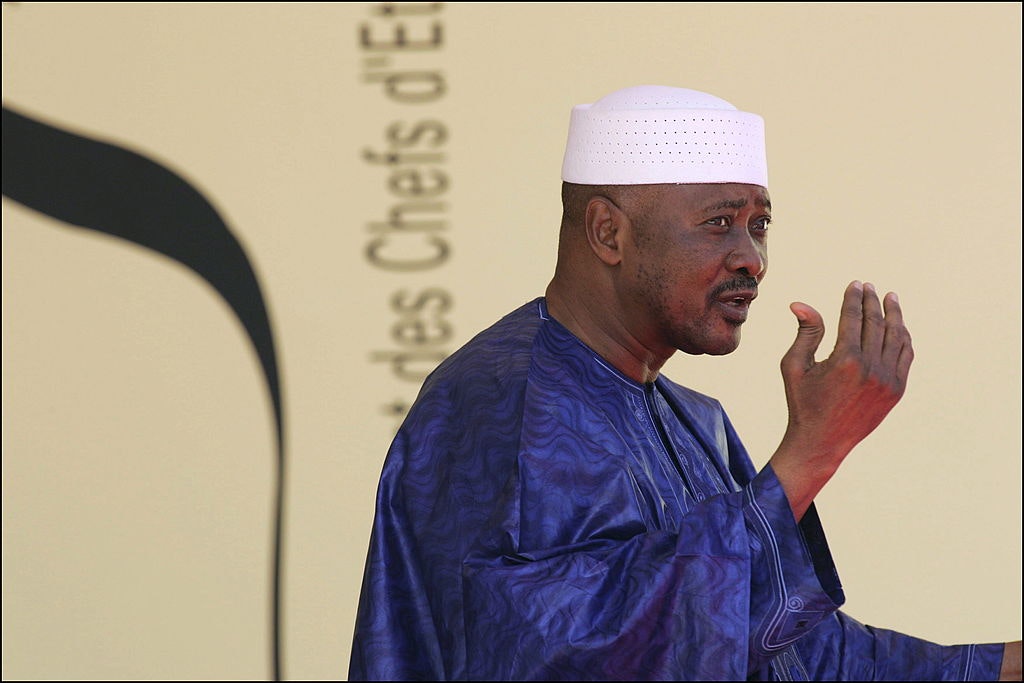
As they say in Mali’s Manding language, yiriba binna: a giant tree has fallen.
Amadou Toumani Touré, who died in an Istanbul hospital on November 10th at age 72, is being warmly remembered in Mali as one of the country’s greatest leaders. As a 42-year-old army colonel, he led the coup that ended more than two decades of authoritarian rule and initiated the transition to multiparty democracy.
During his year as interim head of state, Touré enjoyed such popularity that after he broadcast a statement condemning the chaos and looting in the coup’s wake, Bamako residents recall seeing people return stolen goods to the buildings they’d taken them from.
When, after presiding over that transition, Touré voluntarily stepped down to make way for an elected head of state in 1992, he set a shining example for others to follow. A decade later he again served as president. Two decades later, his reputation lay in tatters.
Colonel Touré
In many respects Touré’s life mirrored that of postcolonial Mali and Africa at large. As a student during the regime of President Modibo Keita (1960-68), Touré trained to become a teacher and embody the values of socialist nation-building. A few months after Keita’s ouster in a military coup, however, Touré decided to join the army. He became a paratrooper and rose through the ranks, ultimately commanding the airborne regiment and the presidential guard.
In March 1991, as nascent democratic movements proliferated across Africa, Colonel Touré intervened following weeks of street protests in Bamako against the harsh and unpopular regime of President Moussa Traoré. He arrested the president, halted the bloody crackdown against demonstrators, and established an interim government. Under his leadership the foundation was laid for new democratic institutions that would reshape the country for decades to come.
By the time he left office, Touré had become known as Mali’s “soldier of democracy”. In the heady, optimistic era between the end of the Cold War and the September 11th attacks in New York, he devoted himself to international advocacy. For example, he campaigned with nongovernmental organisations like the Carter Center to eradicate guinea worm and other infectious diseases, created a children’s health foundation, and worked to ban landmines. He also served as mediator in the conflict-torn Great Lakes region and the Central African Republic.
Return to politics
After retiring from the army in 2001, Touré returned to Malian politics, capitalising on his broad public support.
Rather than join one of the dozens of newly established parties or form his own, he entered and easily won the 2002 presidential election as an independent. By bringing people from across Mali’s political class into his government and by preaching “consensus-based governance”, Touré sought to remain above the unruly partisan fray.
This approach secured him a comfortable reelection in 2007. But it is also what came to tarnish his legacy.
Where supporters saw Touré’s rule as open and inclusive, detractors saw it as too ineffectual to tackle serious problems – and time ultimately proved the detractors right.
Touré’s unwillingness to humiliate public officials guilty of embezzlement permitted a culture of impunity to harden. His reluctance to deploy troops to quell simmering unrest in Mali’s northern desert regions led him instead to back local ethnic militias and to turn a blind eye to growing numbers of radical jihadi fighters and narcotraffickers. Rather than implement necessary reforms of the military, Touré swelled the ranks of its generals while neglecting the rank and file.
In the words of one prominent critic, his consensus-driven approach “diluted all conflicts and emptied the political game of its content, with corruption as its foundation.”
These problems came home to roost as Touré’s second (and, under Mali’s 1992 constitution, final) presidential term neared its end in early 2012. Latent conflict in the north escalated to open warfare as battle-tested Tuareg fighters bent on secession joined forces with jihadi groups. The Malian military, too poorly equipped and badly led to fight this rebellion, abandoned its northern bases in humiliating defeat.
By the time junior army officers mutinied in Bamako on March 21st 2012, ordinary Malians were fed up with Touré and his governing style. Many believed that he had actually fomented the rebellion as a pretext to cancel elections and remain in power. As the mutineers closed in on the presidential palace, Touré fled into hiding and then to Senegal. Mali’s 20-year-old democratic experiment was reduced to an empty shell.
Touré kept a low profile as an ex-president in exile. He returned home to Mali in December 2019 to little public fanfare.
With his passing, Malians have chosen largely to remember him as a builder of democracy rather than as an agent of its demise. They pay tribute to what Touré achieved in the 1990s, when Mali seemed bright with promise, and keep silent about his subsequent missteps that helped to bring the nation to the brink amid proliferating violence and a fourth coup. They do this not because they are in denial about his legacy, but because they prefer not to speak ill of the dead.


